

The Myth of the Abortion Divide
The messy reality of how Americans think about abortion

I don’t need to tell you all that abortion is a heated topic in the United States. For decades, but particularly since the Supreme Court decision to overturn Roe v. Wade in 2022, which removed Americans’ federal right to abortion and left it to legislatures to set their own laws, abortion has been a central issue in political discourse.
It’s a frequent talking point of leaders and candidates for office, it’s the subject of incredible amounts of activism and protest, and it’s personally important to many of us. In fact, in a 2024 poll, one in eight voters said abortion is the most important factor in their vote, with Black voters, Democratic voters, women voters, and young voters (ages 18 to 29) particularly strongly represented in that group.
But what does public opinion about abortion actually look like? Consistent with what many of us probably assume, if you ask Americans whether they consider themselves pro-life or pro-choice, the country indeed is pretty divided. But as we already know from other data explorations here at The Preamble, things can get a little more complicated when we look deeper than the usual categories.
To start, however, let’s establish a baseline. Here are numbers from an ongoing Gallup national poll since 1995 in which respondents were asked whether they considered themselves to be pro-life or pro-choice. Note that respondents were not given the options of “Don’t know,” “Neither,” and “Unsure,” but rather these numbers reflect respondents who volunteered those answers instead of picking one of the two choices provided.
Slightly more than half of Americans identify as pro-choice
Percentage of respondents who said they consider themselves to be pro-choice, pro-life, or mixed/neither/unsure (volunteered), by year
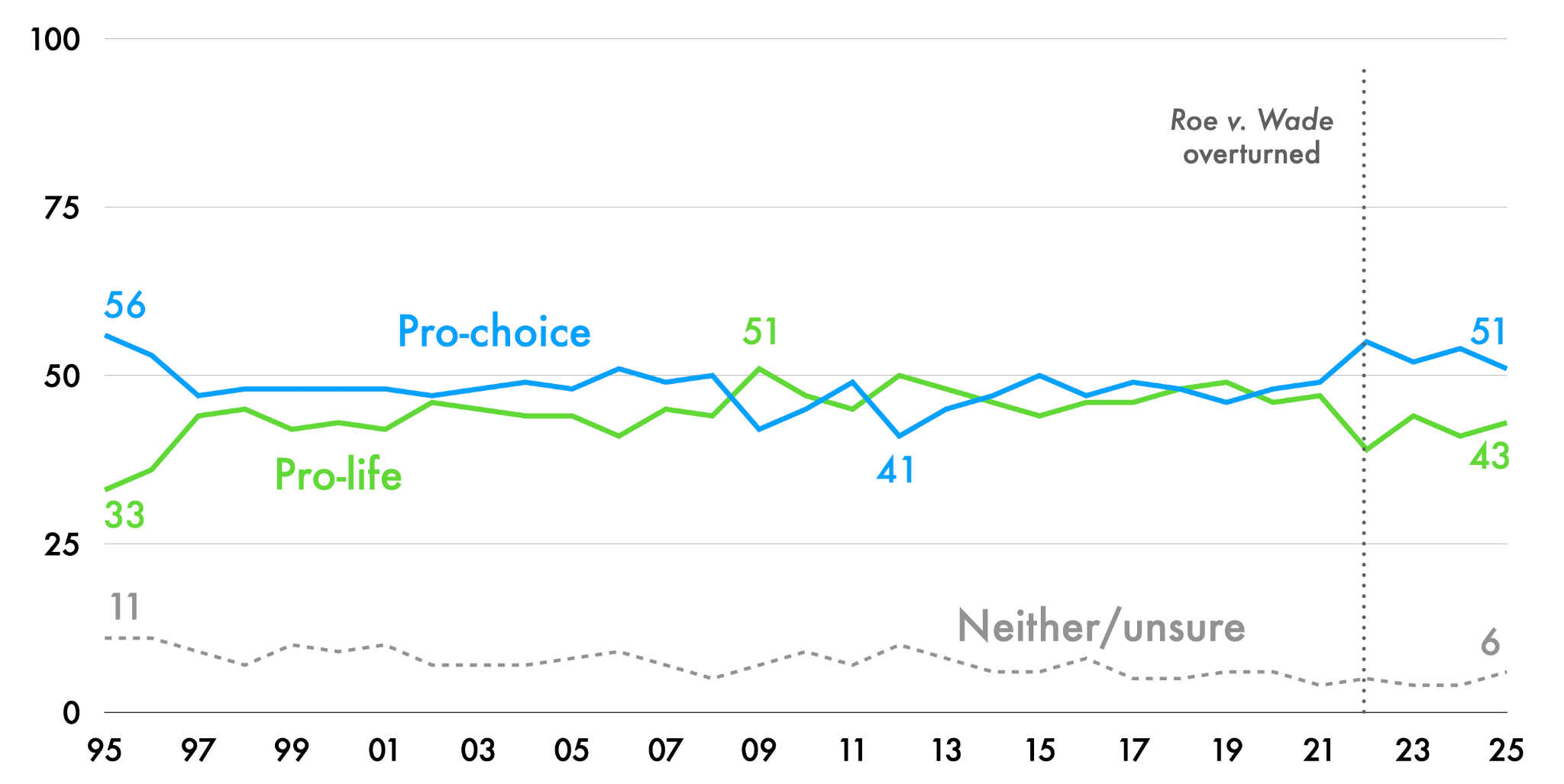
One of the first things that stands out in this graph is how little movement there has been since polling on this question began in 1995. With the exception of just a few years, particularly 1997, when the Partial-Birth Abortion Act was introduced (it was eventually signed into law in 2003), and 2022, the year Roe v. Wade was overturned, the percentage of respondents who identify as pro-life or pro-choice has moved only a few percentage points at a time from year to year. In the most recent polling, about 51% of respondents said they were pro-choice, down from an initial high of 56%, and 43% said they were pro-life, which is a bit higher than the low of 33% but lower than a previous high of 51%.
Notably as well, respondents have gotten slightly more certain about their stance, or at least have become more comfortable sharing it. The percentage of “don’t know” or “unsure” respondents has halved, from an initial high of 11% down to 6%, as of the most recent polling in 2025.
Of course, there are many other ways to characterize someone’s views on abortion. Here’s some data from polling from Pew on whether respondents think abortion should be legal in all or most cases or illegal in all or most cases. Like the Gallup poll, it goes back to 1995, but unlike Gallup it gives us a peek at 2026 numbers (this is a very big deal in polling at this scale, where we almost always are working from last year’s view).
60% of Americans think abortion should be legal in all or most cases
Percentage of respondents who said abortion should be legal in all or most cases or illegal in all or most cases, by year
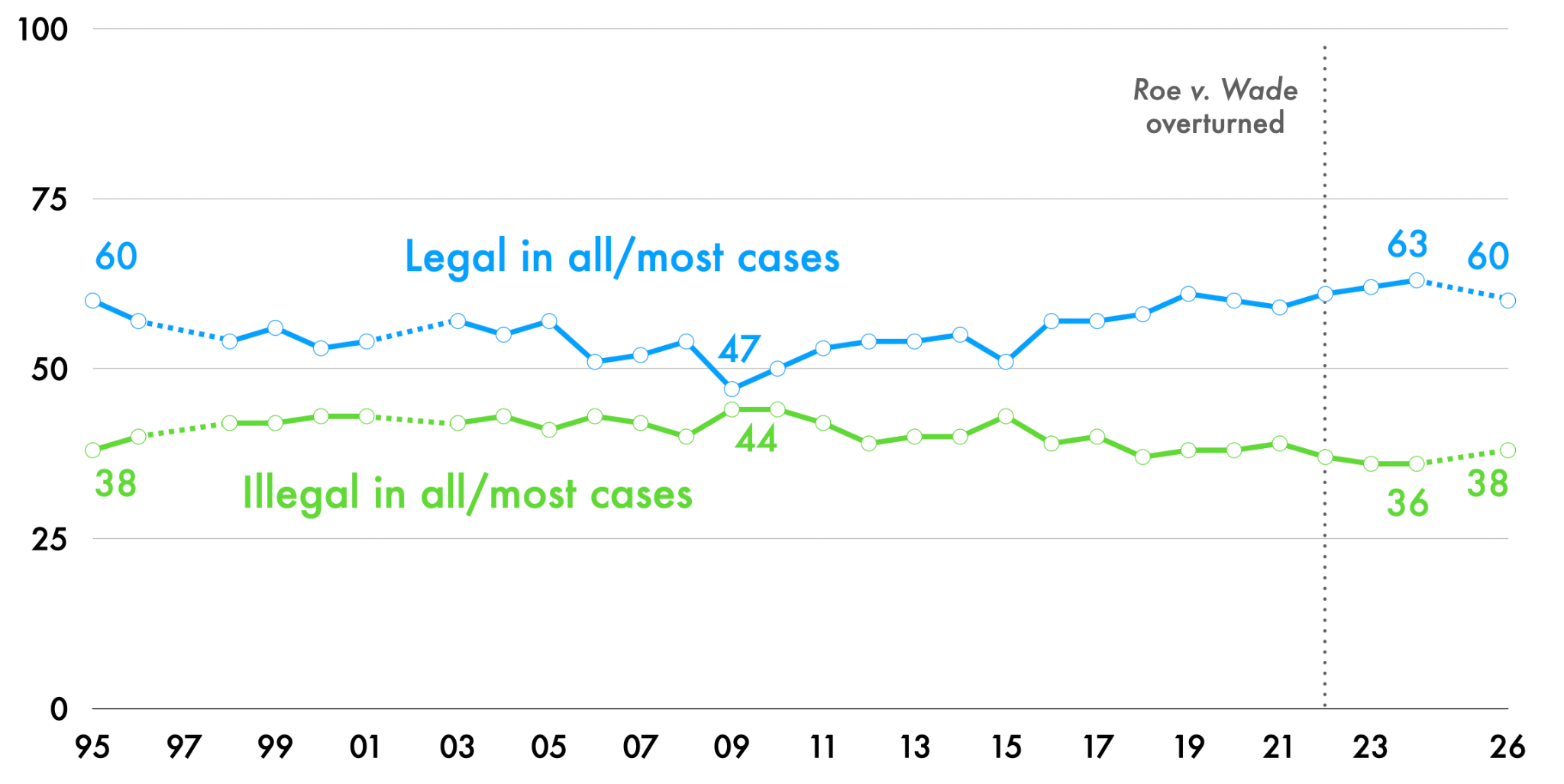
The dotted blue and green lines in the above graph refer to years for which we don’t have data (1997, 2002, 2025). We also don’t have specific numbers about answers of “Unsure” or “Don’t know” in this case. But there is still much to learn. For one, I don’t know about you, but I find it striking that while only about half of polling respondents typically identify as pro-choice, nearly two-thirds of Americans think abortion should be legal in all or most cases. Also, unlike polling on pro-life versus pro-choice, it doesn’t show a swapping of leads — more Americans consistently say abortion should be legal in all or most cases than say it should be illegal in all or most cases, and there has never been a time since polling began in 1995 when the percentage of Americans who think abortion should be illegal in all or most cases has surpassed the percentage who think it should mostly be legal.
 | A guest post by
|