


A brief note before today’s piece:
There’s still time to sign up for my private book club and community, Governerds Insider — but the window is closing soon. This season, we’ve got a great slate of experts signed up to join us for live workshops and author talks, including Ibram X. Kendi and Bob Crawford. We’ll also be reading two fascinating books together, and connecting with the authors live: Dr. Jill Biden and Marjan Kamali.

The doors will close as soon as all seats are filled, and we’re almost there, so don’t miss your chance to sign up.
Now, for today’s story.
—Sharon
Ardent readers of The Preamble will recall that some months ago I wrote an article about the different ways to understand how religious the US is compared with other countries. According to many metrics, such as how important religion is in our daily lives, Americans are, on balance, more religious than our counterparts in other developed democracies around the world.
That pattern shifts, however, depending on how we define “religious.” If we think of it as simply being affiliated with a particular religion (religion might not be important in my daily life, but I still might identify as Christian), then the US is about on par with other developed democracies. If we think of it as a broader kind of spirituality, we’re about level with the entire world. If we think of it as the extent to which religion guides our life choices, the US falls just outside the lowest third across 22 countries globally (among those measured, we’re comparable to Poland, Israel, and Argentina).
Today, we are going to continue our quest to understand religion in America. But this time we are turning a lens inward. In particular, I’m proud to embark on a sacred rite of passage as an elder Millennial: judging the generation after me. What the heck is going on with the kids these days?! (And why won’t they get off my lawn? Lol JK I don’t have a lawn; I bought too much avocado toast.)
A few national trends
Before we start fretting about the youngins, let’s consider some high-level national trends. According to a Gallup survey that’s been running since the 1950s, the importance of religion in our daily lives has slowly been declining, from a high of 75% of respondents indicating it’s very important in 1952 to a near-record low of 47% in 2025 (it hit 46% in 2022 and 2023).
The importance of religion in daily life has been on a long, slow decline among Americans for decades
Percentage of respondents who said religion is “very important,” “fairly important,” or “not very important” in their daily life since 1952. (This question has been asked at least annually, and sometimes more often, since 1980; the dotted lines represent estimated trends between the three times it was asked before then, in 1952, 1965, and 1978.)
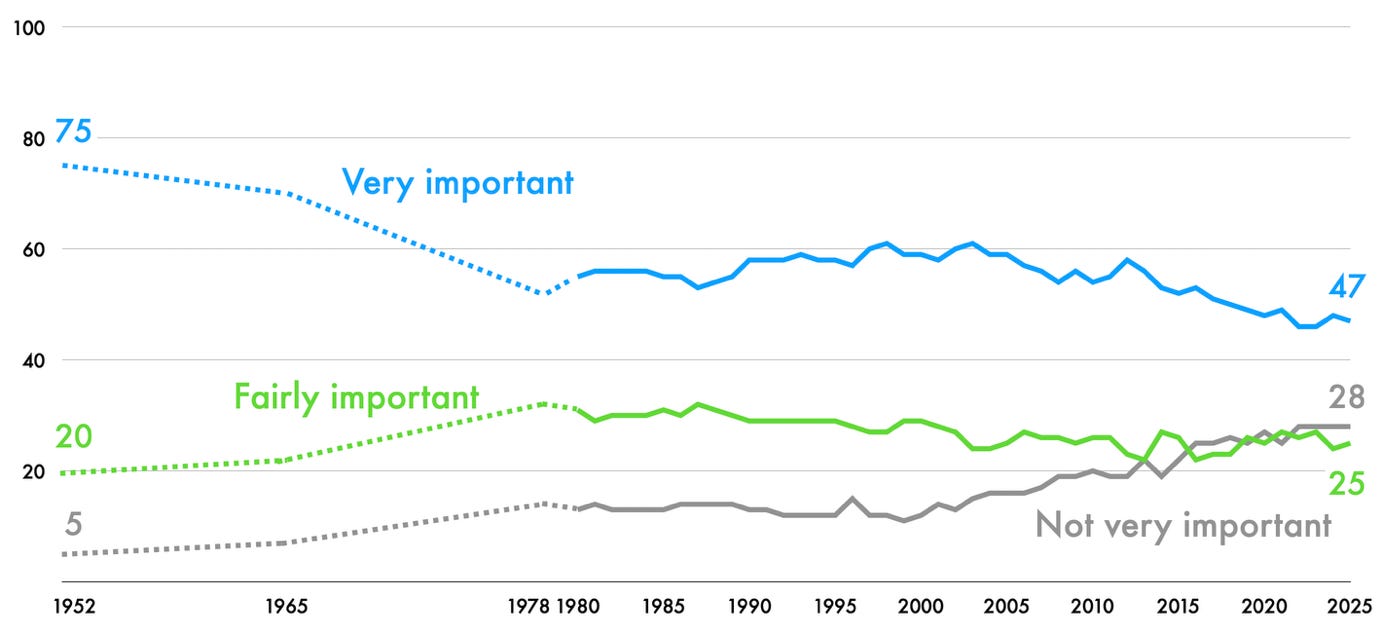
The other trend in this graph that’s gotten a lot of attention is the increase in the percentage of respondents who say that religion is “not very important” in their daily lives. After tying with the “fairly importants” in 2013, the “not importants” overtook the “fairly importants” for the first time in 2016 and have outpaced them for most years since.
Of course, we already know this isn’t the only way to think about religiousness. Here’s another lens, this time tracking the religious affiliation among Americans.
The percentage of Americans who are not affiliated with any religion has been fairly steadily increasing since 2005
Percentage of respondents who identify as Christian (in this case the category includes Protestant, nondenominational Christian, or Roman Catholic), other religions, or none
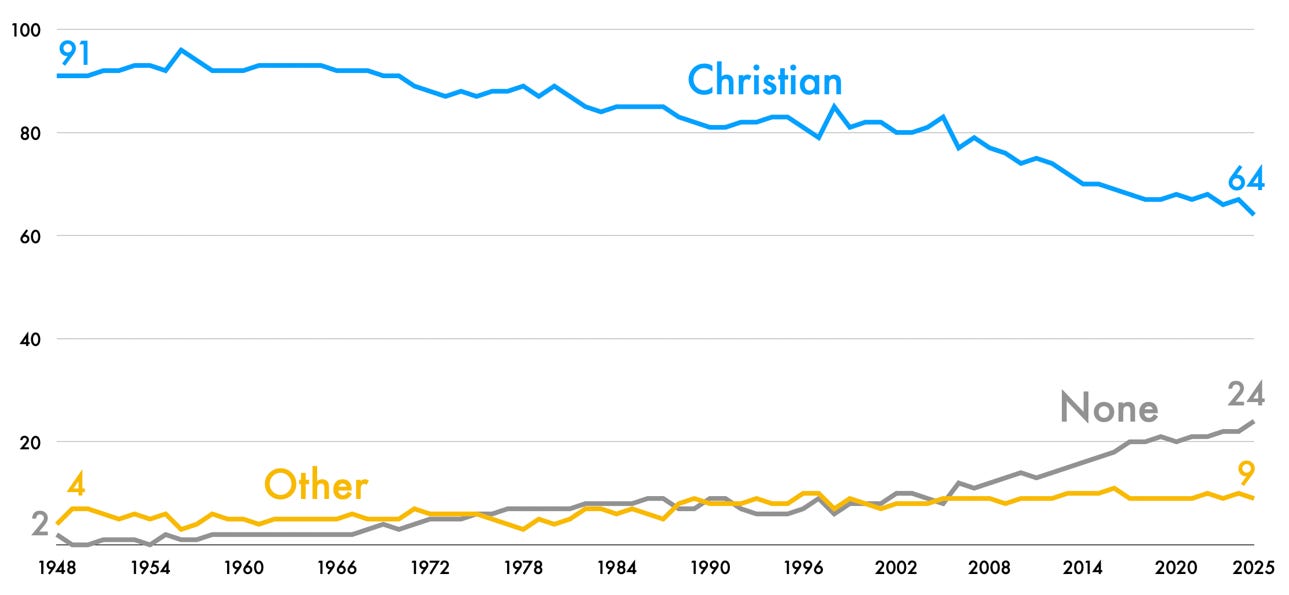
The rise of the religious “nones” has been another closely watched trend. According to a Pew analysis in 2023 that took a close look at this group, most of these “nones” (63%) identify as “nothing in particular,” with a smaller proportion identifying as agnostic (20%) or atheist (17%). Nearly 70% of “nones” still believe in some kind of God or higher power, but very few go to religious services. While a small proportion of “nones” think religion can do more good than harm in society, most either consider it to be more harmful than good or equally good and harmful. In general, they also question a lot of religious teachings and are skeptical of organized religion.
One other small point of interest is that the percentage of Americans who identify as Roman Catholic has held steady at around 20% since the survey began in 1948 (they are folded into “Christian” in the above graph). So the decline in Christianity is due almost entirely to the departure of non-Catholic Christians.
Breaking down some national trends
Whenever we’re working with quantitative data, particularly about complex and abstract topics like religion, it’s good practice to consult multiple sources.
Thus you can imagine my thrill when I found out about the release of brand new findings from the Public Religion Research Institute’s Census of American Religion. PRRI is particularly interested in exploring religious identity along demographic lines like race, party, age, and gender. First, let’s inspect some trends in religiosity by race and by party.
The percentage of Americans who identify as white Christians has declined over the last 12 years among both Republicans and Democrats
Percentage of respondents who identify as white Christians, Christians of color, adherents of non-Christian religions, and having no religious affiliation in 2013 and 2025, nationally and then broken down by political-party identity
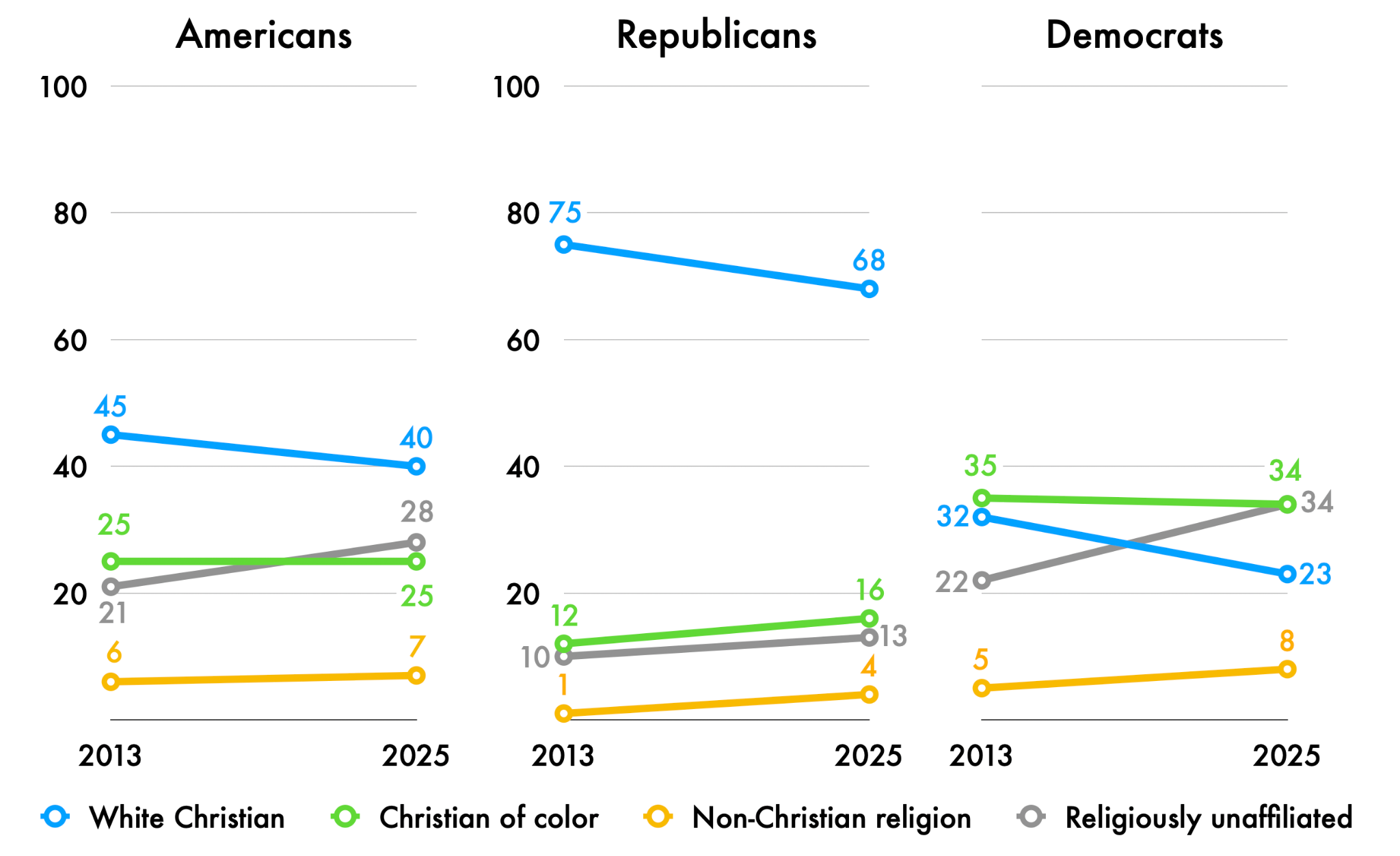
There’s a lot going on in the above chart, but the way to think of it is that the leftmost graph is all Americans in PRRI’s study (about 40,000 people nationally). In 2013 (the first year of this particular study), 45% of respondents indicated they identified as white Christians, while 25% identified as Christians of color.
By 2025, this number was down to 40% for white Christians and holding steady at 25% for Christians of color. This suggests that the decline in Christianity we saw overall might be mostly among white Americans rather than Americans of color (I say “might” because things get a little tricky when we compare across datasets with varying methodologies, question wordings, and survey contexts).
As with our previous national look, we also see a rise in “religiously unaffiliated” — again, this is not quite the same thing as “none” or “not very important,” but seeing this decline across multiple conceptualizations of “no religion” can help us be more confident that, indeed, something is afoot in terms of Americans turning away from at least formal religion.
