

Why Doesn't Infidelity End Careers Anymore?
Partisanship has changed the way voters process scandal

In June 2009, South Carolina Gov. Mark Sanford vanished.
Not politically. Literally.
For six days, no one seemed to know exactly where the governor was. His staff told reporters he was hiking the Appalachian Trail, which immediately became a phrase American politicians would never again be able to say with a straight face. The problem, as the country soon learned, was that Sanford was not walking through the woods. He was in Argentina, visiting the woman with whom he was having an affair.
Then came the press conference.
Sanford stood before cameras and did what politicians in sex scandals used to do: he confessed, wandered through a rambling apology, invoked God, family, failure, and forgiveness, and tried to explain how his private life had become public business. The whole thing was painful, awkward, and impossible to look away from.
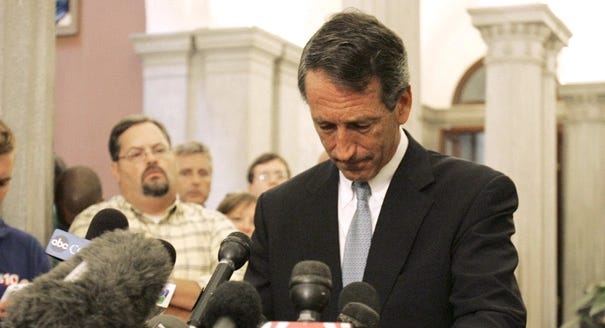
But at the same time, it had all the drama we love in a political scandal — disappearance, deception, romance, taxpayer questions, international travel, a wounded spouse, a public apology, and a euphemism — “hiking the Appalachian Trail” — that sounded like it could only have been thought up by a team of late-night comedy writers.
It also looked, at the time, like the kind of scandal that could end a political career.
And in some ways, it did; at least for a bit. Sanford resigned as chair of the Republican Governors Association, was censured by the South Carolina legislature, and became a national punchline. And yet he finished his term as governor and later won a special election to return to Congress in 2013. The affair badly damaged him, but it did not erase him.
And it revealed something significant: Americans are less consistent about infidelity scandals than we like to pretend.
When shame still (kinda) worked
For a long time, the basic script of a political sex scandal was pretty easy to follow.
First came the rumor. Then the denial. Then the evidence. Then the mortifying press conference, usually staged with a spouse who looked like she had been dragged there by the full force of political consultants. The politician apologized to his family, his constituents, and, if polling looked especially grim, “the people who believed in me.” Then came the question that mattered most: Could he survive the shame?
Sometimes the answer was no.
Gary Hart was the cautionary tale for a generation of politicians who thought private recklessness could stay private. In 1987, the Colorado senator was the early frontrunner for the Democratic presidential nomination. Then came reports about his relationship with Donna Rice and the now-famous photograph of Rice sitting on Hart’s lap after sailing on Monkey Business, a yacht the two partied on with dozens of friends. The details were almost too perfect for political theater. While policy fights, bad debates, or weak fundraising quarters traditionally sank candidates, Hart’s campaign was swallowed by the idea that voters had learned something essential about his judgment. He dropped out of the race soon after.
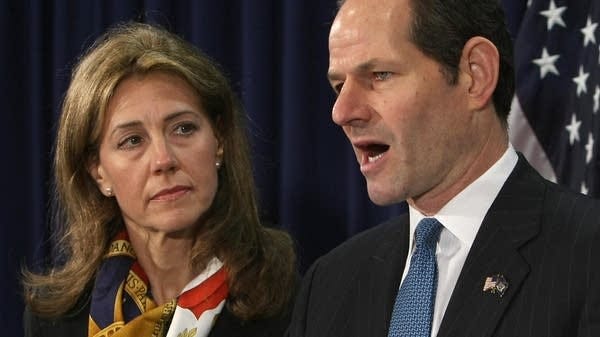
Two decades later, Eliot Spitzer offered a different version of the same lesson. Spitzer had built his career as a hard-charging prosecutor and “sheriff of Wall Street,” the moral avenger who promised to clean up other people’s misconduct. Then, as governor of New York, he was linked to a high-end prostitution ring and identified in reports as “Client 9.” The hypocrisy was too clear, the contrast too brutal. The man who made his name prosecuting vice and corruption had been caught in the kind of conduct he had spent years condemning. Within days, Spitzer resigned.
John Edwards followed the same broad pattern in 2008, only with an even darker personal edge. He was caught having an affair while his wife, Elizabeth, was battling cancer. Even worse, he fathered a child with Rielle Hunter, denied it, and then got pulled into an ugly cover-up involving campaign money, loyal aides, and public humiliation. Edwards had built his national brand around empathy, family, and “two Americas.” The scandal made him look like a fraud in both of them.
In each case, the details mattered. Hart looked reckless. Spitzer looked hypocritical. Edwards looked cruel. Sanford looked ridiculous. These were not identical scandals, and they did not produce identical punishments. Sanford eventually returned to Congress. Spitzer later tried, unsuccessfully, to rebuild a political career. Hart reentered public life in advisory roles. But each man absorbed real political damage because the scandal seemed to reveal something larger than sex.
That was the older model. Infidelity became politically dangerous when it could be translated into a public character flaw: bad judgment, abuse of power, hypocrisy, recklessness, cruelty, deception. The affair was just the spark for a larger conversation about fitness for office.
 | A guest post by
|