

Who Gets the Credit for Falling Crime Rates?
Crime is falling, but the political script hasn’t caught up

For years, national politics treated violent crime as a one-direction story. Cities are dangerous. Democratic mayors are permissive. Police aren’t allowed to do their jobs. Immigrants are bringing disorder. Washington must crack down.
Then the numbers arrived.
In the first quarter of 2026, violent crime fell significantly across many of America’s largest cities, according to preliminary data from the Major Cities Chiefs Association, which compared reports from 67 major US law enforcement agencies from January 1 through March 31 of 2026 with the same period in 2025. Homicides fell from 1,333 to 1,097, a 17.7% decline; robberies declined by 20.4%; reported rapes fell by 7.2%; and aggravated assaults declined by 4.8%.
That is not the story Americans are used to hearing about violent crime, particularly in big cities. It is also not a story politics is especially well equipped to handle.
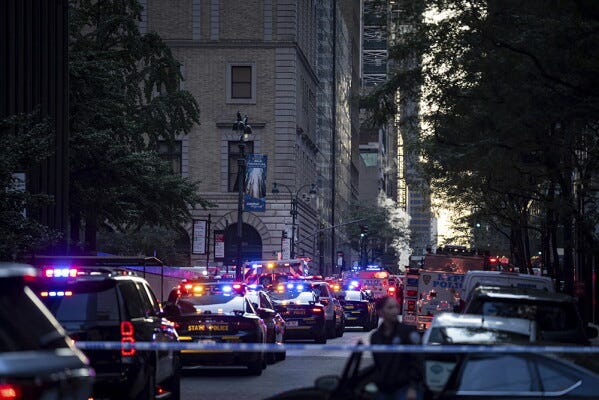
When crime rises, the political script is easy. Blame the mayor. Blame the prosecutor. Blame the president. Blame the other party’s entire governing philosophy. But when crime falls, the script gets messier. Everybody wants credit, nobody wants caveats, and the actual explanation is almost always more complicated — and less satisfying — than the campaign ad.
That is where we are now. Violent crime is falling in major cities across the country. The drop appears real, broad, and encouraging. But the causes are harder to isolate than the politics will pretend.
The continuation of the decline
The first thing to say about the latest violent crime numbers is that they are good news.
Not good news for Democrats. Not good news for Trump. Good news for the people who live in neighborhoods where fewer families are grieving murders, fewer stores are being robbed, fewer people are being assaulted, and fewer blocks are being defined by fear.
The second thing to say is that these are early numbers, so they should be treated as preliminary. Cities report at different speeds, offenses can be reclassified, some crimes are never reported to police, and first-quarter trends can look different by the end of the year, especially because violent crime often rises in warmer months. The Council on Criminal Justice and the Federal Bureau of Investigation similarly caution that city-level data should be viewed as preliminary and that law-enforcement data understate the total volume of crime because many offenses are not reported to police.
But early data does not mean useless data. Perhaps most important, the first-quarter 2026 declines continue a post-pandemic decline that was already well underway. The FBI estimated that violent crime fell 4.5% nationally in 2024 compared with 2023, including a 14.9% drop in murder and non-negligent manslaughter, an 8.9% drop in robbery, a 5.2% drop in rape, and a 3.0% drop in aggravated assault.
The decline appears to have accelerated in 2025. The FBI’s preliminary 2025 data estimated that violent crime fell another 9.3% from 2024 to 2025, including an 18% decline in murder and non-negligent manslaughter, an 18.5% decline in robbery, and a 7.2% decline in aggravated assault.
City-level data tell the same basic story. The Council on Criminal Justice found that reported homicides were 21% lower in 2025 than in 2024 across the 35 cities in its study with available homicide data, representing 922 fewer homicides. It also found that aggravated assaults fell 9%, gun assaults fell 22%, robberies fell 23%, and carjackings fell 43%.
That means the 2026 story is not “Violent crime suddenly fell.” The more accurate story is that violent crime spiked during the pandemic, that it has been falling for several years — under both Democratic and Republican presidents — and that the first quarter of 2026 appears to extend that downward trend.
And perhaps most important, even that recent decline sits inside a much longer historical pattern that our politics often forget. Violent crime in the United States is far lower than it was during the early 1990s, when crime shaped elections, city politics, policing debates, and a generation of public fear. Using FBI data, Pew Research Center found that the violent crime rate fell 49% between 1993 and 2022, including a 74% decline in robbery, a 39% decline in aggravated assault, and a 34% decline in murder and non-negligent manslaughter.
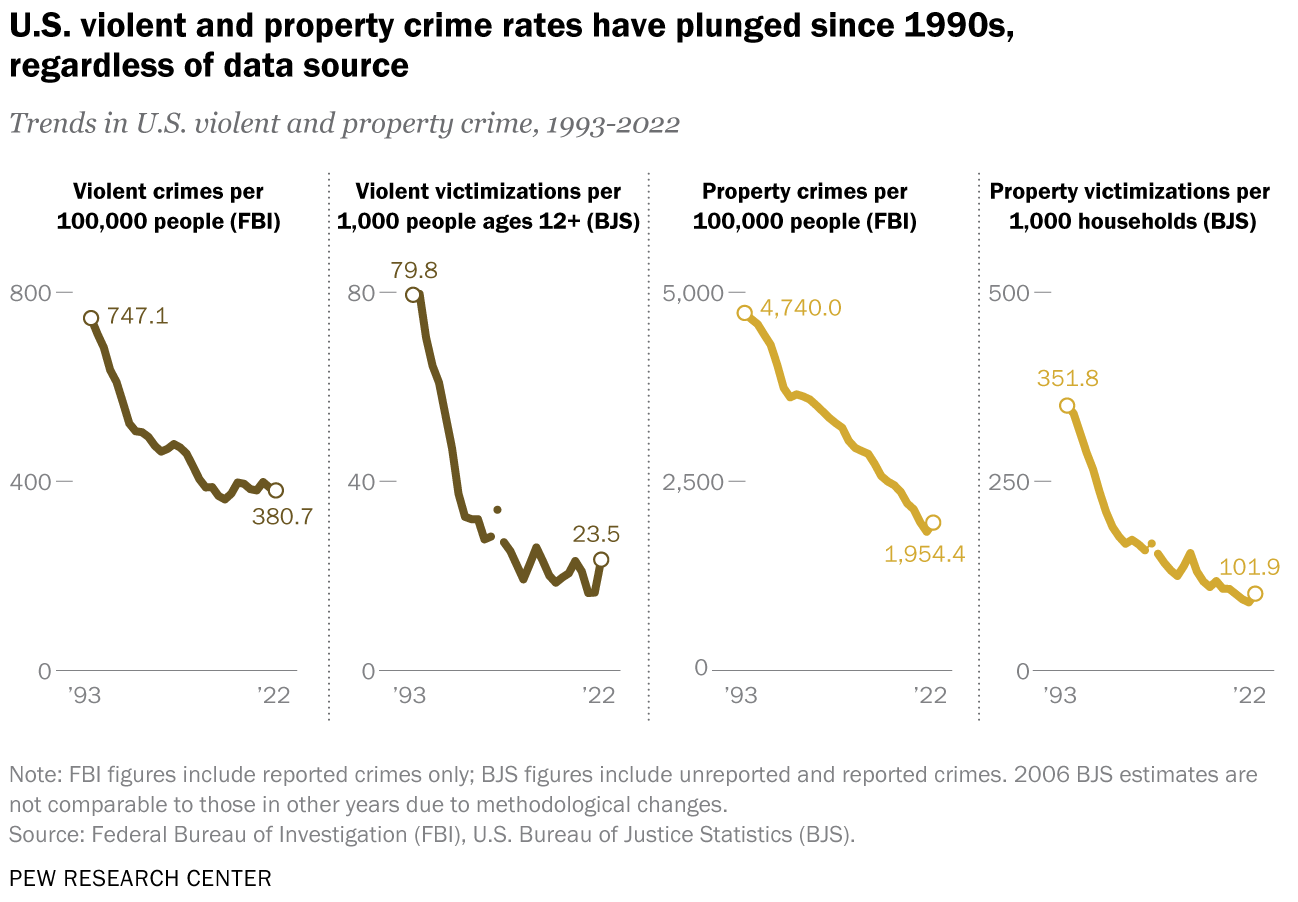
That context is crucial because it prevents two predictable mistakes. The first is pretending the first quarter of 2026 began a brand-new trend. It did not. It extended one. The second is pretending today’s crime debate is happening against the same backdrop as that of the early 1990s. It is not. Crime can still be serious, uneven, and terrifying in the places where it happens, while also being dramatically lower than it was a generation ago.
That is the hard part for politics. Crime is both a lived experience and a statistical trend. A neighborhood can feel unsafe even while citywide numbers improve. A single murder can devastate a family even in a year when homicides fall. But if we are going to argue about what is causing violent crime to rise or fall, we have to start with the actual shape of the data: a pandemic-era spike, a sharp recent decline, and a decades-long fall from much higher peaks.
Why credit is harder than blame
The good statistics inevitably lead to an important political question: Who deserves credit for declines?
 | A guest post by
|