
The US Didn't Free Venezuela — It Just Changed Management
How an oil-first policy came dressed up as liberation
Secretary of State Marco Rubio stood before reporters Wednesday and laid out a three-phase plan for Venezuela. First, stabilize the country following US forces’ seizure of Nicolás Maduro. Second, ensure American oil companies get access during a “recovery phase.” Third — and Rubio was notably vague here — oversee some kind of transition.
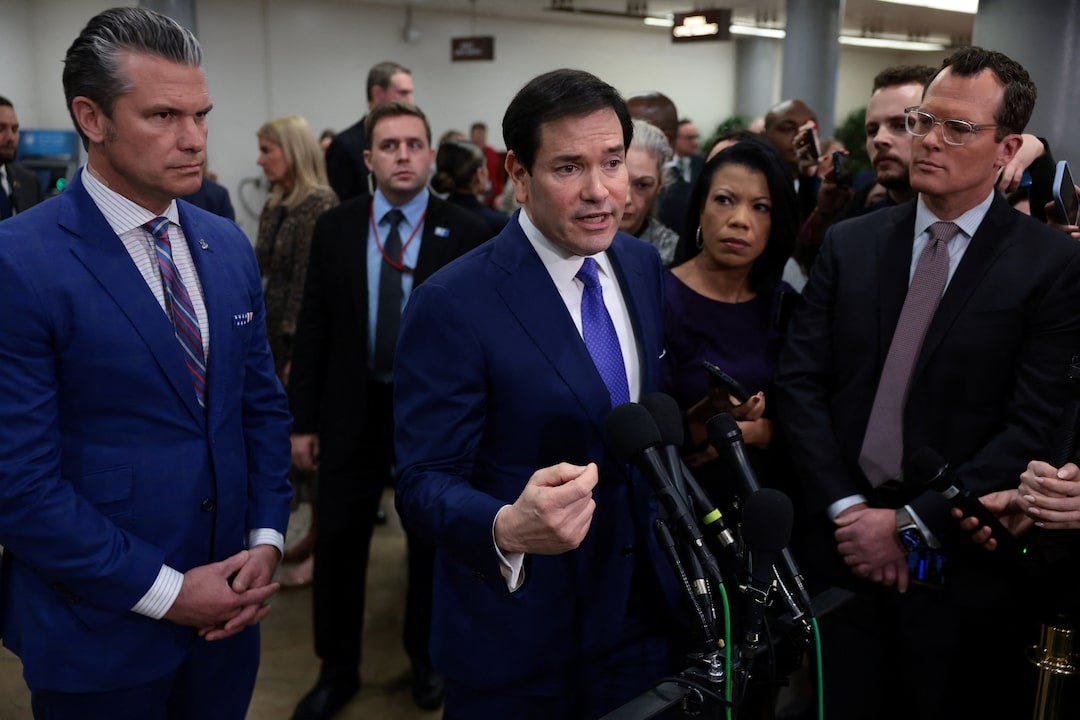
“In the end, it will be up to the Venezuelan people to transform their country,” Rubio said.
Nothing about the current situation suggests that’s true.
Five days after President Trump declared the United States would “run” Venezuela following Maduro’s dramatic capture, the same government that created the worst migration crisis in Latin American history remains in power. The Venezuelan military apparatus is intact. The Cuban-designed surveillance infrastructure that kept Maduro in power for over a decade continues operating. The faces have shuffled slightly. The system hasn’t changed.
Delcy Rodríguez, Maduro’s vice president and oil minister, now runs the country as interim leader. Defense Minister Vladimir Padrino — under US drug indictment — is still there. Interior Minister Diosdado Cabello — also indicted — hasn’t gone anywhere.
These are committed Chavistas — officials who’ve run Venezuela, along with Maduro, since Hugo Chávez’s socialist revolution began destroying the country’s economy and political liberties in 1999. This isn’t regime change. It’s dictator change. And the difference matters.
Oil-first policy
Rubio made the Trump administration’s priorities clear in his Wednesday briefing. Only after securing oil access will the plan “begin to create the process of reconciliation nationally within Venezuela, so that the opposition forces can be amnestied and released from prisons or brought back to the country, and begin to rebuild civil society.”
Then comes phase three: transition. Details? Rubio didn’t provide any.
Trump has been more direct. He told reporters the US would seize up to 50 million barrels of Venezuelan crude and control the proceeds from its sale. He also demanded “total access” to Venezuela’s oil infrastructure.
But the administration’s oil strategy extends beyond simply extracting Venezuelan crude for American benefit. Rubio told CBS the U.S. would maintain a “quarantine” on Venezuelan oil shipments — the government’s main financial lifeline — using it as leverage to force compliance. Trump officials have made clear that any Venezuelan oil sales must receive US approval, and that Venezuela is prohibited from selling to Russia, China, Iran, or other adversaries.
This raises an important question: Is the administration also trying to disrupt the illicit oil networks that have kept some of the world’s worst regimes afloat?
There’s a case to be made. Venezuela has been selling heavily sanctioned oil to Russia, China, and Iran for years, helping all four countries evade international pressure. Cutting off this network would genuinely advance U.S. strategic interests beyond just controlling Venezuelan oil fields.
Oil isn’t the only industry the administration has its eye on. Commerce Secretary Howard Lutnick said the country’s steel and aluminum industries could also be revived “for US benefit.”
US benefit was also the theme when Trump was asked why an “America First” president would take over a South American country. He didn’t mention democracy. “We want to surround ourselves with good neighbors,” he said, without explaining what that meant. “We want to surround ourselves with energy. We have tremendous energy in that country. It’s very important that we protect it. We need that for ourselves.”
Think about that: the administration invaded a sovereign nation, seized its president, and declared American control. The justification wasn’t spreading democracy — liberating an oppressed people was secondary to controlling their country’s natural resources.
Democratic opposition sidelined
Venezuela actually has a democratic opposition. María Corina Machado won the Nobel Peace Prize last year for her courageous leadership. When Maduro barred her from running in 2024, she united opposition forces behind Edmundo González, who won the election in a landslide — roughly 70% of the vote, according to international observers.
Maduro never produced evidence that he won. He declared victory anyway, and then violently repressed anyone who objected. González fled. Machado went into hiding.
Trump dismissed working with her. “She’s a very nice woman, but she doesn’t have the respect within the country,” he said. It was later reported that Trump was influenced by a CIA assessment that had reached similar conclusions. But that skepticism is undermined by Gonzalez’s election triumph.
Instead, Trump is betting on Rodríguez, whom his administration considers pragmatic and potentially willing to work with the US on oil deals. Never mind that she’s publicly contradicted Trump’s claims she’ll cooperate, declaring that Venezuela is “ready to defend our natural resources” and demanding Maduro’s return. Rodríguez and the rest of the regime have spent decades building a system designed to resist exactly this kind of external pressure. They’re not about to dismantle it.
Hugo Chávez and then Maduro created a state apparatus where power is deliberately distributed across multiple power centers - the military, intelligence services, armed civilian militias called “colectivos,” and party loyalists embedded throughout the bureaucracy.
Maduro’s inner circle watched the U.S. try to oust him for years under Biden - through sanctions, diplomatic isolation, and support for the opposition. The regime survived.
Trump’s response was a far-from-subtle threat: if Rodríguez doesn’t “behave,” she’ll face “a situation probably worse than Maduro.” But since the Trump administration isn’t demanding democracy, only compliance, Rodríguez can give Trump his oil contracts while maintaining the repressive apparatus that keeps her in power. That’s not exactly dismantling the system.
The “Donroe Doctrine” in action
The Pentagon has deployed over 15,000 troops to the region — the largest US military presence in the hemisphere in decades. Trump says America is “not afraid of boots on the ground if we have to” and has threatened a “second strike” if Venezuela’s interim government doesn’t cooperate.
Trump framed the Venezuela operation as implementing his new National Security Strategy, which declares that “American dominance in the Western Hemisphere will never be questioned again.”
Unlike the 1823 Monroe Doctrine on which it’s based, that goal isn’t about keeping foreign powers out of the Americas. The Donroe Doctrine, which Trump calls his updated version, is about carving the world into spheres of influence where great powers dominate their regions. Russia gets Europe. China takes Asia. America controls the Western Hemisphere.
To be sure, there are differences. Putin justifies invading Ukraine by claiming it’s not a real country, that Ukrainians and Russians are “one people,” and that restoring Russian control corrects a historical injustice. Xi frames Taiwan as a breakaway province that must be reunified with the mainland. But the United States isn’t claiming Venezuela was historically American territory that must be reunited with the motherland.
But that distinction may matter less than it appears. Whether you invade based on imperial nostalgia or raw resource extraction, you’re still rejecting the principle that borders and sovereignty deserve respect. More broadly, spheres of influence do not produce democracy or stability.
And Venezuela may be just the beginning. Secretary Rubio — a Cuban American who has made no secret of his desire to get rid of the regime there — warned Havana’s leaders they should be “concerned.” President Trump has also threatened military action in Colombia and Mexico, whose leaders were both democratically elected.
What transition means
The administration has outlined precisely how it will extract resources, threatened military force to coerce cooperation, and sidelined democratic opposition leaders in favor of regime remnants. What it hasn’t explained is how any of this leads to Venezuelans’ actually controlling their own country’s future.
When pressed on the timeline, Rubio bristled: “Everyone’s asking why 24 hours after Nicolás Maduro was arrested there isn’t an election scheduled for tomorrow. There’s a process.”
But what process? Rubio won’t say.
You can extract resources through coercion, or you can support genuine democratic transition. You can’t do both. The Venezuelan people already voted. They chose Machado and González overwhelmingly. The United States chose to ignore that and cut deals with the regime that stole their election.
That’s not liberation. That’s just a new nameplate on the same desk.


This reminds me of the dynamic when former NYC mayor Eric Adams was indicted and Trump demanded the charges be dropped: a move so obviously corrupt that several people resigned rather than carry it out, only to be replaced by people who did. There was no ideological alignment to explain it; Adams is a Democrat. The only logic was that Trump prefers compromised leaders he has leverage over.
The same logic applies here. When Trump dismisses Machado as lacking “respect within the country,” he’s obviously not talking about the Venezuelan people who voted for her coalition in a landslide. He’s talking about the military brass, the oil executives, the power brokers who control Venezuelan institutions. Rodríguez has those relationships. Machado threatens them.
Meanwhile, Trump’s support for Delcy Rodríguez contradicts just about every ostensible reason why Maduro was removed.
And notice the degrading position Machado has been forced into: from Nobel laureate and democratic standard-bearer to someone who must publicly praise Trump’s intervention and hope she gets considered for a role in a transition that may never come. Every statement of her gratitude to Trump costs her credibility with Venezuelans who can see what’s actually unfolding against their interests.
Clean democratic transitions empower voters. Negotiated arrangements with compromised holdovers empower whoever brokers the deal.
Very insightful reporting, Elise. Thanks for the heads up on what is really happening there.