The Theater of Control
From Berlin to Arizona: five democracies script their versions of power

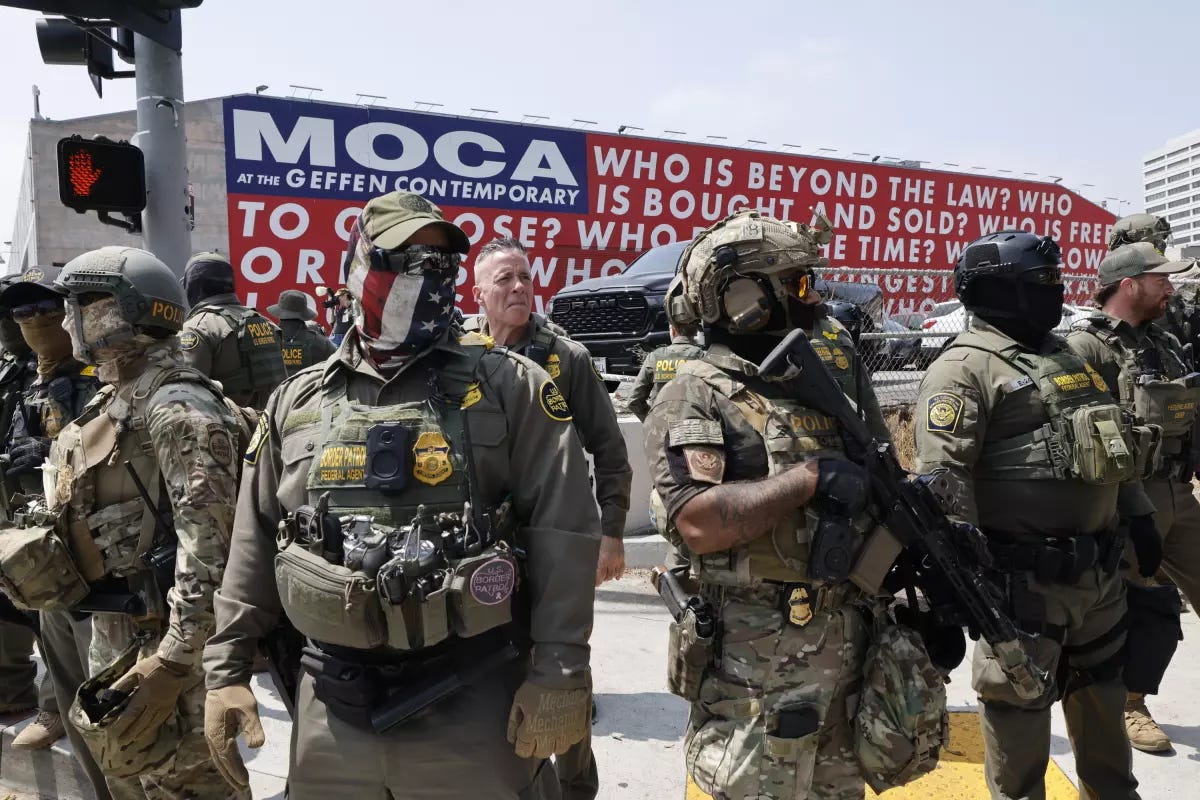
In Arizona, floodlights cut through the dark as masked agents in body armor march a line of suspected migrants toward waiting unmarked vans. Cell phone cameras roll, and the sirens flare red and blue against the dark.
But in Berlin, a similar ritual unfolds without a spectacle. Uniformed officers are dispatched to an address – no camera crew, no face coverings, just paperwork.
Both of these scenes enforce the law. But only one performs it.
America’s Theater of Control
Every democracy polices its borders, but the United States has turned enforcement into performance art.
Under the Trump administration, immigration enforcement has become a spectacle of deterrence, layering high-visibility tactics, like detaining illegal migrants on a strip of land encircled by alligators, on top of a vast system of tens of thousands of ICE agents and immigration courts so backlogged it can take a decade to have an initial hearing. When nothing moves fast enough to satisfy the public rhetoric, the government has begun to substitute visibility for effectiveness. The same bureaucracy that can’t process asylum claims in a timely fashion can stage a raid at a moment’s notice.
Across oceans, other democracies have struck different bargains.
In the UK, immigration control is procedural: officers have to obtain warrants, document every search, and justify any use of force. Raids do happen, but power is largely concentrated in the hands of files rather than flashbangs.
Germany takes Britain’s legalism and hardens it: a 2024 law allows the country to detain individuals for 28 days, instead of the previous 10 it was capped at. Enforcement officers can enter private residences, but only with a warrant. It’s a system with a precision level of coercion. The posture is harsh, but it’s bound by law. Deportations stop where human-rights conventions begin.
France wields enforcement through everyday policing. Officers can stop anyone to verify their identity –– a power that exists nowhere else in the Western world at scale –– and they do so more than 47 million times per year, or 128,000 times per day. The law allows checks in four categories: criminal investigations, prosecutor-ordered checks, border security under the EU rules, and, broadest of all, “administrative” checks to maintain public order. France’s highest constitutional court warned in 1993 that this last category was “incompatible with safeguarding individual freedom” unless strictly justified by circumstance. It persisted anyway.
The result is a quiet, constant form of control. For French citizens, it’s an annoyance; for Black and Arab residents, a form of daily profiling. According to a review by France’s Human Rights Defender’s Office, young Black and Arab men are 20 times more likely to be stopped and checked by police than other residents. A passport or driver’s license usually suffices, but non-citizens must also prove legal status or risk hours in detention.
There are no dawn raids here —- just the low hum of authority that never stops. Human Rights Watch has long argued that French law gives police “too much discretion,” and in June 2025, the European Court of Human Rights found France had carried out discriminatory stops against six people, ordering the state to compensate them. The policing feels bureaucratic, but for those living under it, the bureaucracy never sleeps.
Australia hides its coercion offshore. Migrants intercepted at sea are sent to the island of Nauru, which manages a detention center on Australia’s behalf. The UN Human Rights Committee has condemned the system as “cruel, inhumane, and degrading,” citing overcrowded facilities, extreme heat, poor sanitation, and indefinite confinement. After Australia’s High Court ruled in 2023 that indefinite detention was unlawful when deportation wasn’t possible, Australia found a new workaround: pay Nauru to take those people permanently.
Under a 30-year, AU$1.6 billion deal, Nauru will “resettle” up to 354 non-citizens who have no legal right to remain in Australia. The agreement promises “proper treatment and long-term residence,” but the money only flows only once the transfers begin. Human-rights advocates call it transactional cruelty —- the outsourcing of moral responsibility for a price. The plan has since expanded, with another AU$2.5 billion pledged to send hundreds more people offshore, including foreign-born convicts the High Court ordered released.
For Australians, this system is nearly invisible. There are no televised raids or immigration vans in suburban streets —- just a ledger line in a foreign-aid budget and the knowledge that unwanted people are somewhere else.
Canada offers a softer variation: the same legal architecture, but gentler in tone. The Canada Border Services Agency can arrest and deport, but it also funds “alternatives to detention” — supervised release, case management, mandatory check-ins. Compliance, not confrontation: control through cooperation, proof that the machinery of enforcement can be civil without being theatrical.
A Shifting Continent
But America isn’t alone in orienting itself to the right –– Europe is experiencing it too. Far-right parties –– from France’s National Rally to Germany’s AfD and Italy’s Brothers of Italy –– have dragged even moderates toward “muscular” enforcement. The continent’s so-called super election year has made migration its defining issue. Even Germany’s center-left coalition, once known for its humanitarian stances, has reinstated border controls and sped up deportations. The politics of deterrence now reach from Calais to the Balkans.
The machinery still runs through laws and courts, but the temperature has changed. The rhetoric of emergency inches Europe closer to the American model with a type of control that demands to be seen.
The Politics of Visibility
These differences are not bureaucratic quirks; they reveal national instincts about power. The US chooses spectacle –– fear made visible. France chooses immigration enforcement akin to a droning white noise that never stops. Australia chooses to outsource its moral responsibility to tiny island nations. Britain, Germany, and Canada attempt something harder: law that can be watched, audited, and appealed.
What the US Could Learn – and What It Shouldn’t
Public raids are risky and expensive. They invite lawsuits, viral social media posts, and backlash. Bureaucratic control is cheaper and more precise. The lesson isn’t that America should disappear its enforcement behind closed doors, it’s that democracies must choose systems that are designed to be scrutinized, not systems that are designed to perform or conceal. Oversight, not optics, is the real test of democratic legitimacy.
The Final Choice
Every democracy guards its borders. The question is what it guards most fiercely — its people’s safety, its government’s authority, or its image of control.


Thank you for outlining and comparing the policies of other countries. I think it is important to understand that immigration is monitored throughout the world. I also am encouraged to read about more humane enforcement procedures. I wonder if there is or could be a global conference in which policies and procedures could be shared, discussed, formulated? I know that's simplistic and a bit too optimistic, but in a better world?
Excellent article. "Every democracy polices its borders, but the United States has turned enforcement into performance art." So true.