

The State of the 2026 Midterms
Everything you need to know about the fight for Congress in 2026

By June of a midterm year, the campaigns are already loud enough to feel important yet still early enough to leave voters and parties in that uncomfortable mix of excitement and anxiety.
Primaries are happening, candidates are winning (and losing), and retirements and resignations are turning safe seats into competitive races. Polls are being passed around like weather reports, and special elections are being treated as prophecy. Every campaign wants you to believe the story is favorable, but also uncertain enough to make the latest fundraising email sound urgent enough to open.
Because the stakes are high, it’s worth working through how to think about the midterms before the campaign noise gets unbearable.To do that, we need to separate the things that usually shape midterms from the things that make this cycle especially weird.
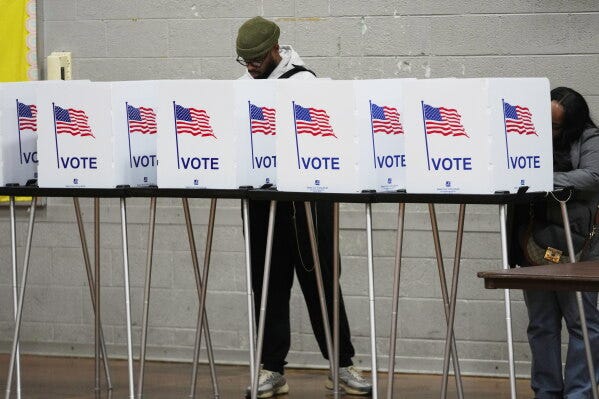
The usual stuff is easy enough. The president’s party is in danger. Trump is unpopular. The economy and prices remain a drag. The party out of power is energized. But the weird stuff this cycle may matter even more. Several state maps are changing in the middle of the decade, and the Supreme Court has made it easier for states to eliminate districts that gave Black voters a meaningful chance to elect their preferred candidates. The number of truly competitive House seats is tiny. And special elections are giving Democrats encouraging signals, though not a guarantee.
That is the state of the 2026 midterms in June. Democrats have the stronger national environment, Republicans have the stronger structural defenses, and the battlefield itself keeps moving.
The state of play
Let’s begin with the basic math.
Republicans control the House 217–212 (with one Independent member who caucuses with the GOP and 5 vacancies), meaning Democrats need a net gain of three seats to take the majority. That is a tiny number in a 435-seat chamber. In a normal midterm environment, a president’s party losing three House seats would barely count as news.
The Senate is harder. Republicans control 53 seats, while Democrats hold 47, including the independents who caucus with them. There are 35 Senate races in 2026, including special elections in Florida and Ohio, and Democrats need a net gain of four seats to take control. The problem for Democrats in the upper chamber? The vast majority of Republicans up for reelection this cycle are running in uber-safe, ruby-red states where Dems have little to no chance of winning.
That is why the House is the more realistic Democratic target and the Senate is the sturdier Republican firewall.
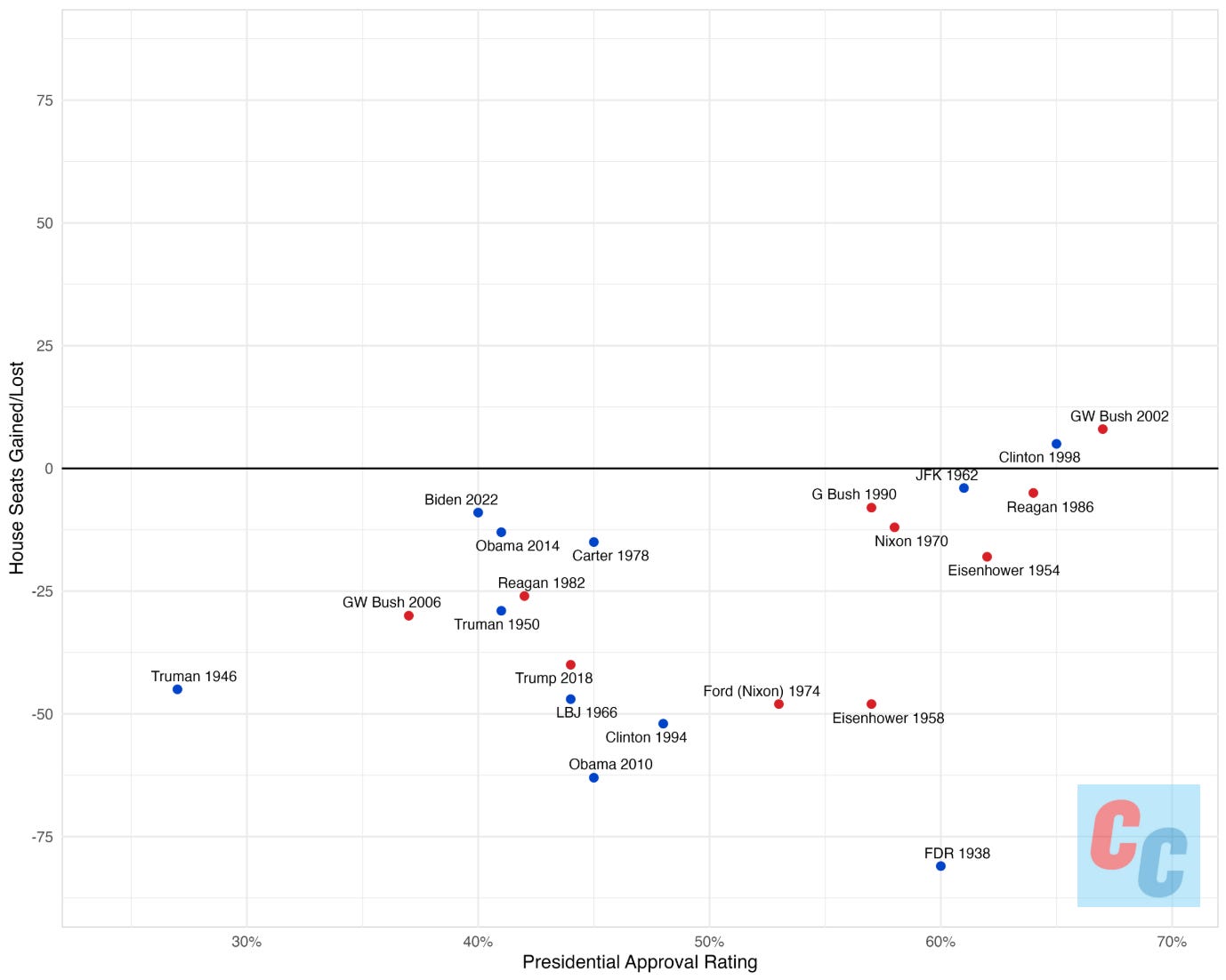
The national environment also points in Democrats’ direction. Midterms are usually political gravity tests for presidents. Since World War II, the president’s party has almost always lost House seats in midterm elections, with only a couple of exceptions. Trump is also sitting in a danger zone on approval. Nate Silver’s tracker had Trump at an abysmal 38.7% approval rating, a near–record low for him, with a net approval of minus 18.7 points. For a historical comparison, Pres. George W. Bush — also an incumbent president in his last midterm — held a similar approval rating in the 2006 midterms, and Republicans lost over 25 seats in the House.
Generic-ballot polling is another warning sign for Republicans. An AtlasIntel poll had Democrats leading Republicans 55% to 40% on the generic House ballot. That number, however, should not be treated as a reliable predictor of a blue wave. Generic ballots bounce around, pollsters differ, and a national House-vote advantage does not translate cleanly into congressional districts. But a president’s party would rather not be down double digits in June of a midterm year. (Deep political analysis, I know.)
Prediction markets are leaning toward a split picture. Polymarket had Democrats favored to win the House at roughly 83% as of June 11, while Kalshi had Republicans favored to hold the Senate at 56%. Prediction markets can be wrong — and often are.They can move quickly, and they reflect the sentiments of speculative traders rather than voters. But they capture the same broad read as the fundamentals: the House is the main Democratic opportunity, while the Senate remains a harder climb.
The tiny battlefield
What makes modern House elections feel so strange is that even when majority control of Congress is up for grabs, most individual House races are not.
In 2024, 366 of the 435 House races were decided by more than 10 points. That means nearly 85% of districts were not especially competitive, even in a high-turnout presidential year with Trump on the ballot and control of Congress at stake. In the same election, only 69 House races were decided by 10 points or fewer.
When the majority can turn on a handful of seats and only a small slice of the country lives in truly competitive districts, moving even one or two seats through redistricting can change the balance of power.
It also changes political incentives. In safe districts, the real election is often the primary. That rewards the candidates who are best at exciting the party base, not necessarily those best at persuading the middle. Then we all act shocked when Congress behaves like it was elected by the most partisan voters in America. Most lawmakers are.
The map wars
Congressional maps are supposed to be redrawn after the census every 10 years. At least that is the Civics 101 version of reality. Actual reality now comes with blatant gerrymandering, lawsuits, emergency appeals, state constitutional fights, ballot measures, special sessions, and a level of partisan creativity that would be impressive if it were not deciding who governs the country.
The National Conference of State Legislatures says states have undertaken mid-decade redistricting within the last year at rates not seen since the 1800s. As of June 2026, 10 states had new congressional maps for this election cycle: Alabama, California, Florida, Louisiana, Missouri, North Carolina, Ohio, Tennessee, Texas, and Utah.
The net effect of all this gerrymandering brinksmanship likely favors Republicans.
 | A guest post by
|