

The Meritocracy Myth
Unqualified appointees are running the government

Last year, conspiracy theorist and election denier Gregg Phillips went on a podcast and talked about a religious miracle he’d supposedly experienced: being teleported to a Waffle House. “Teleporting is no fun,” Phillips said. “It’s no fun because you don’t really know what you’re doing. You don’t really understand it, it’s scary, but yet, um — but so real. And you know it’s happening but you can’t do anything about it, and so you just go, you just go with the ride. And wow, what just an incredible adventure it all was.”
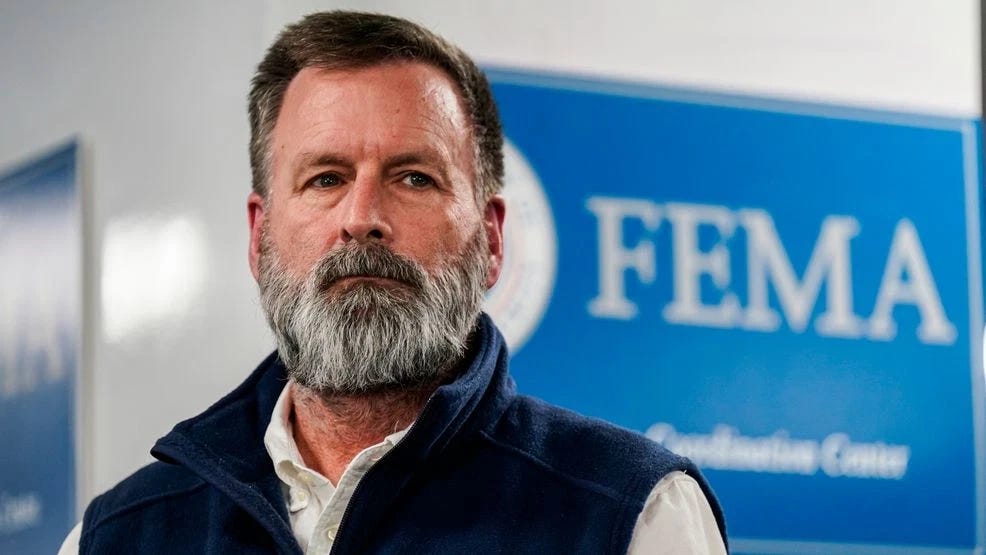
Months later, President Donald Trump appointed Phillips to lead FEMA’s Office of Response and Recovery. Phillips is now someone who oversees a thousand federal employees and helps direct the federal government’s response to natural disasters. Perhaps his decision-making in that role is more sound than his belief that he was mysteriously spirited to breakfast at a beloved chain restaurant. But both his comments and his background suggest that he wasn’t selected for his current position purely on merit.
Nevertheless, Trump has hung his hat on merit throughout his second term and claimed that a meritocracy is incompatible with diversity, equity, and inclusion (DEI) efforts. Just last month, he issued the most recent of several executive orders targeting DEI, this time in federal contracting. The stated goal is to ensure that those receiving government contracts are “treated equally and objectively based on their merit.”
With such emphasis on meritocracy, you would think that Trump’s hires for his own administration would be extremely qualified. Yet they often aren’t — and it’s not just Phillips.
Unqualified appointees
Robert F. Kennedy Jr.’s appointment to the role of secretary of health and human services, for instance, was a leap. Kennedy’s background in environmental law did not include education or direct experience in health care or health policy; instead he gained prominence by promoting conspiracy theories and disproven medical claims, such as that Wi-Fi causes cancer, that vaccines are ineffective and cause autism, that school shootings and other forms of violence can be attributed to antidepressants, and that Black people’s immune systems are stronger and therefore have less need of immunization.
As HHS secretary, Kennedy oversees 13 health-related organizations, including the National Institutes of Health, the Centers for Disease Control and Prevention, and the Substance Abuse and Mental Health Services Administration (SAMHSA). His history of endorsing and spreading medical misinformation makes him a questionable choice to lead his department at best, and certainly not the most meritocratic choice from among the nation’s medical minds.
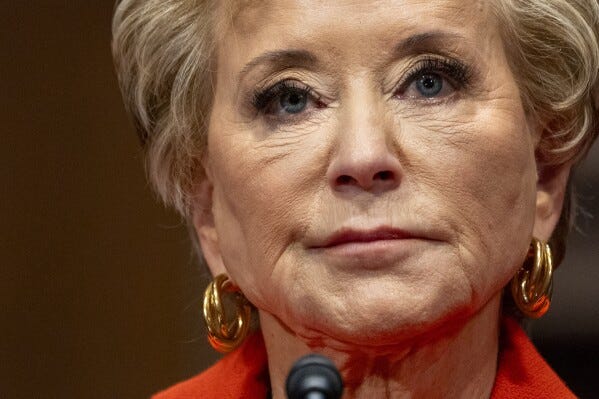
To lead the Department of Education, Trump selected Linda McMahon. McMahon co-founded World Wrestling Entertainment (WWE) with her husband Vince, a longtime friend of Trump. It was an unusual background for an education secretary. President Obama’s education secretary, Arne Duncan, had a degree from Harvard and was the CEO of Chicago’s public schools. Miguel Cardona, President Biden’s education secretary, had a doctorate in education and had long worked in public education. McMahon’s experience in education is limited to a single year on the Connecticut Board of Education; she resigned when it was discovered that she did not have a bachelor’s degree in education as she had claimed. In fact, she had a degree in French and a teaching certificate.
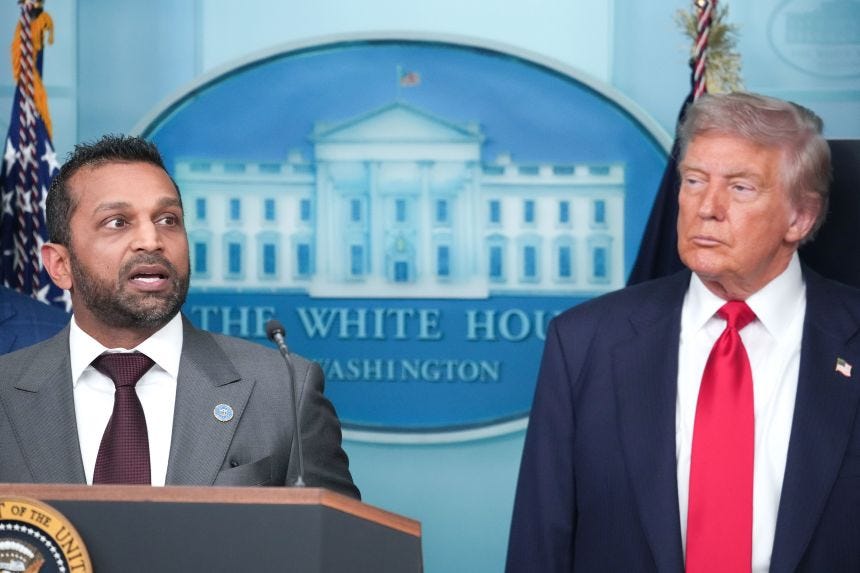
Trump chose Kash Patel as director of the FBI. In his first term, the president had considered making Patel deputy director of the FBI. “Over my dead body” was the response of then-Attorney General Bill Barr. Barr wrote in his memoir that he “categorically opposed” the idea and that “Patel had virtually no experience that would qualify him.” (Patel served as both a public defender and a prosecutor early in his career, but otherwise his experience was mostly in intelligence and defense policy.)
Later, when Trump thought of making Patel the deputy CIA director, Gina Haspel, who was CIA director at the time, reportedly threatened to quit. But as Trump’s second term began, there was no one to dissuade him from nominating Patel to lead the FBI. Patel barely received confirmation by the Senate, in a vote of 51–49. His three most recent predecessors, who had more conventional law-enforcement backgrounds, received at least 92 votes. Support for Patel was weakened by his description of January 6 rioters as “political prisoners” and his publication prior to his nomination of an “enemies list” of former government officials he considered worthy of prosecution.
Trump’s pick for secretary of defense was Pete Hegseth, a former Fox News host and an Army veteran. Before Trump selected Hegseth to lead the Pentagon — the largest employer in the nation, with 3 million personnel and an $850 billion budget — Hegseth had managed, at most, 200 people during his military career.
The Center for Economic and Policy Research explains, “Hegseth’s lack of experience is a stark contrast to former secretaries of defense such as Robert Gates or Leon Panetta, who previously managed complex government agencies.” It is also in contrast with some of Trump’s first-term secretaries of defense, including Mark Esper, who had served as secretary of the Army, and Jim Mattis, a retired general who, as joint forces commander, had directed more than 200,000 service members.
During his confirmation hearing, Hegseth spoke about DEI and “wokeness” infiltrating and undermining the military, resulting in unqualified and undeserving people being appointed to certain roles. He had previously said that women are “life-givers, not life-takers” who make the military less effective, and he’d called out DEI as a reason women were permitted to serve. He’d also accused the then-chairman of the Joint Chiefs of Staff, General Charles “CQ” Brown, who is Black, of being “woke” and a DEI hire.

The irony was that Hegseth himself was not a picture of merit. He has an extraordinary history of extramarital relationships, allegations of sexual assault, accusations of misappropriated funds, and other issues of conduct, such as allegedly going to strip clubs on company time and excessive drinking throughout the course of his career. In his hearing, though, he was using persuasive speech about meritocracy to distract from the gaps and blemishes on his resume.
After being confirmed by a margin of one vote, Hegseth removed top military officials who were women. Admiral Linda Fagan, the first female leader of a US military branch (the Coast Guard), was fired for her support of DEI; Admiral Lisa Franchetti, whom Hegseth had deemed a “DEI hire,” was promptly fired as chief of Naval Operations.
As for Brown, Hegseth successfully and publicly urged Trump to fire him. He was replaced by Dan Caine, then a retired three-star general, who is white. By statute, the chairman of the Joint Chiefs is supposed to be a four-star general, but the president waived this requirement in Caine’s case. That is, eliminating DEI resulted in a replacement who was less meritorious than his predecessor.
Of course, the inexperience of Trump’s picks is emblematic of Trump himself, who didn’t have any experience in public office when he first became president. Under Trump, to be conventionally qualified is to be part of the political establishment; to operate without a background in politics or to lack specialized expertise is something that Trump and his team have spun as a positive. Sean Spicer, Trump’s first White House press secretary, argued that talk of political experience is a “dog whistle” that “means status quo.”
Loyalty over merit
Some of Trump’s most baffling picks used flashy gestures of support to win the president’s favor. Twenty or so staff roles in his second term went to Fox News hosts or contributors who were willing to parrot his claims about the 2020 election being stolen; between staff positions and advisory roles, he appointed about a dozen billionaires who had endorsed him during the campaign; before she was made head of the Department of Homeland Security, Kristi Noem had sent Trump a four-foot-tall Mount Rushmore replica that added his face alongside the greats.
The result is that unqualified people have reached the highest ranks of federal office — which is the very thing that the campaign against DEI was supposed to correct.
Trump’s picks during his second term are less diverse than those of the last four terms, including Trump’s first. It’s of course possible that diversity goals in previous administrations were at times a source of unfairness. Perhaps certain people were selected in part because they belonged to an underrepresented group and other qualified candidates were rejected in part because they were a member of a majority group. But under Trump’s so-called meritocracy, people have been elevated to power who normally wouldn’t even make it into the pool of qualified candidates.
During his first term, Trump mostly made conventional picks. “The biggest mistake I made was… I picked some people that I shouldn’t have picked,” Trump said. He went on to describe them as “bad people or disloyal people.” By his second term, Trump had learned from his mistakes. This time around, he would find loyalists who would stand behind him, no matter what.
During confirmation hearings for Trump’s first term, nominees explained the ways they diverged from the president. Several sought to distinguish their views on climate change and plans for a border wall between the US and Mexico, for example, from those of Trump. But during confirmation hearings for his second term, the nominees were trying to prove the opposite — that they and Trump would move in lockstep. “This time, people view the nominees as an extension of Donald Trump and his agenda,” said Spicer.
So it’s meritocracy in theory and blind loyalty in practice. Time and again, when the two have come into conflict, meritocracy has lost. Trump’s catalogue of questionable hires and nominees suggests that the crusade against DEI is not really about “restoring merit” after all.
 | A guest post by
|
Unfortunately, “fake it ‘til you make it” doesn’t work when the fate of a nation depends upon your decisions.
Remember the Potomac crash right at the beginning of Trump’s 2nd term? Sixty-seven people dead, including children coming home from a figure skating event, bodies still being pulled from the water, and Trump was already at the podium blaming DEI hiring at the FAA. A reporter asked how he could possibly know that so soon and he said, “Because I have common sense, OK, and unfortunately a lot of people don’t.” Hegseth (whose previous employer needed to change its alcohol policy because of him, and whose own mother says he can’t be trusted with any women) was right there next to him declaring “the era of DEI is gone at the Defense Department.” Vance piled on too. They wasted no time turning a mass casualty event into a campaign rally before the families had even been notified.
But we all knew what was coming, right? The NTSB spent a year investigating and put out their final report in February, long after the news cycle had moved on from Trump’s wildly incompetent accusations of incompetence. Turns out the causes were systemic FAA failures: a helicopter route running right beneath an active approach corridor, controllers doing the work of two positions at once, chronic staffing shortages, and constant near-collisions in that same airspace over the prior years. The pilots were qualified, rested, and cleared. DEI had absolutely nothing to do with the accident. It was the kind of institutional neglect that competent, experienced leaders are supposed to catch before 67 people die.
And it goes beyond Trump just picking unqualified people. Senators who publicly leaned toward opposing nominees like Hegseth were met with threats to their careers until they caved. The confirmation process was supposed to be a system in which competence was required, but has become one where competence is routinely dismissed as something to be skeptical of. There’s actually a word for it, which I learned from another Preamble reader a while back: kakistocracy, government by the least qualified. Kind of hard to claim you’re restoring standards while destroying the one mechanism designed to enforce them.
That’s what makes “merit” such a useful word politically. It gives you a scapegoat for every failure and a shield for every unqualified loyalist you install. And the bar for it to land with supporters is almost nonexistent: if there’s a woman or a person of color anywhere in the chain of authority, that’s all the evidence they need. Their presence alone becomes proof that standards were lowered. The anti-DEI campaign just redefines who gets the presumption of competence and who doesn’t. But they are actively making the world a less safe place by putting idiots in charge.