

The Latchkey Generation Has Entered Its Power Years
Why Gen X matters more than ever

When I was growing up as an elder Millennial, members of Generation X always represented my friends’ way cooler older siblings. They seemed to know everything about music and movies, they seemed wickedly sarcastic in a way I could never muster, and they were definitely the most fun babysitters on the planet (shout out to Cheryl and our couch forts).
So when Axios published a story last month about how the population of middle-aged Americans (mostly Gen X and some younger Baby Boomers) is shrinking (due to the fact that Gen X is a smaller generation, not because they’re dying off!), it motivated me to explore what else might be going on with my friends’ older siblings these days. And because data is my love language, that’s the lens through which we’ll view our topic.
What is a generation?
The first thing to know about any discussion of generations is that they are entirely made up. While they can be useful shorthand for a group of people whose experiences of technology, cultural trends, and life in general are similar, they are not set in stone, meant to imply within-group homogeneity, or anywhere close to a scientifically validated classification of humans (just ask members of Generation Jones).
Generation designations are also not neutral — they can be used to stereotype and even discriminate against people who are perceived to be members of particular groups. The business world in particular is rife with (usually oversimplified and unscientific) ideas about how to appropriately manage or market to people from different generations. In fact, Pew Research recently announced a decision to move away from generational comparisons in favor of more neutral age-period cohorts.
Thus, when I speak about generations here, I want to be very clear that I am referring simply to groups of people who were born during a particular window of time and am not applying any broader or subjective assessment of their characteristics or worldviews (other than my statements in the opening paragraph, which are obviously cold hard fact).
Who are Gen X?
Because it’s more conventional than scientific, there’s no agreed-upon set of birth years when each generation begins and ends. I’ve decided to go with cutoffs from the University of Southern California for the very sophisticated reason that they sound right to me. According to USC, “Generation X” refers to Americans born between 1965 and 1980 (I should add that these naming conventions are largely American-centric, though many other countries use them).
Generation X was born during a period of relatively low birth rates in the US
Birth rate (number of live births, in millions, left y-axis) and general fertility rate (number of live births per 1,000 women aged 15–44, right y-axis), in the US annually since 1909
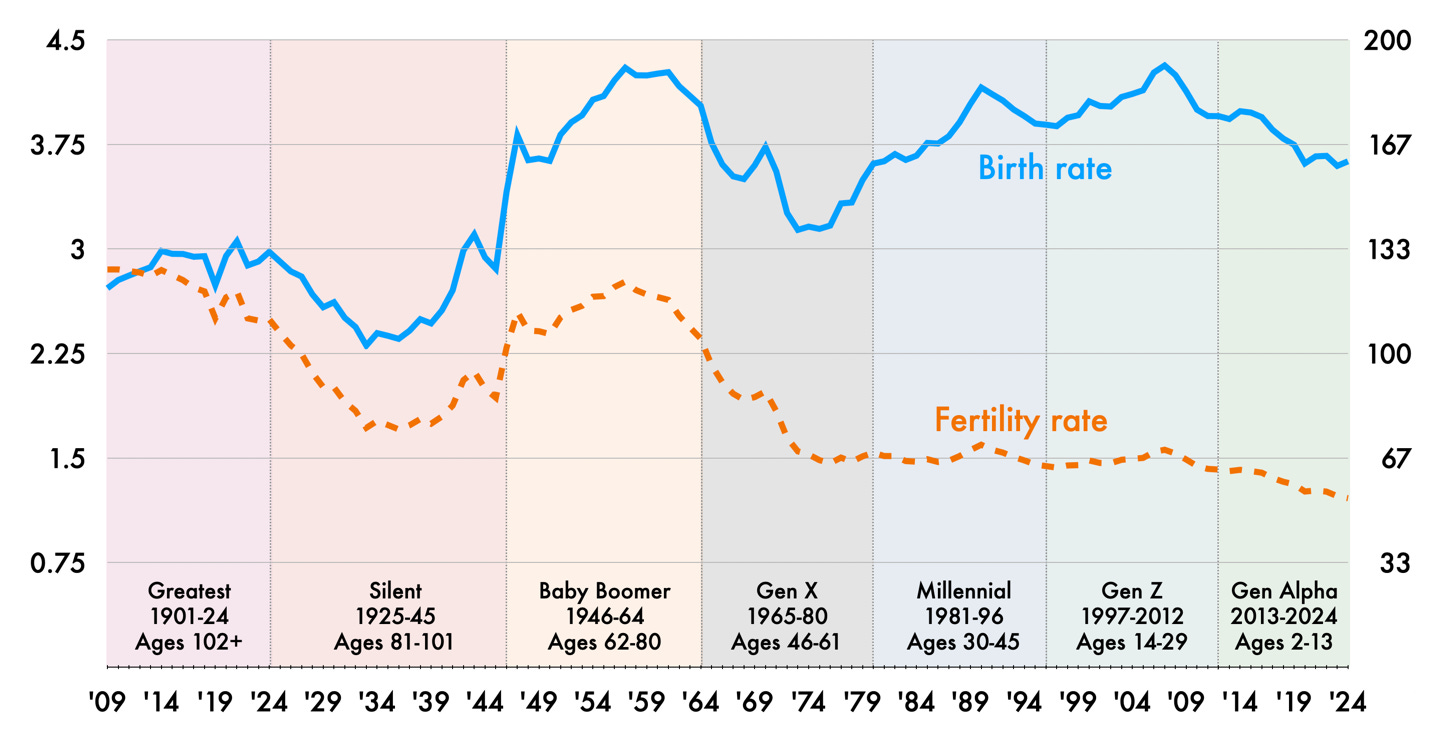
The chart above shows a striking “U” shape in the birth rate in the US during the years typically considered to be those when Gen X was born. It’s not universally agreed upon what caused those “baby bust” years, though experts have offered hypotheses including the introduction of the birth control pill, increasing education and employment opportunities for women, a rise in abortion access, changing ideas about family composition, and the economic uncertainty of the 1970s. It’s also worth noting that while birth rates rebounded a bit in the following decades, they’re now falling again and projected to continue hovering close to Gen X levels in the years ahead.
Gen X came of age during major technological, economic, and societal changes. They are widely considered to be the last “analog” generation, having grown up just before technology went digital. They’ve also been known as the “latchkey” generation, the first to come back after school to an empty dual-income house. Their coming of age was marked by the end of the Cold War, the Challenger explosion, the AIDS epidemic, energy crises, the War on Drugs, and the start of a serious rise in college tuition costs, to name just a few “once in a lifetime” events they endured. They also win the extremely dubious prize of being the generation most exposed to lead during their childhood.
Since then, they have also of course endured 9/11, the Great Recession, and Covid. Because they were in the work force and (supposedly) earning and saving for retirement during these events, they are projected to be the first generation not to be wealthier than previous ones. Add to this that Gen X has now entered what demographers call the “sandwich generation” — a period all generations pass through during which they have to care for both children and aging parents — and it’s no wonder Gen Xers currently have the lowest consumer confidence of any generation and largely describe themselves as unprepared for retirement.
Of course, it’s not all bad — Gen X also enjoyed wild freedom as children to leave the house and run around without being tracked. They grew up through the rise of incredible artifacts like arcades, music videos, home gaming systems, and the cultural masterpiece that is the mixtape. They also perfected the ideal Friday night of hanging around a Blockbuster. The influence of Gen X on music and other aspects of culture, of course, also cannot be overstated.
The doorway generation
Because Gen X is crammed between two much larger generations, Boomers and Millennials, Gen Xers are frequently overlooked in discussions of generational trends. In fact, even today they are smaller than Gen Z and only just tied with Boomers, who are aging out of population counts (yes, this is a data-based euphemism for dying).
Generation X makes up only 19% of the US population
Percentage of people in the US who belong to each generation as of the end of 2025
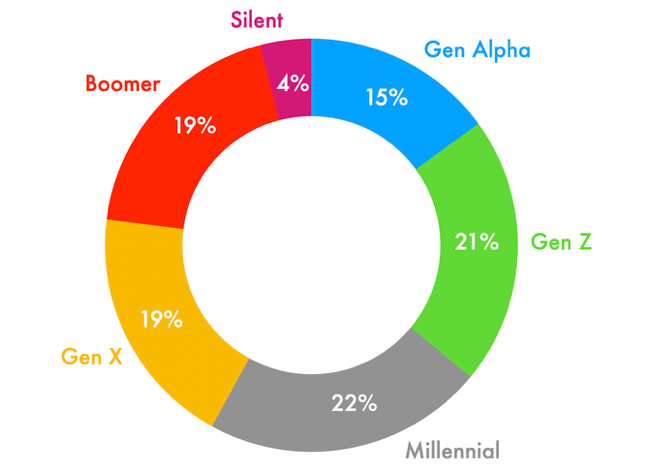
It is of course unfortunate that we persist in overlooking this “neglected middle child” generation, because they are awesome and we have much to learn from them (these are the only stereotypes I will accept, by the way). But it’s also worth paying attention to them because demographers increasingly describe Gen Xers as a “demographic bridge” between Boomers and younger generations, in that they mark a gateway between an older set of demographic characteristics and newer ones.
Gen X marks the beginning of a trend toward a more racially diverse America
Percentage of Americans belonging to each generation by racial group (as designated by the US Census) in 2025
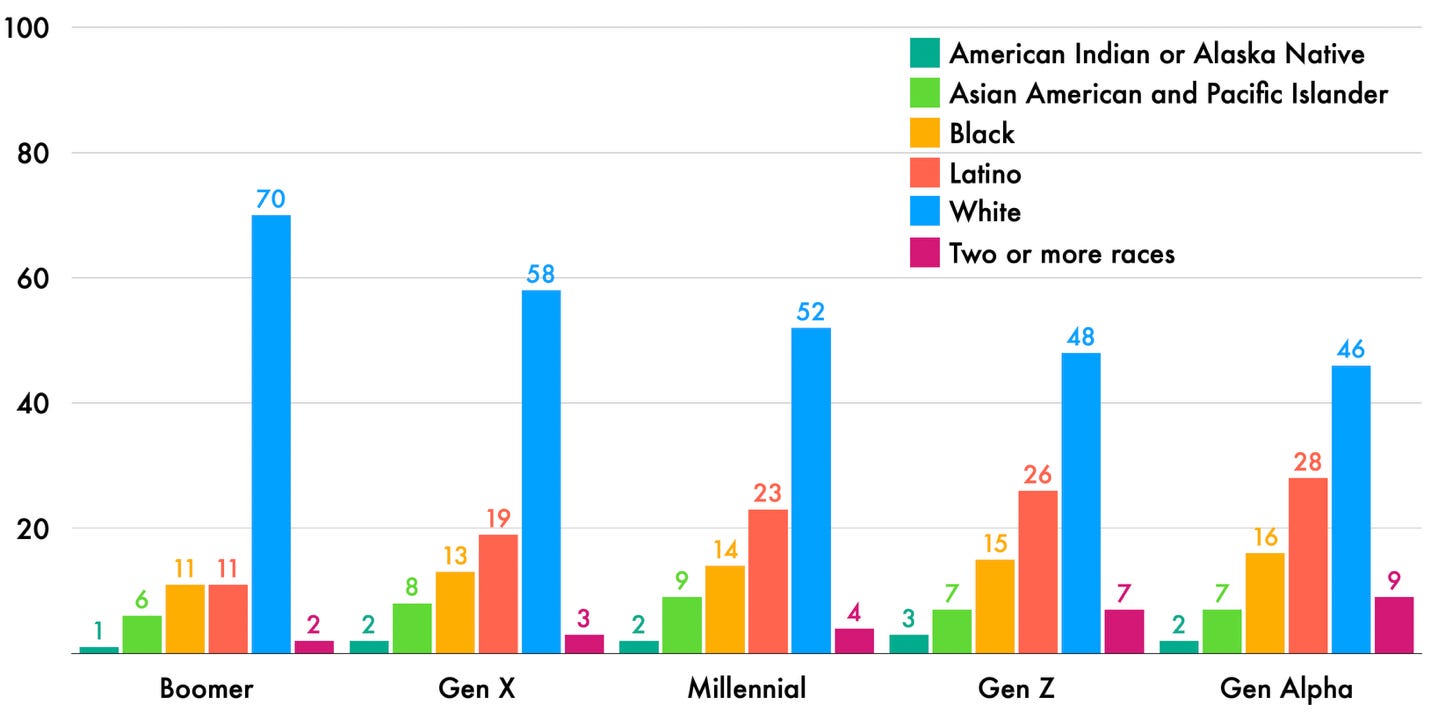
From the chart above we see that Gen X can indeed be thought of as a kind of bridge between the more homogeneous and 70% white Boomer Americans and more diverse younger generations, in which just under half of Americans are white.
Gen X also marks a transition between stronger political party loyalty more mixed loyalties
Percentage of Americans belonging to each generation who self-identify according to one of the party identities listed below in 2024
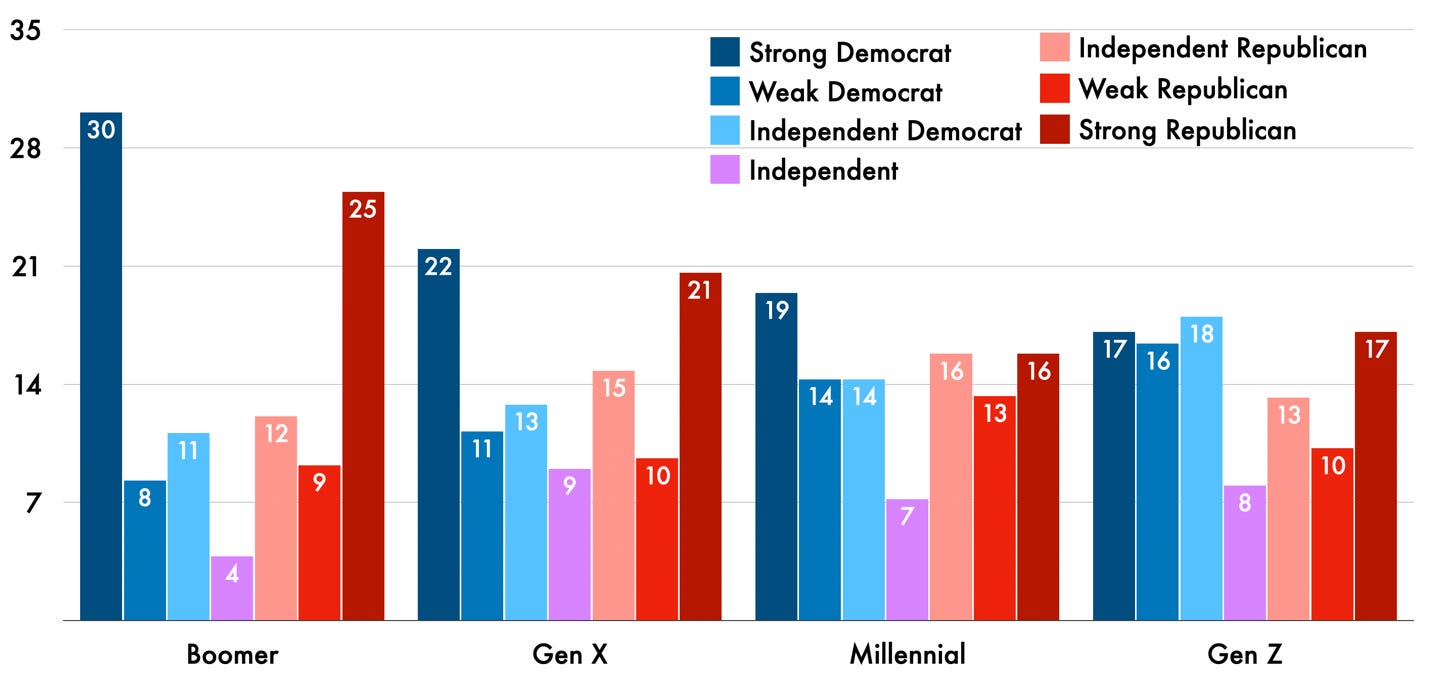
While Boomers are more likely to self-identify as strong Democrats or Republicans, members of Gen X are a bit more tepid. We see this trend continue among Millennials and Gen Zers, who are much more likely to self-identify as independents or just slightly leaning toward one party or the other.
Surprisingly — at least to me — this trend doesn’t hold just for party identity. It holds even if we abandon the language of Democrat versus Republican and ask members of each generation how liberal or conservative they consider themselves to be.
Gen X represents a shift toward more moderate political ideologies compared with Baby Boomers
Percentage of Americans belonging to each generation who describe their ideological leanings according to the below options in 2024
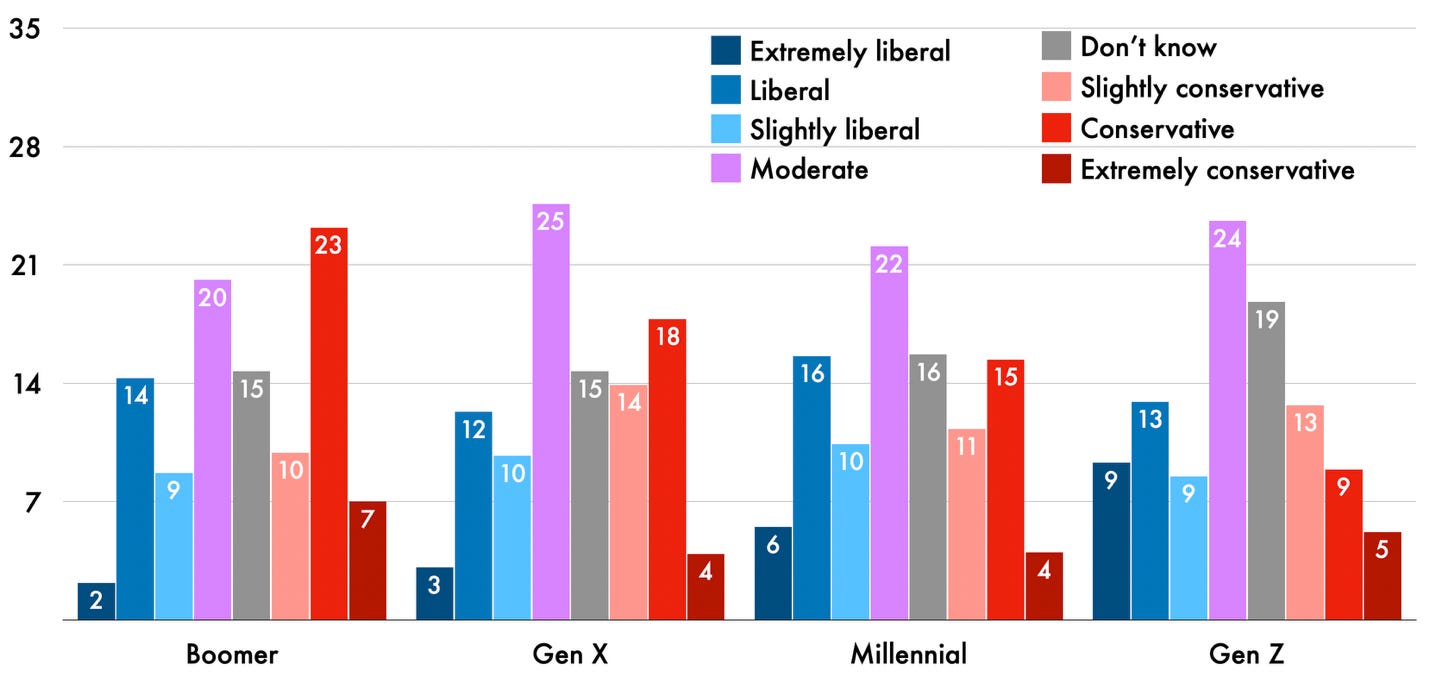
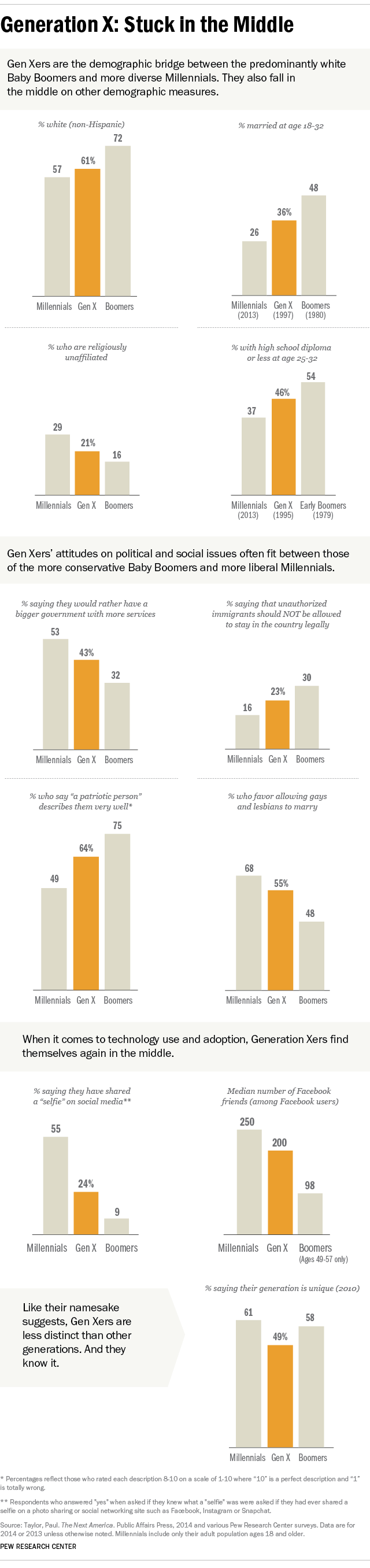
The above chart shows that members of Gen X are much more likely to self-identify as moderate than are Boomers. We also see a meaningful drop in the percentage who consider themselves conservative or extremely conservative. And it’s striking that despite our highly charged political environment, a lot of respondents of all ages indicate they don’t know or haven’t thought about their ideology.
Interestingly, we see a fairly notable increase in self-identification among Gen Z respondents with extremely liberal or conservative views. We’ll have to explore this in a future article!
The bellwether generation
Finally, because they are also the first generation to fully face the consequences of many major economic, social, and policy changes, Gen Xers are also increasingly thought of as a “bellwether” for future generations. For example, they are the first to fully face the consequence of retirement policy shifts away from pensions and towards 401(k)s, as well as the first to enter a workforce that effectively requires a four-year undergraduate degree. They’re also likely to be the first to face serious shortfalls in Social Security in the years ahead. Already, Gen X is in even more debt than any other generation, including Millennials (one more avocado toast for me after all!).
That said, trends are not immutable. Policy conversations about, for example, retirement, Social Security, the cost of living, and the cost of education are afoot. And this brings me to my final chart about Gen X: they are increasingly in charge now. For the first time, in our current 119th Congress, Gen Xers have replaced Boomers as the majority generation in the House (though not yet in the Senate).
Gen X represents the majority generation in the House for the first time
Percentage of representatives from each generation over the past five Congresses
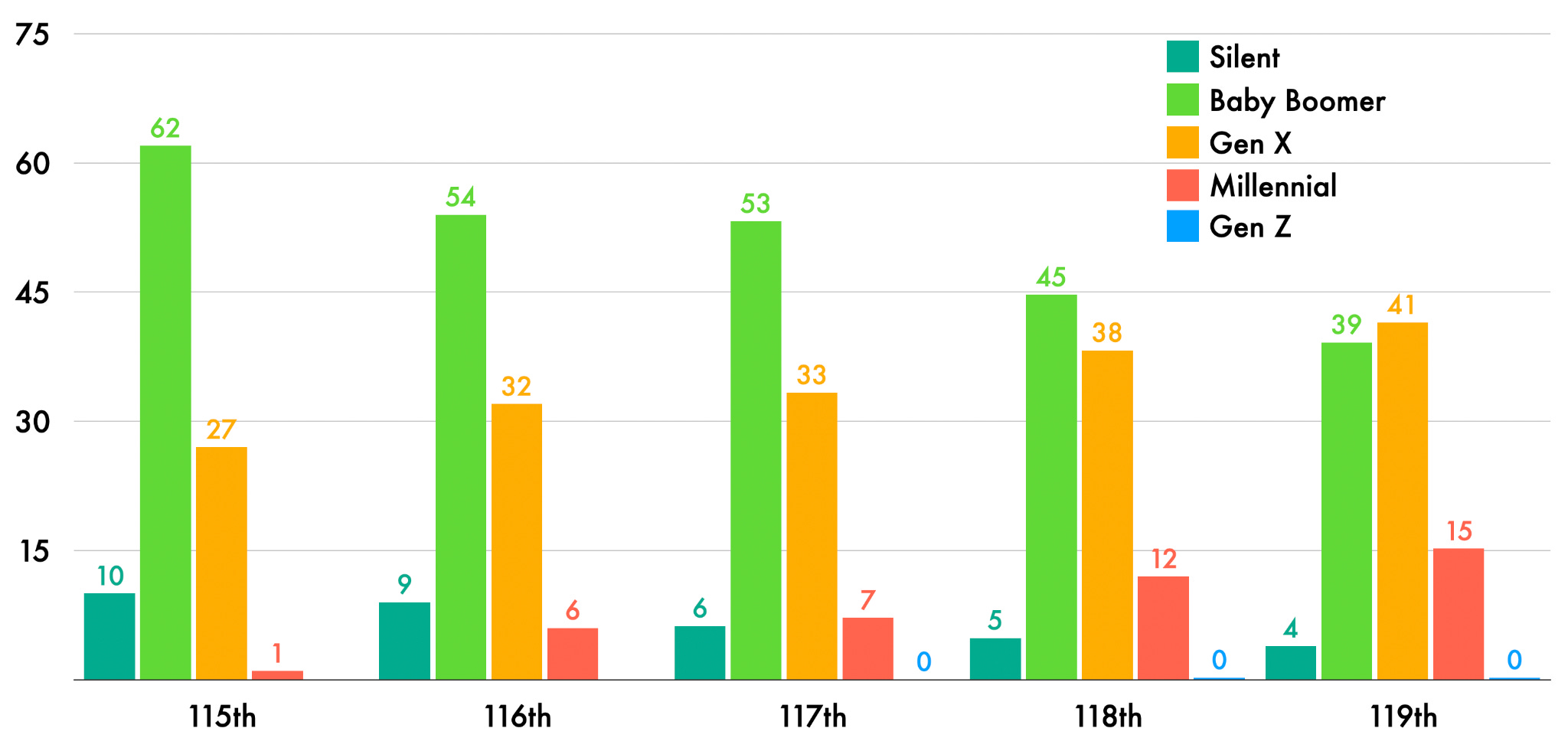
So how will our new Gen X majority representatives govern? Of course, we can’t make individual predictions, but in general experts anticipate a few things. For one, the difference between younger and older members of Gen X tends to map to liberal and conservative divides, so we might do well to more closely inspect the microgenerations we discussed above. To this end, some observers expect Gen X to really overhaul things, while others see it as a generation mostly interested in preserving the status quo.
Consistent with general trends as Americans get older, on balance Gen Xers are leaning slightly more conservative than younger generations. On the other hand, because of their lifetime of experience with economic instability and financial challenges, it’s plausible we’ll see more focus on policies to address Social Security, the cost of living, and the cost of caregiving. After all, if Tyler Durden from Fight Club is to be believed, some of these new lawmakers are probably “very, very pissed off.”
 | A guest post by
|