
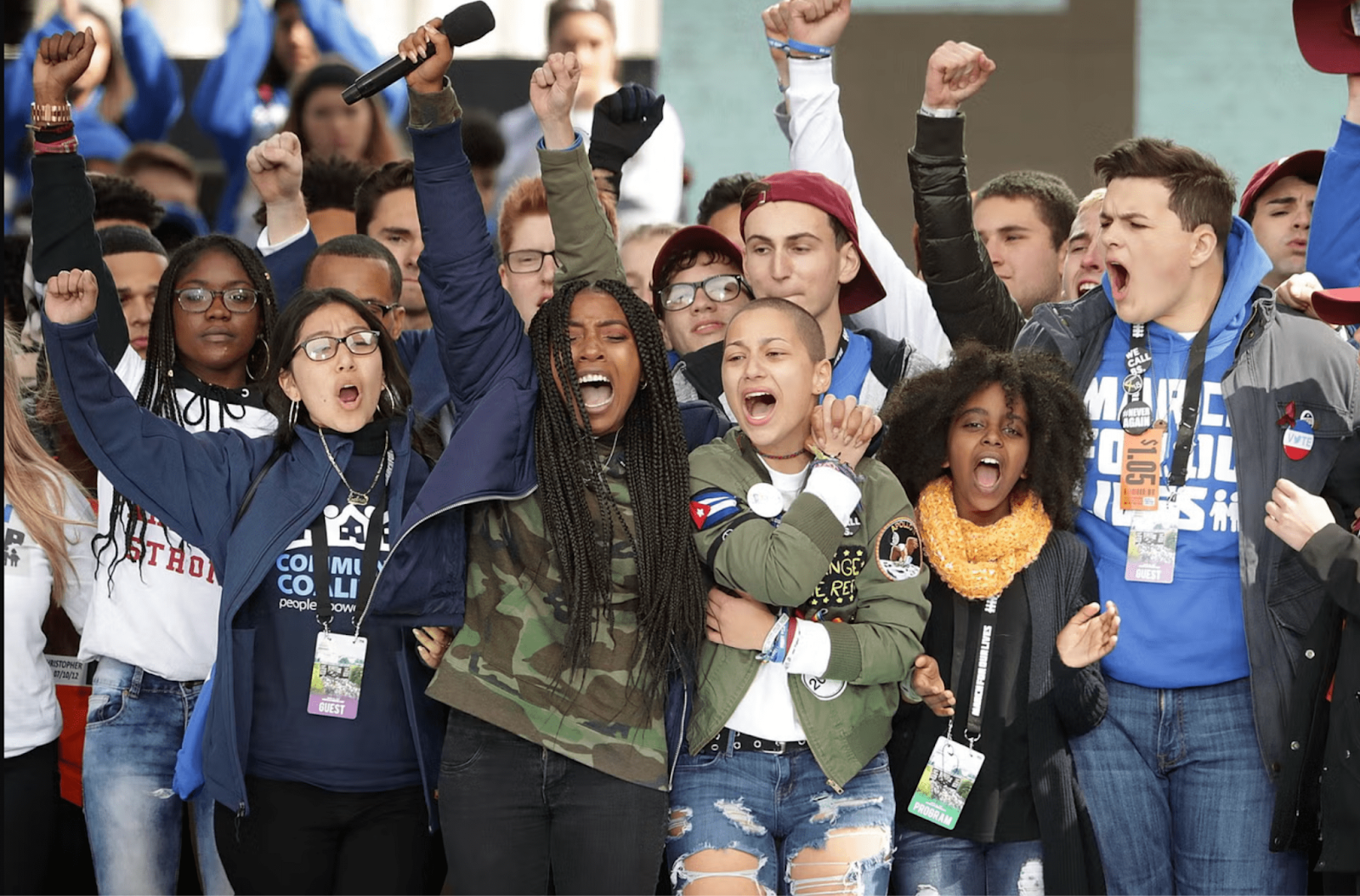
As a government professor, I get one question more than almost any other: “Do you have any hope in the next generation?” Not for the next generation (though that is a common one, too); hope in the next generation.
The tone accompanying the obviously leading question is always the same — worry wrapped in nostalgia, seasoned with that familiar complaint that “kids these days” are too fragile, too distracted, too online, too disengaged to run the country they’re about to inherit.
I get it. There are some very troubling trends with today’s youth. An average of nearly 7.5 hours on screens every single day. Almost 40% of US teens report regular feelings of sadness or hopelessness. Soaring diagnosis rates of ADHD and anxiety at the same time as declining test scores in math, reading, and science. Oh, and much lower voter turnout rates than their elders.

And yet, despite all the stats and stereotypes, my experience teaching, working with, and advising the next generation has given me a much different answer to the question of whether I have hope in them: “They are pissed, and in all the right ways.”
Not apathetic. Not indifferent. Not asleep at the wheel.
Compassionate. Tolerant. Unsatisfied. Unbelievably creative and technologically savvy. Frustrated at the broken systems and promises of those who came before. Unwilling to accept the status quo. And, if given a little nudge, more than willing to use their talents for change.
You are forgiven if you’re a bit skeptical. After all, complaining about the youth being too entitled or unwilling to listen is as old as civilization itself. No, not the United States — civilization. One of the earliest recorded complaints about “kids these days” comes from an inscription on a Babylonian clay tablet from around 1000 BC, quoted in Robert Greene’s The Laws of Human Nature: “Today’s youth is rotten, evil, godless and lazy. It will never be what youth used to be, and it will never be able to preserve our culture.”
It’s nothing new even if everything is different.
And yet, for all our recycled anxieties about “kids these days,” we keep overlooking a simple truth: every generation has its doers. This one is no exception. In fact, they may be ahead of schedule. The next generation is not waiting for permission to lead. They’re already doing it.

When I was told this edition of The Preamble was about inspiration, I knew my contribution would have two tenets. First, it wouldn’t be about a name or story you already know (the famous already hog the spotlight). And second, it would be about younger folks, in an effort to combat the assumptions and complaints of the older.
In short, I got to work to find an uplifting but untold story of a young person making a difference. And within minutes I was drowning in possibilities. Rural kids building broadband networks. Indigenous teens running public-health systems. College students exposing government failures. High school coders building eviction-prevention tools.
I kept reading. And reading. And reading.
At some point, I stopped looking for “the best example” and realized the fact that there are too many stories to choose from is the entire point.

Across the country, on issues that cut across geography, ideology, and identity, young Americans are solving civic problems adults have spent entire careers complaining about. They’re not the caricatures older generations invent for them.
They are, in the most literal sense, already leading and making change.
Below is just a sampling of under-the-radar stories of young Americans tackling civic challenges with the kind of creativity, urgency, and practicality our politics desperately needs.
Let’s meet a few of them.
California Teens Who Turned Wildfire Trauma into Life-Saving Engineering
After watching the 2018 Camp Fire destroy nearly 18,000 homes, 13-year-old Ryan Honary decided he wasn’t willing to wait for the next catastrophe. With no formal engineering training, he began teaching himself AI modeling, sensor design, and wildfire behavior from his bedroom.
Within months, he had built a portable early-detection system: a network of low-cost sensors that communicate with a solar-powered base station and use AI to detect abnormal heat and smoke patterns at the very start of ignition — often before traditional systems can. His invention caught the attention of CAL FIRE, Orange County Fire Authority, and emergency planners across the state. Fire officials began partnering with and investing in Honary to test and scale the sensors in real-world environments across California.

With the help of funding from the Irvine Ranch Conservancy, Ryan founded SensoRyAI, a tech startup that leverages AI to help communities respond to various environmental and climate change dangers. For his work, Honary was designated a UNESCO/Learning Planet Youth Fellow and was named a top-ten global finalist at the Earth Prize, the world’s largest environmental competition for teenagers.
And while this California teen was engineering his way out of the next disaster, 3,000 miles north, another group of young people were doing the work usually reserved for federal scientists.
Alaska Native Teens Who Mapped Climate Collapse Before FEMA Did
Along Alaska’s western coast, where Yup’ik and Inupiat communities watch permafrost melt beneath their homes and storm-driven erosion eat away entire shorelines, a group of young researchers refused to wait for government agencies to show up.
Working through the Alaska Native Science & Engineering Program and the University of Alaska Fairbanks (UAF) Geophysical Institute, high-school and college-aged interns began using drones, GPS units, time-lapse cameras, and open-source GIS (graphic information system) tools to map coastal erosion and thawing permafrost with a level of detail state and federal agencies simply didn’t have.
Their work was not symbolic. It was scientific — and crucial.

The students produced high-resolution imagery in the Yukon-Kuskokwim Delta, the North Slope, and the communities around Bristol Bay, documenting how water erosion threatens vital community infrastructure. UAF scientists incorporated the youth-generated data into larger coastal-change models, and tribal and local governments used the students’ maps to support applications for federal resilience and relocation funding — including major grants from the Denali Commission and FEMA hazard-mitigation programs.
In some regions, these student-produced datasets were the first comprehensive mapping of erosion ever completed.
While agencies debated responsibility, these teens built the evidence record themselves — proving, with data and drone footage, that their villages weren’t just at risk. They were disappearing in real time.
The Colorado Teen Who Turned Curiosity into World-Changing Innovation
When most 11-year-olds were figuring out middle school, Gitanjali Rao was figuring out how to detect lead in drinking water faster than any existing technology. Disturbed by the Flint water crisis, she taught herself carbon-nanotube chemistry and built Tethys, a portable lead-detection device that delivers results in seconds.
Using the prototype, Rao partnered with Denver Water to refine and test Tethys in real-world conditions, validating its accuracy and adapting the device based on feedback from professional water-quality engineers. She entered it into the prestigious 3M Young Scientist Challenge and won the $25,000 prize.
And, still, Rao kept inventing.

By high school, Rao had developed “Kindly,” an AI-powered tool that detects and interrupts cyberbullying in real time. She built a global network of volunteer testers — more than 3,000 students in 30+ countries — to improve the model’s accuracy.
Her work earned her recognition as Time’s first-ever Kid of the Year in 2020, but the headlines undersold the real story: Rao trains thousands of young innovators through workshops, virtual labs, and STEM camps. Her programs have now reached over 50,000 students worldwide, giving other kids the tools to invent solutions to their own community’s challenges.
The Rhode Island Fifth-Grader Who Turned French-Fry Grease into Heat for Families
When she was just ten years old, Cassandra Lin noticed restaurants in her coastal Rhode Island town were tossing out thousands of gallons of used cooking oil every week, all while low-income families down the street struggled to pay for winter heat.
So she asked a simple question that would become a national model: What if waste grease could become fuel — and fuel could become help?
Lin founded TGIF: Turn Grease into Fuel, convincing local restaurants to donate their used cooking oil, partnering with biodiesel processors to convert it, and coordinating with city officials to distribute the resulting clean-burning biodiesel to families in need. What began as a fifth-grade service project quickly became a full-fledged municipal program.

The impact was staggering. Within a few years, TGIF had recycled tens of thousands of gallons of waste oil. The resulting biodiesel provided heating assistance to dozens of Rhode Island families, many of whom had fallen through the cracks of traditional aid programs.
Cassandra’s work earned her the EPA’s Presidential Environmental Youth Award, national recognition from the Disney Channel, and a feature on Good Morning America, elevating her from local innovator to a nationally recognized leader in youth-driven climate action.
The Teenager Rebuilding the STEM Pipeline from the Inside Out
In 2019, 18-year-old Emily Cho was quietly building a national youth-run STEM organization designed for students unlikely to see themselves in science at all. What started as a small project out of her Rhode Island living room became Juvie for STEM (JSTEM) — an ed-tech nonprofit that sends teen instructors into underserved classrooms and even juvenile justice facilities to run hands-on science and engineering labs.

Cho’s mission has two aims. First, she wants to bring science directly to students who have been told, implicitly or explicitly, that STEM isn’t “for them.” She and her team created age-appropriate materials and recruited mentors who actually looked like the young people they were teaching. Second, she aims to show those same students that STEM isn’t just a school subject but a pathway that could lead to real careers and reduce the cycle of reoffending.
By 2025, JSTEM has 18 chapters across the United States and more than 6,000 volunteers. It has delivered programming to young people in schools and correctional facilities where STEM courses were limited or nonexistent. In communities that had never been part of the tech pipeline, Cho’s teenage instructors are raising tens of thousands of dollars to keep programming free and expanding.
The Teen Who Refused to Wait — and Built a Voting Movement
And in the cause closest to my soul, 16-year-old Jahnavi Rao stood outside her high school in Berwyn, PA, and felt voiceless. Too young to vote, she spent hours listening to her older classmates debate issues that would shape their lives — and hers. So she started New Voters, a school-club project built around one idea: register eligible teens now so their own generation won’t be ignored later.
Rao and a handful of classmates targeted their peers and within three days registered 85% of their senior class. Then they really got going. To scale their work, they created New Voters’ registration toolkits and training programs to help other young leaders create similar civic change in their own communities.

Their model caught fire. Within a few years New Voters had expanded from a single high school into a national nonprofit operating across over 500 high schools in 42 states, encouraging tens of thousands of young people to take civic action.
Today, New Voters mentors high-schoolers to run their own registration drives, but it also publishes research on what actually motivates youth civic participation. Rao herself earned a place on Forbes’s 30 Under 30 Social Impact list in 2025 for her work, and served as the youth lead of the Youth Engagement and Millennial Voter Participation at the Democratic National Convention. Needless to say, Rao is voiceless no more.
So… Is There Hope?
I wish everyone who asks me whether “kids these days” are helpless could spend an hour reading what I found. Or talk to any of the students I teach — thoughtful, restless, impatient with dysfunction, and allergic to “That’s just the way things are.”
We keep expecting young people to engage the way we did — through the same institutions, in the same tones, with the same habits and hierarchies. And when they don’t show up in those familiar forms, we assume they’re absent. Detached. Hopeless. Lost. Doomed.
But that’s not what’s happening.
Young people aren’t disengaged; they’re rewiring what engagement looks like. They’re not waiting for gatekeepers to hand them a microphone; they’re building their own tech, their own networks, their own communities, their own maps, their own markets, their own movements. Many of them don’t even call what they’re doing “politics” because the word feels too small for the work — too slow, too noisy, too stuck. They’re solving problems directly, using the tools and skills of their world, not the one their parents or grandparents grew up in.

Digital fluency. Mutual aid. Open-source engineering. Real-time data. Community science. Civic design. These aren’t extracurriculars for this generation — they’re the instincts of a cohort raised in overlapping crises who learned early that waiting for adults to fix everything is not a winning strategy.
And that’s the quiet miracle of this moment. While so many grown-ups sit around wondering whether the next generation is ready to lead, the next generation is out there already creating waves.
Hope in the next generation isn’t something I have reluctantly. It’s something they’ve earned. Not with potential, but with receipts. Not with speeches, but with solutions.
The future isn’t coming. It’s here.