
The Daily Brief — June 4, 2026
House votes to limit Trump’s war powers, SCOTUS backs FCC, Bolton to plead guilty in classified information case
These are today’s top stories, delivered straight to your inbox. Catch up here on all the news.
SCOTUS Backs FCC Against AT&T, Verizon
The Supreme Court ruled today that the Federal Communications Commission can fine companies without first giving them a jury trial. The 8–1 decision upheld more than $100 million in penalties against AT&T and Verizon.
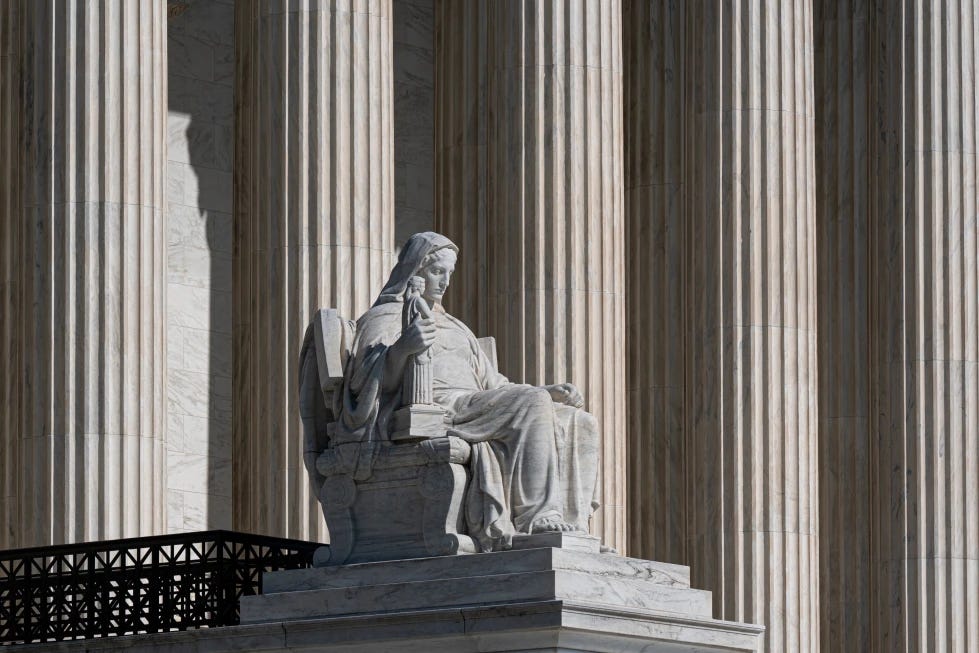
In the opinion, Chief Justice John Roberts wrote that FCC “forfeiture orders” — fines assessed through internal FCC proceedings rather than a trial — do not violate the Constitution’s Seventh Amendment right to a jury trial, because they are not final. A company can refuse to pay, which would then force the government to file a collection action in federal court. That collection action would then entitle the company to a jury trial and a fresh review of the case.
The FCC fined AT&T $57 million and Verizon $46.9 million in 2024, finding they failed to protect customers’ location data. Both companies paid under protest, then challenged the FCC’s procedures, arguing that the Constitution required a jury trial before the agency could impose such fines.
Justice Clarence Thomas dissented from the majority’s decision, arguing the companies had no assurance they would ever get the jury trial they were entitled to.
House Passes Resolution to Limit Trump’s Iran War Powers
The GOP-led House passed a resolution yesterday seeking to limit President Trump’s ability to continue the war with Iran. Four Republicans joined nearly all Democrats in the 215–208 vote. The measure directs Trump to withdraw US forces from the conflict unless Congress votes to declare war or authorize military action.
The War Powers Resolution of 1973 requires a president to end hostilities within 60 days unless Congress declares war or authorizes force. That deadline passed on May 1. The Trump administration has claimed it does not apply because hostilities ended when a ceasefire with Iran took effect in April, though the ceasefire has repeatedly been violated by both sides.
The Senate advanced its own resolution last month but has not held a final vote. The House measure now heads there as well.
The House passed its measure as a concurrent resolution, which Congress uses to state its position. It still needs the Senate to pass it as well — but even if the Senate does, it would not go to the president for a signature. Its legal force is disputed. A 1983 Supreme Court ruling found that Congress’s actions are binding only if they clear both chambers and are presented to the president. The Senate is separately advancing its own version. If enacted, it will carry the force of law.
Trump to Nominate Blanche as Attorney General
President Trump said he will nominate acting attorney general Todd Blanche to lead the Justice Department permanently.
Trump announced the decision at a White House dinner yesterday evening and praised Blanche’s work as acting attorney general. He said he would formally submit the nomination today. The post requires Senate confirmation.
Blanche has run the department since his boss, Pam Bondi, was ousted as attorney general in April. He previously served as Trump’s personal lawyer in several criminal cases.
As acting attorney general, Blanche has pursued Trump’s priorities. The department secured an indictment of former FBI Director James Comey, one of Trump’s perceived enemies. Blanche also defended a settlement that shields Trump, his family, and their businesses from certain IRS audits.
Newsbreak
I’m so excited to share that my new children’s book, We Are Mighty, is here, and the response has been amazing — it’s a New York Times and Publishers Weekly bestseller! It tells the true stories of twelve real people from America’s past — some famous, most not — who saw what needed doing and did it. It’s a book about courage, hope, and the quiet ways ordinary people can change the world. If you’d like to share that message with a child you love, I’d be so honored for you to buy a copy.
Senate Advances Immigration Bill Without Ballroom Funds
Senate Republicans dropped $1 billion in funding tied to President Trump’s White House ballroom from an immigration enforcement bill.
The Senate voted 53–46 yesterday to begin debate on the roughly $70 billion bill, which funds ICE and the Customs and Border Patrol. Republicans are moving it through reconciliation, a process that lets a simple majority pass a budget bill and bypass the 60-vote threshold needed to defeat a filibuster.
The bill has been stalled for weeks over two obstacles. The Senate parliamentarian ruled that the ballroom money could not stay in a reconciliation bill, which meant that keeping it in would have let Democrats force a 60-vote threshold. Several Republicans also objected to the separate $1.8 billion Justice Department “anti-weaponization fund” to compensate people who say they were wrongly prosecuted by the federal government. The chamber advanced the bill only after acting attorney general Todd Blanche told a House panel earlier this week that the administration would drop the fund. A series of amendment votes is expected before a final vote.
The amendment votes are taking place during a Senate “vote-a-rama,” an often marathon series, sometimes all night, of rapid-fire votes on proposed changes to a budget reconciliation bill.
Trump Order Strips Protections From 8,000 Federal Workers
President Trump signed an executive order yesterday making it easier to fire about 8,000 federal workers.
The order moves senior employees in policy-related jobs into a new category, Schedule Policy/Career, formerly known as Schedule F. Workers in the new category lose the right to appeal firings and other personnel actions to the Merit Systems Protection Board, an independent board that hears federal employee disputes. They can effectively be fired at will.
Scott Kupor, director of the Office of Personnel Management, which oversees federal hiring, said the change is about accountability. He said employees can hold any political views, but those views cannot interfere with carrying out the administration’s policies.
The change faces several lawsuits, including one from the advocacy group Democracy Forward, which argues the order exceeds the president’s authority, violates federal civil service laws, and strips workers of due-process protections under the Constitution and the Administrative Procedure Act.
Israel and Lebanon Agree to Renew Ceasefire
Israel and Lebanon agreed yesterday to renew their ceasefire after US-mediated talks in Washington. The agreement, reached after two days of negotiations, also creates pilot security zones in southern Lebanon.
The intended security zones will be placed under the exclusive control of the Lebanese Armed Forces and off limits to the Iran-backed militant group Hezbollah, according to a joint statement from the US, Israel, and Lebanon.
The ceasefire depends on Hezbollah halting all attacks and withdrawing from the South Litani Sector — the area in southern Lebanon between the Israeli–Lebanese border and the Litani River.
Hezbollah was not part of the talks. Hours after the deal was announced, Hezbollah struck northern Israel, and Israel retaliated with strikes in southern Lebanon.
A halt to Israeli attacks in Lebanon is one of Iran’s key demands in its own talks with the US on ending the war between them. Iran has insisted any deal with the US must also address the strikes in Lebanon.
John Bolton to Plead Guilty in Classified Information Case
Former national security adviser John Bolton has agreed to plead guilty to a felony count of retaining classified national security information. He has also agreed to pay a $2.25 million fine under a plea agreement with federal prosecutors, according to multiple news reports.
Bolton, who served as national security adviser during President Trump’s first term before becoming one of his most outspoken critics, was indicted last year on 18 counts related to the alleged retention and transmission of classified information.
Prosecutors alleged that Bolton shared sensitive government information, including diary-style notes containing classified material, with family members over several years. The notes reportedly included information from intelligence briefings, meetings with foreign leaders, and other national security matters.
The charges against Bolton carry a potential sentence of up to five years behind bars, though the agreement could allow him to avoid prison. Any sentence must be approved by a federal judge.
A hearing is scheduled for June 26 in federal court in Maryland.
Protests Continue Over Kushner-Linked Resort in Albania
Thousands of Albanians have protested in the capital, Tirana, this week against a luxury resort linked to Jared Kushner, President Trump’s son-in-law.
The $1.6 billion project, led by Kushner’s investment firm Affinity Partners, would put hotel complexes on the uninhabited island of Sazan and along the protected Vjosa-Narta coast in southern Albania.
Protestors oppose development because of the Vjosa-Narta wetland, which is home to flamingos, seals, and sea turtle nesting sites. It is also a stopover for migratory birds. Protesters and environmental groups want construction halted, citing threats to the area’s ecosystems. The dispute escalated after developers fenced off public access to a local beach.
Albania’s anti-corruption prosecutors have opened an investigation into how the land was acquired and sold to investors. The Albanian government has said the project will boost tourism, create jobs, and support the country’s economic development.


