
The Daily Brief — June 29, 2026
SCOTUS allows late-arriving mail voting, prevents president from firing Fed governor but allows him to fire FTC commissioner
These are today’s top stories, delivered straight to your inbox. Catch up here on all the news.
SCOTUS Allows Late-Arriving Mail-In Ballots
The Supreme Court has upheld a Mississippi law allowing state election officials to count absentee ballots received after Election Day as permitted by state law.
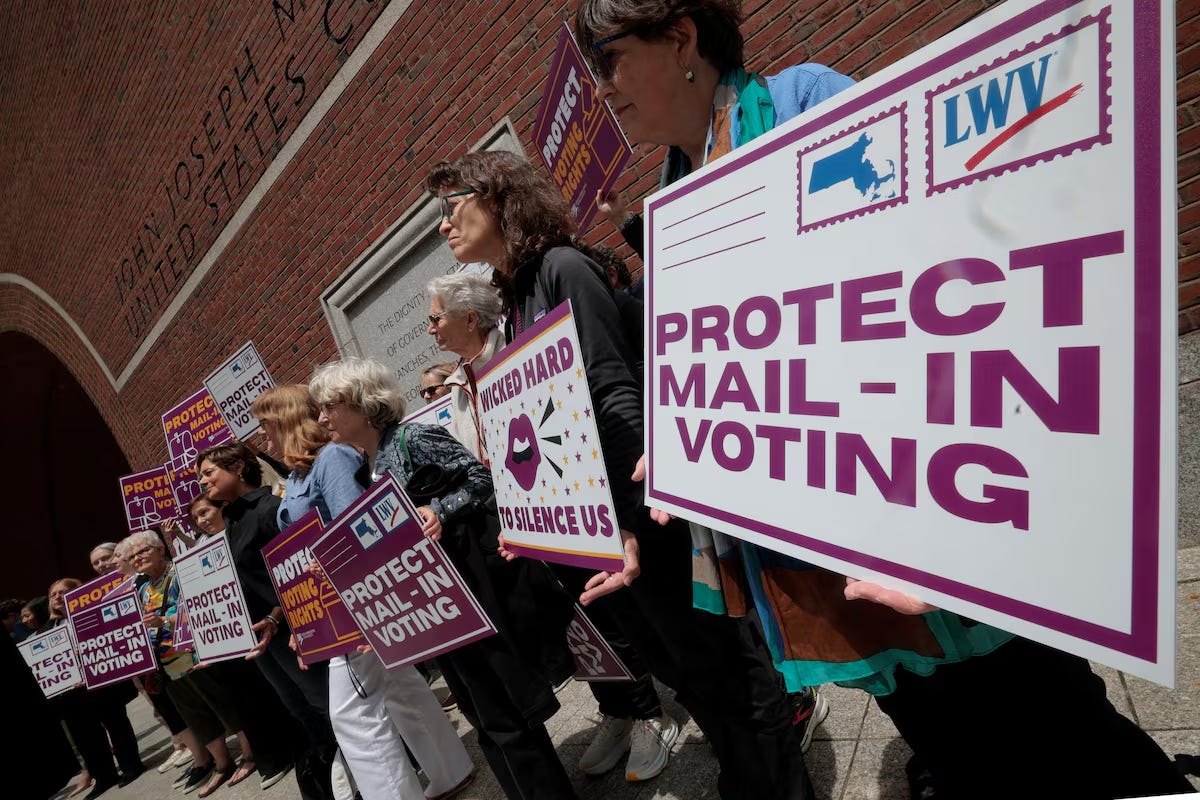
The dispute centered on a Mississippi law that allows absentee ballots to arrive up to five business days after Election Day if they were mailed on time. The Republican National Committee and other challengers argued that federal laws requiring elections to occur on a single day mean that ballots must be not only cast but also received by Election Day.
In a 5–4 decision in Watson v. Republican National Committee, the Court ruled that federal statutes establishing a national Election Day for presidential and congressional elections do not require states to receive all ballots by that date.
Writing for the majority, Justice Amy Coney Barrett said the case presented a “narrow” question: whether federal election-day laws prohibit states from counting ballots “postmarked by election day, but received up to five days later.” Barrett stressed that the case was not about the Constitution or the broader legality of absentee voting, but whether Mississippi’s law conflicted with federal election statutes. The Court held that it did not, and that the “defining element of an ‘election’ has always been the electorate’s choice of candidate.” Barrett wrote that while federal law dictates when votes must be cast, state law governs when they must be received.
Justice Samuel Alito, writing in dissent and joined by Justices Clarence Thomas and Neil Gorsuch, argued that the majority’s interpretation effectively extends Election Day beyond the single day required by federal law, and that allowing ballots to arrive after Election Day undermines public confidence in elections.
SCOTUS Blocks Trump from Firing Fed Governor
The Supreme Court has refused to let President Trump remove Federal Reserve Governor Lisa Cook while she fights her firing in court.
Cook is the first Fed governor any president has tried to fire in the central bank’s 111-year history. The case, Trump v. Cook, stemmed from President Trump’s attempt to fire Cook before the expiration of her 14-year term, which began in 2023. The Trump administration argued that it was firing Cook for cause, saying she had committed mortgage-related fraud before joining the Fed.
Cook denied any wrongdoing and argued that the allegations were a pretext to remove her because of disagreements over monetary policy. She argued her removal violated the Federal Reserve Act’s required procedures for removing a governor “for cause.” She also argued that her Fifth Amendment right to due process was violated, and that allowing her firing would strip the Fed of its independence.
In a 6–3 ruling, the majority held that President Trump skipped a step the Federal Reserve Act requires before removing a governor for cause: giving her notice of the charges and a chance to respond.
With Chief Justice John Roberts writing, the majority found that Trump fired Cook without the process the statute demands. “At minimum,” Roberts wrote, Cook was owed “some explanation of the evidence at issue, some avenue for a response, and a deadline by which a response would be due.”
The Court emphasized that “for cause” protection is particularly important for employees of the Fed because the central bank sets monetary policy free of presidential and congressional control.
There were three separate dissents. All three dissenters would have let Trump remove Cook while the case played out. Justice Clarence Thomas called the for-cause protection itself unconstitutional because all executive power belongs to the president and agreed the alleged mortgage fraud was reason enough to fire Cook. In their dissents, Justice Amy Coney Barrett and Justice Samuel Alito, joined by Neil Gorsuch, accused the majority for deciding far more than the case required.
SCOTUS Lets Trump Fire FTC Commissioner
The Supreme Court today gave President Trump the power to fire Federal Trade Commission members at will, overturning a nearly century-old precedent that had let Congress shield them from removal except for “inefficiency, neglect of duty, or malfeasance in office.”
Trump fired Rebecca Slaughter, a Democratic member of the Federal Trade Commission, in 2025 without citing any statutory cause, telling her only that her service was “inconsistent with [his] Administration’s priorities.” Slaughter’s term at the independent agency was not set to expire until 2030, and under federal law, FTC commissioners can be removed only for “inefficiency, neglect of duty, or malfeasance in office.”
Slaughter sued, arguing that her dismissal violated both the FTC Act and prior Supreme Court precedent on the president’s authority over independent regulatory agencies. The administration, however, argued that the Constitution gives the president broad authority to supervise and remove executive officials.
In a 6–3 decision, the Court’s conservative majority validated Trump’s firing of Slaughter.
Chief Justice Roberts said the Constitution vests the executive power in the president. Since the FTC exercises executive power — enforcing statutes through rulemaking, investigations, and in-house adjudication that affect private parties — the agency must answer to the president, and he must be able to remove officials within the agency. The decision overturned a longstanding precedent that set certain independent agencies beyond the president’s authority to remove officials at will.
In dissent, Justice Sotomayor, joined by Justices Kagan and Jackson, accused the majority of discarding a century of settled practice, resulting in “a President who emerges with far greater power than ever before,” a power “that neither the People, nor Congress, nor the Constitution bestowed upon him.”
SCOTUS Says Police Need Warrant to Access Cell Location History
In a 6–3 ruling, the Supreme Court held that people’s cell phone location history is constitutionally protected by the Fourth Amendment and that the police need a valid warrant to access it.
The case, Chatrie v. United States, arose from a 2019 bank robbery in Virginia. When police could not identify the robber, they persuaded a local magistrate to approve a “geofence warrant” — a request to a service provider for information from every cell phone that was within a certain area during a certain time period. Google gave the police anonymized information from the phones of 19 people who had turned on Location History and were in the vicinity of the bank around the time of the robbery.
After narrowing down the pool of individuals, the police asked Google to reveal the identities of three people about whom it had provided information, one of whom was Okello Chatrie. Based on this information, the police obtained a warrant for a physical search of Chatrie’s home, where they found stolen banknotes and a gun that matched the one used in the robbery. Chatrie argued that the geofence warrant was unconstitutional and the location information obtained from it should be excluded.
With some exceptions, the Fourth Amendment protects against warrantless searches of places and objects if people have a reasonable expectation of privacy.
The government argued that the Fourth Amendment did not apply because Chatrie gave up the expectation of privacy when he turned on the Location History feature and thereby chose to share his information with Google.
Writing for the majority, Justice Kagan rejected that view. “An individual has a reasonable expectation of privacy in records about his cell phone’s location, and police intrude on that constitutionally protected interest when they demand the information — even though for only a limited time, and from a third-party tech company,” she wrote.
The majority did not, however, decide whether the search was reasonable under the Fourth Amendment, instead returning the case to the Fourth Circuit to evaluate that question.
Justice Alito dissented, joined in part by Justices Thomas and Barrett. Alito argued that the Fourth Circuit had been correct that Chatrie did not have a reasonable expectation of privacy. He also wrote that the Supreme Court’s opinion was unlikely to change Chatrie’s conviction.
Newsbreak
If you’re looking for a way to enjoy your e-reader more comfortably, check out this tablet pillow stand from Flippy. Compatible with Kindle, Fire, iPad models, Samsung Galaxy Tabs, and iPhones, the pillow adjusts to three different angles for comfortable reading, streaming, or browsing in bed, on the couch, or at a desk. It’s made from lightweight foam with a soft, durable cover, making it sturdy, flexible, and easy to clean.
Trump Sexual Abuse Verdict Stands
The Supreme Court has refused to hear President Trump’s appeal to overturn a jury’s finding that he sexually abused and defamed writer E. Jean Carroll, leaving him liable for a $5 million verdict. The jury previously concluded that Trump assaulted Carroll in a New York City department store in the mid-1990s and later defamed her.
A jury also awarded Carroll an additional $83.3 million after a second defamation trial. Trump also plans to appeal that ruling to the high court, his attorneys have said.
Dershowitz’s Suit Against CNN Rejected
The Supreme Court has refused to revive a $300 million defamation lawsuit filed by law professor Alan Dershowitz against CNN over its coverage of his remarks during Trump’s 2020 impeachment defense.
Dershowitz claimed CNN selectively edited his comments to falsely suggest that he was arguing that if a president committed illegal acts with the goal of being elected — in this case, allegedly offering Ukraine weapons in exchange for a political favor — he could avoid impeachment. The Supreme Court declined to take up the case in an unexplained order. Justices Thomas and Gorsuch dissented.
Court Blocks Mail-In Ballot Limits
A federal judge has blocked key parts of President Trump’s executive order aimed at creating a federal voter list and restricting mail-in voting, preventing the measures from taking effect ahead of this year’s midterm elections.
A coalition of Democratic-led states and the District of Columbia sued to challenge the president’s March executive order, arguing that the Constitution gives states and Congress — not the president — the authority to set election rules. US District Judge Indira Talwani in Boston agreed, finding that the executive order violated the separation of powers and exceeded the president’s authority.
The White House said it plans to appeal.
Bolton Pleads Guilty
Former national security adviser John Bolton pleaded guilty last week to illegally retaining classified information. Prosecutors had accused Bolton of retaining and sharing more than 1,000 pages of classified diary-style notes, including some he shared with his wife and daughter.
Under the plea agreement that he reached with federal prosecutors in Maryland, any prison sentence would be capped at five years, though the judge is not bound by that recommendation. Bolton also agreed to pay a $2.25 million fine, forfeit his federal pension, perform community service, and undergo a debriefing with intelligence officials. He is scheduled to be sentenced on October 28.
Venezuela Earthquakes
The death toll from last week’s twin earthquakes in Venezuela has risen to about 1,500, with thousands more injured. Venezuelan authorities said an unknown number of people remain trapped beneath collapsed buildings as rescue crews continue search-and-recovery operations.
The earthquakes struck Venezuela’s northern coastal region last week, reducing dozens of buildings to rubble and triggering a large-scale emergency response. Rescue teams have continued working around the clock in hopes of finding additional survivors amid the widespread destruction.
Iran Conflict
President Trump said Monday that US and Iranian officials would meet in Qatar tomorrow, but Tehran denied that any talks had been scheduled.
The latest diplomatic dispute followed an exchange of military strikes over the weekend. US officials said American forces struck targets in Iran after Tehran attacked a vessel attempting to transit the Strait of Hormuz.
Afterward, Iran once again began restricting traffic through the waterway, accusing the US of violating the 60-day peace framework the two nations signed earlier this month.


I hate that the Supreme Court just feels like four, mostly right-leaning justices (Roberts, Gorsuch, Kavanaugh, and Barrett) deciding everything. You almost always know where Thomas, Alito, Sotomayor, Kagen, and Jackson will vote. It's like how most congressional elections are decided well before election day due to districts and state party loyalty. It feels like too much power in too few people.
Thank you for attending my TED talk.