
The Daily Brief — Apr. 29, 2026
The latest on SCOTUS’s ending Voting Rights Act protections, weighing the end of deportation protections for Syrian and Haitians, a State Department plan to put Trump’s photo on passports, and more
SCOTUS Strikes Down Louisiana Congressional Map
The Supreme Court struck down Louisiana’s voting map that created a second majority-Black congressional district, ruling today that it was an unconstitutional racial gerrymander under the Voting Rights Act (VRA).
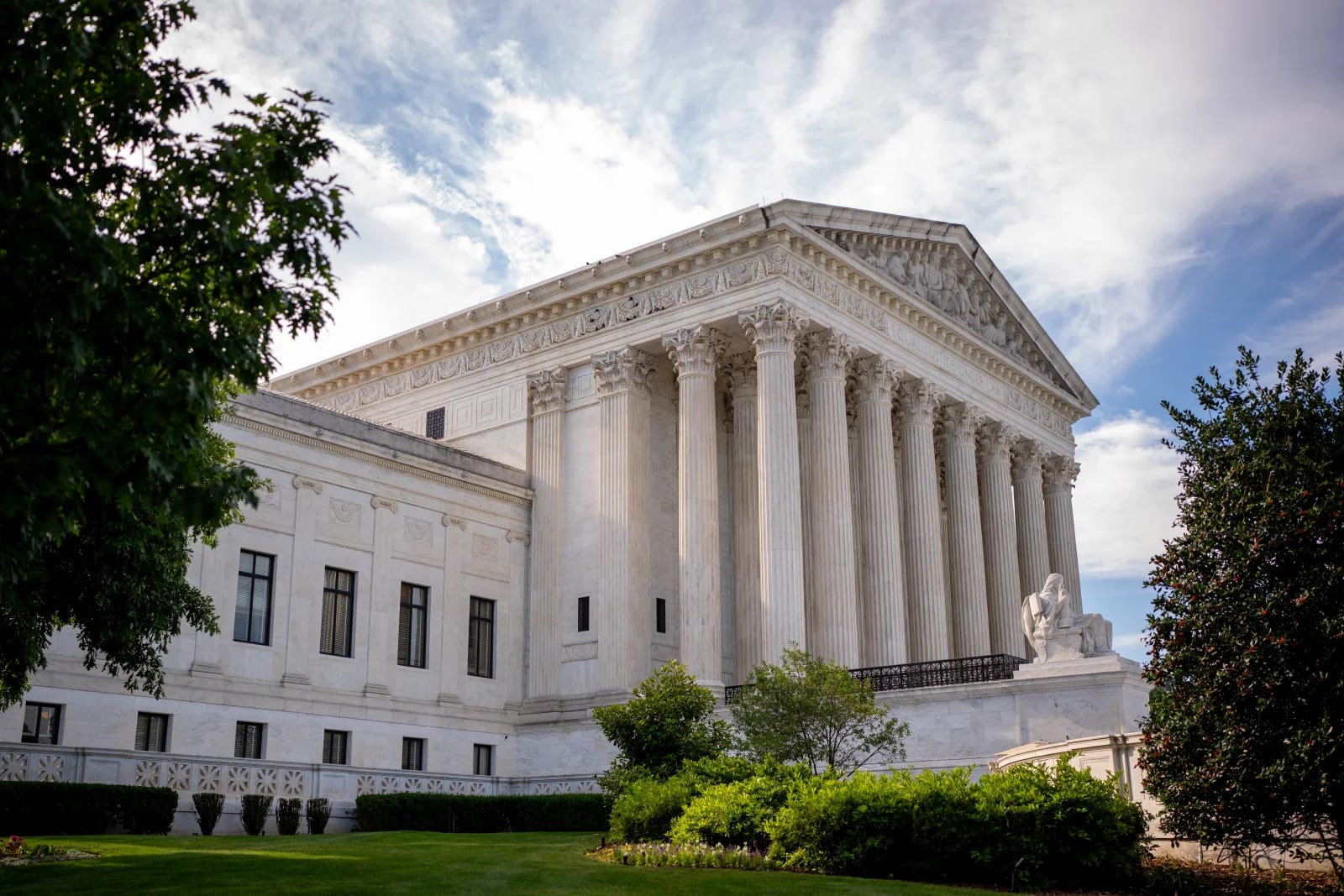
Section 2 of the VRA effectively bans voting rules or political maps that result in racial discrimination, even if no one can prove racist intent. The case, Louisiana v. Callais, is about Louisiana’s map for federal congressional districts. After the 2020 census, Louisiana’s legislature initially enacted a map with only one majority-Black district out of six, despite Black residents comprising roughly one-third of the state’s population.
A court found that map likely violated the VRA by failing to include a second majority-Black district, so it ordered that the map be redrawn in 2024 to add another. The state then redrew the map to include a second majority-Black district, to prevent a court from imposing its own map. Members of its legislature said they also wanted to protect the seats of multiple prominent members of Congress from Louisiana, like Speaker of the House Mike Johnson. In response, a group of non-Black voters challenged the new map, saying adding another Black district was also a racial gerrymander.
In a 6–3 decision in Louisiana v. Callais, the Court split along ideological lines. Writing for the majority, Justice Samuel Alito wrote the newly-created district was an illegal racial gerrymander because that the VRA never required Louisiana to create a second majority-Black district in the first place, so the state had no legally justifiable reason to use race in creating the new map. Justice Clarence Thomas, joined by Justice Neil Gorsuch, added that the “Court should never have interpreted [Section 2] of the Voting Rights Act of 1965 to effectively give racial groups ‘an entitlement to roughly proportional representation.’”
The majority held that, going forward, unless plaintiffs can prove lawmakers acted with discriminatory intent when creating a district map, the VRA doesn’t justify the creation of a new, race-conscious map as a remedy.
Justices Kagan, Sotomayor, and Jackson dissented sharply, saying the majority decision effectively guts the protections of the VRA against racial vote dilution without openly admitting it.
TPS for Haitians, Syrian Nationals
The Supreme Court today appeared split over whether the Trump administration can immediately strip humanitarian protections from hundreds of thousands of Haitians and Syrians living legally in the US under Temporary Protected Status (TPS), a program Congress created in 1990 for migrants from designated countries hit by war or disaster.
The two cases — Trump v. Miot for Haitians and Mullin v. Doe for Syrians — concern about 350,000 Haitians and 6,000 Syrians with TPS. Haiti was first designated after the 2010 earthquake, Syria after its civil war began in 2012. The administration moved last year to end both designations, arguing conditions had improved.
Federal judges in New York and Washington blocked the terminations, finding officials had failed to consult adequately with the State Department and other agencies — a step the TPS statute requires before a designation can end. The State Department still has Level 4 “do not travel” advisories on both countries, citing ongoing violence.
During oral argument, conservative justices seemed skeptical of whether the TPS statute allows courts to review countries’ designations at all.
The statute bars judicial review of a “determination” to designate or end the program, and several justices appeared inclined to read that ban broadly. “If we apply ordinary meaning of that term here, I really don’t understand how you can prevail,” Justice Samuel Alito told the lawyer for the Syrian plaintiffs. The plaintiffs’ lawyers argued that even if the final TPS decision is unreviewable, the process leading to it must be subject to review, and that in this case officials skipped the consultation with other federal agencies that the law requires.
The three liberal justices focused on whether Trump’s past comments about Haitians — calling Haiti a “sh**hole country” and falsely claiming Haitians in Springfield, OH, ate neighbors’ pets — show the decision was racially motivated.
Courts could send the administration back to redo its review — fix the consultation, document the country conditions — after which it would be free to end the program again based on a cleaner record.
A ruling, expected by early July, could also affect more than a million people from other TPS countries the administration is trying to remove from the program.
Justices Weigh Fate of Cancer Lawsuits
Yesterday, the Supreme Court heard oral arguments in a case that will decide whether tens of thousands of cancer lawsuits about Roundup — the weedkiller now owned by Bayer — can move forward.
The case, Monsanto Company v. Durnell, centers on claims by users who developed non-Hodgkin lymphoma after exposure to Roundup. The litigation surged after the World Health Organization’s International Agency for Research on Cancer classified glyphosate, the herbicide’s key ingredient, as “probably carcinogenic to humans” in 2015, though the Environmental Protection Agency disagreed with that finding in 2017. More than 100,000 lawsuits have been filed.
Plaintiff John Durnell, a Missouri resident, won $1.25 million in state court after a jury found Monsanto failed to warn him of cancer risks by noting them on the Roundup label. Bayer (which bought Monsanto in 2018) took the case to the Supreme Court.
The company has argued that plaintiffs like Durnell shouldn’t be allowed to sue for failure to warn because the EPA has sole legal authority over pesticide labeling and the agency approved Roundup’s label without a cancer warning. Bayer says that because states aren’t allowed to impose label requirements beyond what the EPA requires, state lawsuits for failure to warn shouldn’t be permitted. The Trump administration backs Bayer’s view.
Justices Kavanaugh and Kagan worried that letting juries in different states impose their own warning requirements would defeat the nationwide uniformity that federal regulations are meant to create. Chief Justice Roberts and Justices Gorsuch and Jackson focused on a different problem: the EPA reviews pesticide labels only about every 15 years. Jackson said science can shift significantly in that gap, and Roberts asked what states are supposed to do if evidence of harm emerges before the EPA updates its regulations.
Durnell’s lawyer faced notably fewer questions than Bayer’s. A ruling is expected by early July.
Newsbreak
The Great Divide is a beautifully written historical novel that sheds light on a fascinating period: the building of the Panama Canal. In this deeply-researched and evocative story, author Cristina Henriquez explores the lives of the people who built the canal and those who lived in the surrounding communities where lives and landscapes were disrupted. Through the intersecting lives of activists, fishmongers, laborers, journalists, neighbors, doctors, and soothsayers, The Great Divide highlights those rarely acknowledged by history even as they carved out its course.
Falun Gong and the Supreme Court
The Supreme Court held a hearing yesterday on a lawsuit accusing Cisco Systems of helping China build the surveillance system allegedly used to track and torture practitioners of Falun Gong — a religious movement that began in China in the 1990s.
The case, Cisco Systems v. Doe, turns on the Alien Tort Statute, a 1789 law that lets foreigners sue in US courts for serious violations of international law, such as torture, genocide, and slavery. The plaintiffs — Chinese nationals and one US citizen — say Cisco designed and maintained the “Golden Shield,” the system Chinese authorities used to identify them as Falun Gong followers, after which they were allegedly detained, beaten, tortured, or forced into labor. The plaintiffs argue Cisco can be sued for aiding and abetting those abuses. Cisco, a California-based company, says the 1789 statute does not allow suits against companies for helping a foreign government commit abuses — only against those who commit them directly. Letting courts apply in that “aiding and abetting” theory, Cisco’s lawyer argued, is a job for Congress, not the courts.
Several conservative justices signaled concern about judicial overreach. Brett Kavanaugh said it’s not the role of the courts to decide when foreign-conduct suits belong in US courtrooms. Neil Gorsuch suggested that the plaintiffs should ask Congress to pass a law that expressly allows suits like theirs, since the claims under Alien Tort Statute are rarely successful.
A decision is expected by late June or early July.
President Trump on US Passports
The State Department is close to finalizing a new design for US passports that would put President Trump’s photo and signature on the inside cover to mark the 250th anniversary of American independence next July.
The inside cover will feature a Trump portrait superimposed over the Declaration of Independence, with Trump’s signature in gold. The back cover will carry a detail from John Trumbull’s painting Declaration of Independence.
The redesigned passports are the latest in a string of moves placing Trump’s name or image on official symbols: his signature is set to appear on future US currency; the US Institute of Peace and the John F. Kennedy Center for the Performing Arts have been renamed for him; the Navy is developing a new “Trump class” of warships; and the administration has launched a prescription-drug website, TrumpRx.gov.
Appeals Court Blocks ICE Policy
A federal appeals court ruled yesterday that ICE cannot jail immigrants without giving them a chance to seek bond, calling ICE’s policy “the broadest mass-detention-without-bond mandate” in US history. A bond is typically a financial guarantee, often called a judicial bond, posted to ensure a person fulfills court-ordered obligations such as appearing at hearings, complying with rulings, or paying judgments.
Under the policy, which ICE began enforcing last summer, the Department of Homeland Security has denied bond hearings to immigrants arrested anywhere in the country, including longtime US residents with no criminal record. That breaks with prior administrations, which generally reserved mandatory detention for people just arriving at the border and let others request a bond hearing while their immigration cases proceeded. Judges often granted bond to those deemed not to be flight risks.
The Second Circuit Court of Appeals, based in New York, ruled 3–0 that ICE’s policy rests on a flawed reading of decades-old immigration laws. It is the first appellate ruling against the administration’s position, though district judges across the country have already found the policy illegal and unconstitutional. Two other appeals courts — the Fifth Circuit and the Eighth Circuit — have ruled in favor of the policy.
The conflicting rulings mean the issue will likely end up at the Supreme Court.
Florida House Passes Map That Could Add Four GOP Seats
Florida’s Republican-controlled legislature passed a new congressional map that could hand Republicans four additional US House seats. Gov. Ron DeSantis will now sign the new map into law.
Florida is the latest front in a national redistricting fight that started last July, when Trump asked Texas Republicans to redraw their map to favor the GOP. California and Virginia have moved in the opposite direction, advancing changes that could benefit Democrats.


