

The Boys Are Being Radicalized
There’s a far-right recruitment tool running on your kid’s phone

Early in Louis Theroux’s new Netflix documentary, Inside the Manosphere, the journalist stands across from Myron Gaines, host of the Fresh and Fit podcast, and asks him plainly, “Are you a misogynist?”
Gaines stays calm and rejects the label: “No, because misogyny would be the hatred of women,” he explains. “I love women and actually understand them. So, since I understand them, I know what’s best for them.”
Moments earlier, the film had cut to a clip from one of Gaines’s livestream podcast episodes. Speaking about men in relationships, Gaines coaches them on how they can speak to their female partners: “B***h, we are not equal. I’m the dictator, you are the subordinate. And I dictate when I want to put d**k in you, b***h. And then you dictate when the sandwiches come by my dictation. That’s how this goes.”
If that language shocks you, if it reads like something from the furthest corners of the internet that you would never visit, then you need to know that the middle- and high-school-aged boys in your life may be hearing it every day. These messages are tucked between gym-motivation clips and dangerous prank videos in the personalized “For You” feeds that apps like TikTok serve to viewers. It’s the background noise of adolescent male life in 2026.

It’s easy to think the danger lies in a few outrageous creators, or to blame the boys who watch them and the parents who “failed” to stop it. But the real story is bigger: political leaders, tech platforms, and their recommendation algorithms have built an ecosystem that profits from radicalizing young men and then pretends what’s happening is the result of individuals’ choices.
Theroux has spent decades covering stories that make the average person extremely uncomfortable. He’s embedded with white supremacists, sat with convicted predators, and charmed his way into a cult. So when he calls the manosphere “the final boss subject in the video game of my career,” that’s worth listening to.
What is the manosphere?
The manosphere is a loose network of male-centered online communities. Debbie Ging and other researchers emphasize that these spaces include subcultures like incels (self‑described “involuntary celibates,” or young men who bond over blaming women for their lack of sexual experience), “men going their own way” (young men who have decided to withdraw from relationships with women altogether), pick‑up artists, and men’s rights activists. A shared grievance unites them: the idea that feminism has given women too much power at men’s expense.
The most visible faces of this world include Andrew Tate, a self‑described misogynist currently facing human trafficking and rape charges in Romania and the UK, and Myron Gaines, the aforementioned Fresh and Fit host who told men to be “dictators” in relationships. But the infrastructure runs deeper than just these men.
There are also meme tools like the “Female Delusion Calculator,” a website that invites women to input physical and financial preferences for a partner, and then labels them on a spectrum from “easy to please” to “aspiring cat lady.” Although the site’s About page claims it is a tool to “help women discern what is realistic from what is highly unlikely,” in practice it has become a staple of manosphere content, where male creators plug in women’s stated preferences and then broadcast the results as “proof” that they are delusional and need to lower their standards.
If the manosphere is telling boys a grand story about society’s decline, it also gives them a villain — and it’s not just women. While many influencers argue that women can be a problem, they say it’s only because shadowy forces have tricked women into abandoning their “natural” role of submission under male control.
The lens zooms out: ordinary life is recast as The Matrix, a rigged simulation designed to keep men weak and lied to. Content creators pitch their content as the red pill that lets boys “wake up” and see how things really work, much as Keanu Reeves’s character does in the movie. Once you wake up, you see that feminism, mainstream media, and basic democratic norms are just the tools of control.

Who is actually in control? Well, this is where antisemitic talking points about shadowy Jewish elites seep in, and talk of The Matrix blurs into talk of satanic or globalist cabals secretly running everything. In Theroux’s film, when he asks streamer Ed Matthews who he thinks controls the world, Matthews answers plainly and in earnest: “The Jews.” HSTikkyTokky, one of the main subjects of the documentary, loudly starts a chant in public: “F**k the Jews! F**k the Jews!” He then tells Theroux, “You’re a puppet, you can’t say what you want to say… I’m real. I’m raw. I’m not a puppet; no one is controlling what I say. No one’s my daddy… The Jews are your daddy.”
For boys watching, influencers’ conspiratorial and transgressive commentary models a way of feeling powerful, by imagining yourself as the only one brave enough to say what’s “really” going on. Real men are the ones who have taken the red pill. That worldview doesn’t stop at the edge of the internet.
Cozying up to power
The manosphere has walked into the White House.
In March 2026, Donald Trump appointed Nick Adams, an Australian-born self-described “wildly successful alpha male” influencer with a history of Islamophobic commentary and fabricated social media vignettes (like a viral tale in which two “attractive Latinas” spot him at the gym, praise Trump’s border policies, and cheer him on while he hits a personal-record bench press) as special presidential envoy for tourism, exceptionalism and American values.
Adams built his brand by posting lines like “I go to Hooters. I eat rare steaks. I lift extremely heavy weights. I read the Bible every night. I am pursued by copious amounts of women.” Trump wrote the foreword to his book Alpha Kings, which promises to show young American men “what it means to be a true alpha male in today’s hyper-feminized world.”
Adams is not an outlier in Trump’s orbit. Defense Secretary Pete Hegseth has repeatedly argued that women do not belong in combat roles and has portrayed efforts to make the military more inclusive of women as a kind of social experiment that undermines effectiveness, signaling to young men that equality itself is a national security threat.
Trump acolyte and former leader of the Department of Government Efficiency Elon Musk has been sued for engaging in sexual harassment at his company SpaceX (though he has denied the allegations), and currently presides over X (formerly Twitter), where independent researchers have reported increases in misogynistic, extremist, and conspiratorial content since he took the helm of the company. Trump’s appointments of men like these are a signal that the president himself has aligned himself with the manosphere — in fact, he might be considered one of its biggest influencers.
In the 2016 “Access Hollywood” tape, Trump boasted about his approach to women: “I just start kissing them. It’s like a magnet. Just kiss. I don’t even wait. And when you’re a star, they let you do it. You can do anything. Grab them by the p***y.” It sounds like a Fresh and Fit livestream.
Over the course of his public life, he’s faced 26 sexual misconduct allegations, was found liable for sexual abuse in a civil trial, and still won two presidential elections. If the manosphere teaches boys that powerful men face no consequences for how they treat women, Trump is living proof. And growing young male allegiance to him has shown up in electoral politics: according to PBS NewsHour, young men shifted roughly 15 points to the right between 2020 and 2024.

Researchers noted that within hours of Trump’s 2024 electoral victory being called, social media was flooded with celebratory misogynistic posts, with figures like white nationalist Nick Fuentes posting, “Your body, my choice. Forever.” Signs reading “Women Are Property” appeared on a Texas university campus. A widely circulated TikTok reported that schoolboys were repeating Fuentes’s slogan directly to female classmates. The pipeline from manosphere content to electoral politics to classroom harassment ran in a single unbroken line. We’ve seen this pattern before. When leaders wink at or reward this kind of aggression, it hardens into a movement with real‑world enforcers.
An army of disaffected young men
Fascist movements have always known what to do with disoriented young men. Historians of Mussolini’s Blackshirts and the Nazi’s Brownshirts note that these paramilitary formations drew heavily on war veterans, unemployed youth, and men who felt humiliated by economic collapse and political instability. In Italy, the regime drilled boys in a cult of virility — lauding those who were “young, strong, obedient, sacrificial, and heroic” — and turned Blackshirt violence against socialists, trade unionists, and other designated enemies into public spectacle.
The squads thought of themselves as cleaners-up of degeneracy, street enforcers of moral order, defenders of women and children against lurking predators and corrupt elites. At the core of these movements was a deep‑rooted misogyny: historic fascist parties in Italy and Germany insisted that women’s “proper” role was to stay home, have children, and produce future soldiers for the nation. In far‑right rhetoric since, left-leaning policies and movements are often mocked as a “nanny state” that pampers citizens instead of letting “real men” stand on their own.
Those movements also had men in suits who found them useful. Mainstream conservative parties in Germany and Italy tried to harness fascist energy to break trade unions and smash socialist and communist parties to restore a more authoritarian order without having to dirty their own hands. They backed Mussolini and Hitler, believing they could “frame” and control them, using Blackshirts and Brownshirts as a disposable muscle to discipline the left and intimidate voters, then swapping the dictators out once the job was done.
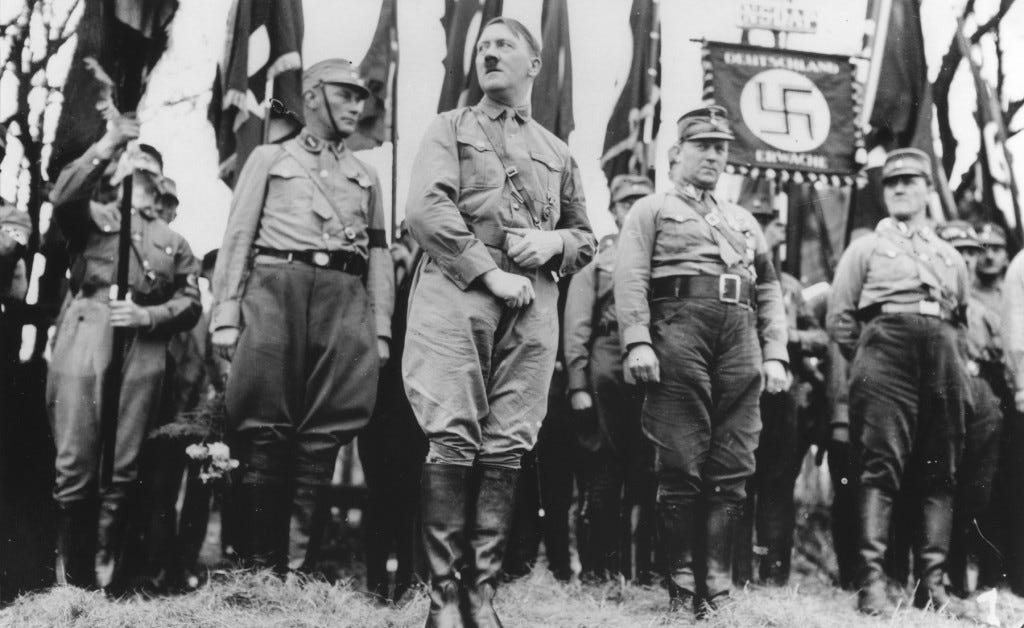
The Brownshirts and Blackshirts consumed them instead, helping to dismantle parliaments, outlaw opposition parties, and sideline or even imprison some of the very elites who had first opened the door. The people who recognized the danger earliest were the ones the movement was already targeting: women, Jewish communities, labor organizers, and minorities. We are watching the same dynamic in the US, and the manosphere’s most important recruiter is the one sitting in the Oval Office.
Who’s actually sounding the alarm
Research shows that if a 16-year-old opens TikTok and searches for gym tips before school, within his first 23 minutes of scrolling, he’s been served toxic content: clips pushing rigid, dominance‑focused masculinity, degrading or dehumanizing women, promoting far‑right or anti‑LGBTQ views, or amplifying conspiracies about things like globalism or a plot to silence Andrew Tate. Within 26 minutes, manosphere content will show up.
In high schools, 76% of teachers are already extremely concerned about how this content is shaping the young men in their classes. And this isn’t just an American problem. Studies and educators from the UK to Australia describe the manosphere as a global, algorithm‑driven ecosystem. One British schoolteacher reported hearing a student say it was “ok to hurt women because Andrew Tate does it.”
According to security strategist Cecilia Polizzi, writing for the Global Network on Extremism and Technology, algorithms reward engagement over nuance and amplify outrage, fear, and treat polarizing content as a structural feature. Platforms are designed to profit from this pipeline. The moral panic about individual “bad boys” and broken homes, the idea that this is just a problem of a few damaged kids or inattentive parents, is a distraction they don’t mind at all. It keeps attention on supposedly defective families instead of on the platforms, business models, and political actors that are deliberately engineering this ecosystem for profit and power.
This can’t be solved with a list of conversation starters for concerned parents. Structural problems require structural solutions. In Europe, the Digital Services Act now forces the biggest platforms to assess how their algorithms fuel systemic risks like gender‑based violence and extremism, and to open up their recommender systems to outside scrutiny.
In the US, California’s Age‑Appropriate Design Code pushes companies to prioritize children’s safety over engagement metrics in any service likely to be used by under‑18s, including by limiting data‑driven features that amplify harmful content. Outside of government, organizations like the Global Network on Extremism and Technology are mapping how manosphere content reaches boys in minutes and calling for targeted de‑amplification of extremist networks, data access for researchers, and real penalties when platforms ignore these risks.
Manosphere radicalization is a youth-focused, male-centered, fascist recruitment pipeline, and it’s running right now on your kids’ phones. Combating it will require monitoring, research funding, and platform accountability. The question Inside the Manosphere leaves open is this: If we already know what this looks like, and we can see it scaling in real time, at what point do we start calling it what it is and treating it as such?
 | A guest post by
|
There are a lot of moving parts here. And I’m not going to pretend to address everything in a comment. But here’s a start.As a former educator, this brings to mind how many young girls and women I’ve met who suffered from massive insecurity. Some of this insecurity is just part of growing up. Healthy women and girls will reject this sick ideology. Teach your girls well. Call this out for what it is. Shine a light on it. Pay attention to what’s going on with the young people in your world. And the adults. It’s not a cliché that healthy people choose healthy people. Working on myself has never been a mistake. There are always going to be men like this in the universe. Unfortunately, we know who the politicians are and this hyper masculinity is very much embedded at the moment. I don’t think it’ll be forever. I know many good men and women. I don’t deny that fundamental changes are being made, but I do have hope that they can be fought. Administrations are temporal.Paying attention is very important. Reading the hard stuff. Having the hard conversations. Staying open is one of my main tools for engagement. This is sickening, of course, along with so many other things, but must not be ignored. Again, teach your girls well. They are on the front lines.
I actually just started watching Inside the Manosphere last night, and although I haven't yet finished it, I was overwhelmed by how much these guys are recognized on the streets and also how much I questioned if some of them actually believe their own BS. I'd be interested to know if they made as much money from saying the opposite, would they flip their scripts?