

Summer Friday: Why Do We Call 911 For Emergencies?
How an easy-to-remember code replaced thousands of local numbers

Before 911, America had a very strange expectation of people in crisis: remain calm, diagnose your own emergency, know the correct local seven digit number, and call the right office. The system assumed you could think clearly at the exact moment you were least likely to be able to think clearly.
For something so woven into American life, 911 is surprisingly young — younger than color TV. It arrived after Alaska and Hawaii joined the union in 1959, and after Dr. Martin Luther King Jr.’s “I Have a Dream” speech of 1963.
Life before 911
Before 911, calling for emergency help was a genuine hassle. Until the 1960s, Americans relied on a patchwork of local seven-digit numbers — one for police, another for the fire department, another for an ambulance. You were expected to know them, or to go hunting through a phone book, which is not what you want to be doing when your kitchen is on fire or your uncle just fainted at a barbecue.
The push for something better came from the rising national alarm over crime in the 1960s. In 1967, a major federal panel — the President’s Commission on Law Enforcement and Administration of Justice, appointed by Pres. Lyndon Johnson to study the American justice system from top to bottom — delivered its findings. Tucked into that sweeping report was a simple recommendation: there should be a single number people could call to reach the police, the fire department, or the ambulance in an emergency. The rationale was to save precious minutes hunting for a separate set of 7-digit numbers during an emergency.
The job of actually making that happen fell to the Federal Communications Commission, the agency that regulated the country’s phone lines. In the 1960s, AT&T was a near-monopoly that owned the wires, the switches, and the network itself. So in late 1967, the FCC sat down with AT&T and asked it to find a workable number, fast. AT&T came back with 911. It was short, easy to remember, and — conveniently — had never been used as an area code or local prefix, so it wouldn’t resemble a normal call. Which raises a good question: Why not 111? In those days, telephone switching equipment treated a leading “1” as the signal for a long-distance call, so a number starting with 1 could have confused the system. The 9 wasn’t an accident either — it sat far around the rotary dial, hard to dial by mistake.
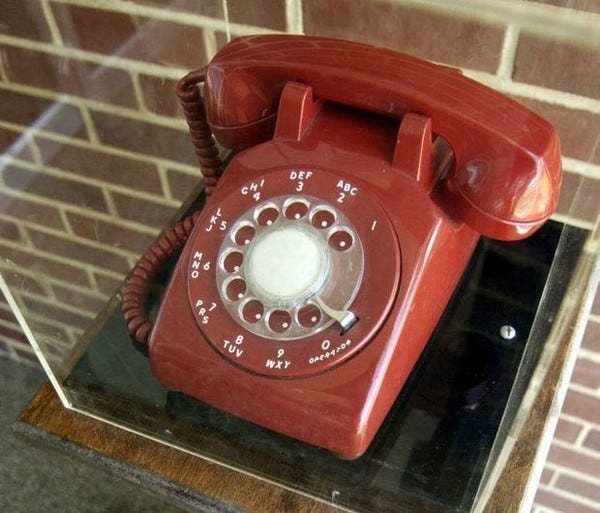
And then there’s the question of who would actually pick up the phone when someone dialed 911. The calls would need to go to a public safety answering point, a call center where dispatchers would receive those calls and route them to the appropriate unit — police, fire, or ambulance services.
A surprisingly slow rollout
The first real 911 call was placed on Feb. 16, 1968, in Haleyville, AL — and it was a small company that beat the telecom giant to the punch. After AT&T announced its national 911 plan, B. W. Gallagher of the small Alabama Telephone Company decided to go there first, wiring up the new phone equipment within a week. The first call ran from the city hall to the police station. Haleyville has been bragging about it ever since: a highway sign reads “Where 911 Began,” and the original red rotary phone sits in a glass case in City Hall.
But despite Alabama’s pioneering system, the rest of the country didn’t start dialing 911 right away. For one primary reason: money. Installing the actual equipment and building the call centers was left to state and local governments, and many smaller or rural areas either couldn’t afford it or decided it wasn’t worth the cost. And the upgraded version — “enhanced” 911, which automatically shows a dispatcher the caller’s number and location — was a separate, pricier add-on.
Congress didn’t formally make 911 the nation’s universal emergency number until 1999. The 911 system had been built for landlines, and the explosion of mobile phones in the late 1990s disrupted that model and forced federal action. The 1999 Wireless Communications and Public Safety Act formally established 911 as the single nationwide emergency number for both landlines and cellphones.
According to the National Emergency Number Association, Americans place an estimated 240 million 911 calls a year — more than 1,200 every minute — and most now come from cellphones rather than landlines. Modern dispatch centers can often locate callers by GPS, and many areas now accept emergency texts — useful when speaking out loud isn’t safe.
As 911 became the number that people associated with needing help, they began to use it for a host of non-emergency problems they were trying to solve. For example, in 2009, a Florida woman named Latreasa Goodman called 911 three times because a McDonald’s had run out of Chicken McNuggets and wouldn’t refund her money. (She later said she was embarrassed by the media attention.)
But here’s the twist that makes those calls worth thinking about. In 2019, a dispatcher in Oregon, OH, took what sounded like another silly one — a woman calmly ordering a pizza. The dispatcher nearly brushed it off, but then Tim Teneyck — on the job for 14 years — realized it was a call for help, according to the Oregon police chief. The woman couldn’t speak freely because her abuser was in the room, and “ordering a pizza” was the only way she could ask for help without tipping him off. Police arrived with their sirens off, and the man was arrested.
It worked because that one dispatcher was paying close attention. After the incident, local dispatchers began to receive training for coded messages and active listening.
Beyond America
The rest of the world has its own share of emergency service numbers, and the sheer variety of them is interesting. In the United Kingdom, the number is 999. It launched in London in June 1937. It came out of tragedy: a 1935 house fire on a London street killed five women, and a government committee concluded Britain needed a single, instantly recognizable number. India now has a single national emergency number like 911. It’s 112, but traditional emergency numbers are still in use: 100 for police, 101 for fire, and 102 or 108 for ambulances. Across the European Union, 112 works as a single continent-wide number.
Huh, you might think: if a leading “1” was such a problem, how do India and much of Europe use 112 today? The “1” trouble was likely a quirk of America’s 1960s telephone equipment, not a universal rule. By the time the EU and India adopted 112 — decades later — phone networks had gone digital, and a leading “1” no longer carried any special meaning.
The numbers differ, but one aspect is universal: When someone is in crisis, somebody picks up the phone. And in the end, that is all that matters.
Very interesting! When I was a child my dad was an ambulance driver on the weekends (in addition to his FT job as a truck driver). I remember the ambulance calls came directly to our home phone number and we could not use our phone during the weekend because he might get a call (call waiting didn’t exist then). Also, the ambulance was parked in front of our house on weekends!
I’m from Cape Cod and we didn’t get 9-1-1 service until the mid to late 90’s. I remember learning the local emergency numbers at school. Also, a fun fact, in Japan the emergency number is 1-1-9