

Learning to Belong on Land That Isn’t Mine
How a historic compromise shaped Alaska’s public waters

There is a river in Alaska whose name I will not share, because that’s how it is with fly anglers, no matter where we’re from — every last one of us has a secret fly-fishing spot we like to think of as “ours.” Mine is not really mine, of course.
The federal government manages the stream’s waters, while the state of Alaska manages the land beneath and surrounding it. Therefore, the setting itself is public and accessible, which is another way of saying that it belongs to everyone. My home state accounts for nearly one-third of all US public lands, and is itself roughly 80% public.
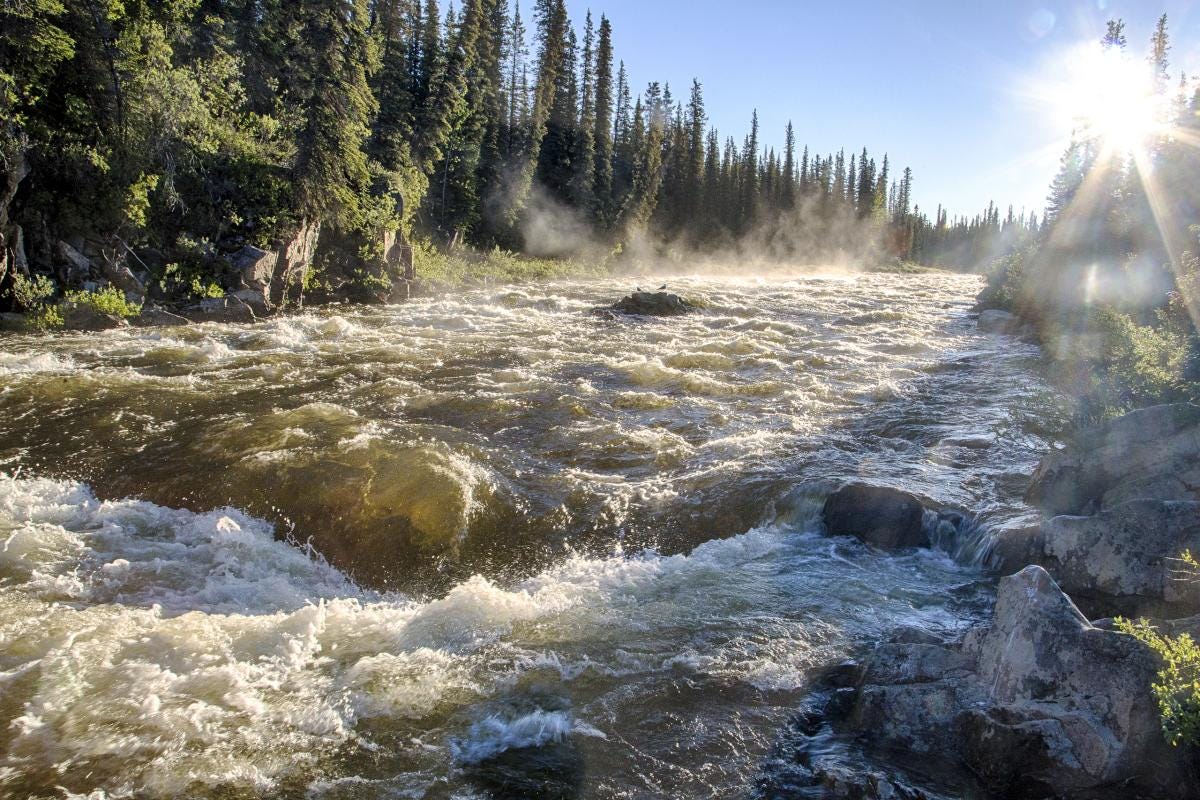
We took a boat there last time. Well, it got us part of the way. Engine roar echoing off canyon walls that gave way to flat riparian zones. My friends Ben and Jeff talked above the din and I stared out the back of the boat, watching backpack straps catch wind. And then we were there, hopping off the front and disappearing into head-high grass. It took me a couple of trips to get used to that.
The place is bear country, where imagined half-ton carnivores lurk behind every wall of green undergrowth that seems to dominate any riverine area south of the Brooks Range. We made plenty of noise when walking those woods. In case the abnormally high volume of our conversations and occasional “Hey, bear!” shouts failed to scare off ursine neighbors, Ben wore a hand cannon over his waders, while Jeff and I carried bear spray.
Before all this talk of bears and boats and wild spaces leaves you constructing some kind of Jeremiah Johnson–esque image of who I am: that isn’t me. I didn’t even fish until a few years ago. My father, a Japanese immigrant, and my American-born mother raised me to assimilate with the mostly blond, blue-collar suburban kids in northern Minnesota. To be an “all-American boy,” as my dad once put it. Then, on March 11, 2011, a 9.2-magnitude earthquake touched off a tsunami that killed my Japanese grandmother and 20,000 others in the Sanriku region of northeast Japan.
The tragedy awoke a desire to understand who I was as a half-Japanese person. Grasping for heritage wherever I could find it, I discovered a centuries-old method of Japanese fly-fishing called tenkara that uses only a rod, a line, and a fly (no reel), and decided it would be the way I would learn to fly-fish in Alaska. Adapting it from its origins on small Japanese mountain streams, I started on local lakes before moving to campground streams, and finally to wilder waters like the creek I found myself considering after several miles of hiking.
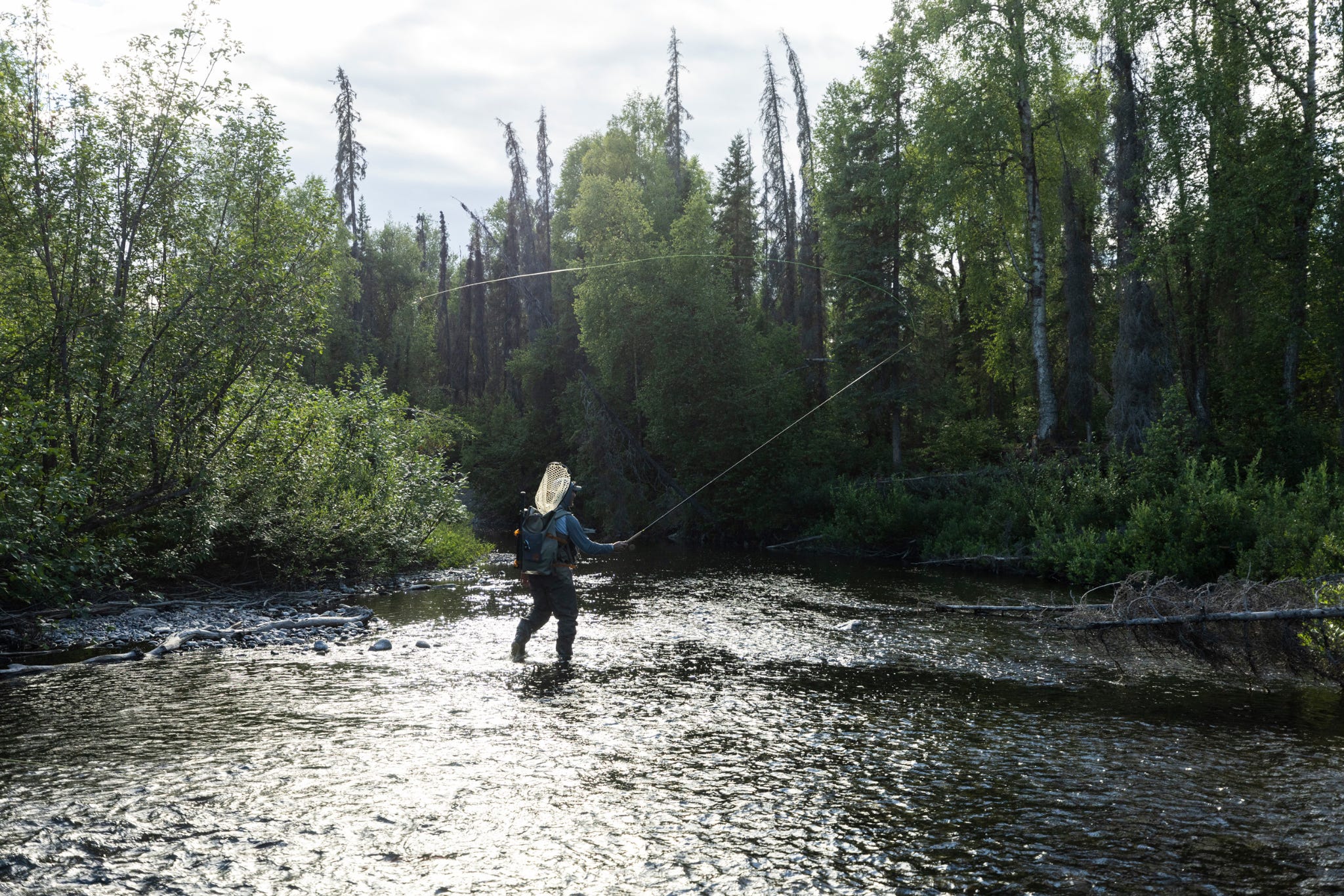
After spraying each other down with a(nother) layer of DEET, we assembled rods and rigs on a gravel bar. There are no fish here, I thought. No shadows darted in the waters, no dorsals cut the surface.
Ben pointed at a hollow spot of bank underneath a tree root, made one cast with a gaudy mash of foam and fur meant to approximate a swimming mouse, and watched as a dark spot of water no bigger than a basketball erupted with predatory vigor. Less than a minute later, he landed 14 inches of Onchorhynchus mykiss (rainbow trout), then released it.
There is an extractive instinct in all of us, the desire to take and take again. Whether fish are taken to sustain a subsistence culture or caught for sport and released, there is an id-based irrational hunger for more, inherent to every Homo sapiens.
And so you fire a cast so that the current brings the fly, which in my case is a pattern called an “egg-sucking leech,” beneath five feet square of alder branches dancing in the top few inches of current. It lands exactly where it should. You maneuver your tenkara rod in such a way as to ensure you achieve the best drift possible, the one that will allow you to twitch your rod tip low and swim the fly in front of the nose of the large trout you’re sure is sucking beneath those branches.
Magic. The fish strikes the fly. You set the hook, electricity coursing up the meager ten feet of line attached to the rod tip that bows and twitches as the fish tries to flee. The fight is on, and you’re breathless. Ben and Jeff shout with glee as you battle the trout across the current. Now it’s come to hand in the calm of an eddy.
You look at this living thing, all green sides, scarlet slashes, and black dots, gills heaving. If you are me, you think, I did this with my Japanese fly rod. In an old way I have made new. And as you release the fish back into its aqueous home, you think, I bet I could catch one or two more out of that same spot.
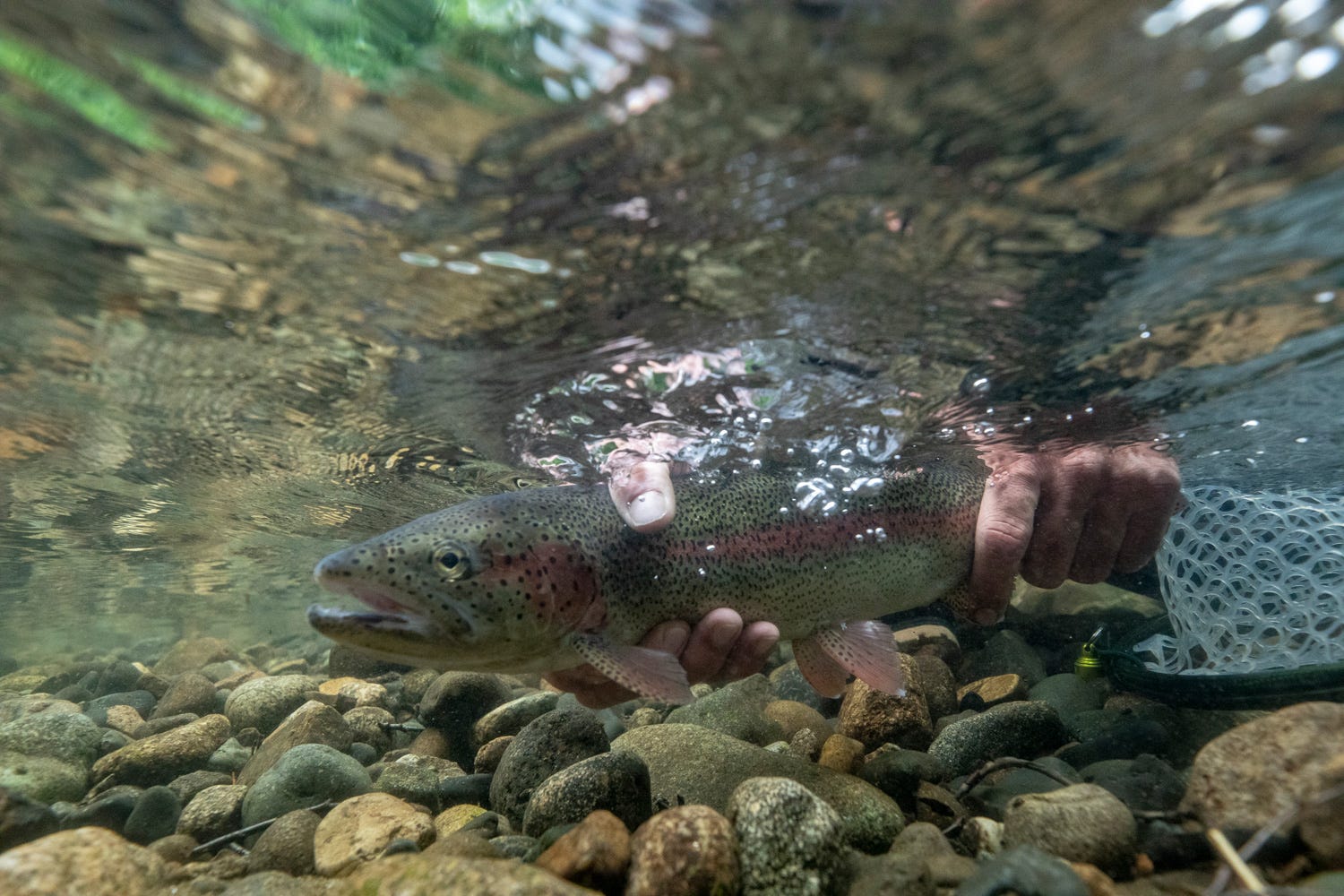
We fished into what passes for summer nightfall in the Land of the Midnight Sun, catching dozens of eager trout, without seeing another soul. And yet around us, the land spoke of an older purpose than sport. Here and there, sometimes hidden in a bramble, other times atop a ridge crest, we found indentations in the land.
Too regular to have been formed by nature, these shallow holes dug by Alaskan Natives once held catches of what was likely the most prized species of salmonid — sockeye or red salmon — until it was time to prepare and preserve the foodstuffs that would sustain a tribe and its subsistence culture. These depressions are the only remaining traces of the indigenous people who once plied the waters. Nature filling them in, bit of detritus by bit. Moss takes root. Green things sprout. Memory rooted in landscape fades.
This is Native land, as the acknowledgement goes, but if you are a non–Native Alaskan bushwacking your way across what you know to be public land in search of catchable fish, you might not grasp what the phrase means in the moment. In 1971, against the backdrop of a more global Indigenous-rights movement, the landmark Alaska Native Claims Settlement Act (ANCSA) recognized 229 Alaska Native tribes and created a new approach to Native Americans and the land taken from them. Instead of establishing reservations, ANCSA and the subsequent 1980 Alaska National Interest Lands Conservation Act (ANILCA) struck a compromise, recognizing the value of public lands as well as their role in sustaining indigenous Alaska culture.
The way that I think about the two bills is admittedly rudimentary. ANCSA extinguished aboriginal title to the entire state but allotted roughly 44 million acres to 25 Native Alaskan corporations. Nine years later, ANILCA carved off an additional 104 million acres of federal conservation lands and recognized the primacy of “customary and traditional” land use by “rural” Alaskans.
The arrangement found middle ground between public, rural, and Native Alaskan subsistence, conservation, and developmental interests. It is imperfect and complex. “Rural” subsistence does not always mean “Native Alaskan” subsistence, and the federal legislation does not always agree with Alaska state law. But I think about it like this: ANCSA and ANILCA made it legal for Alaska Natives to use federally conserved lands for subsistence, and also made it legal for me — a non-Native — to trek across those lands to fly-fish. I am grateful for both opportunities the laws provided.
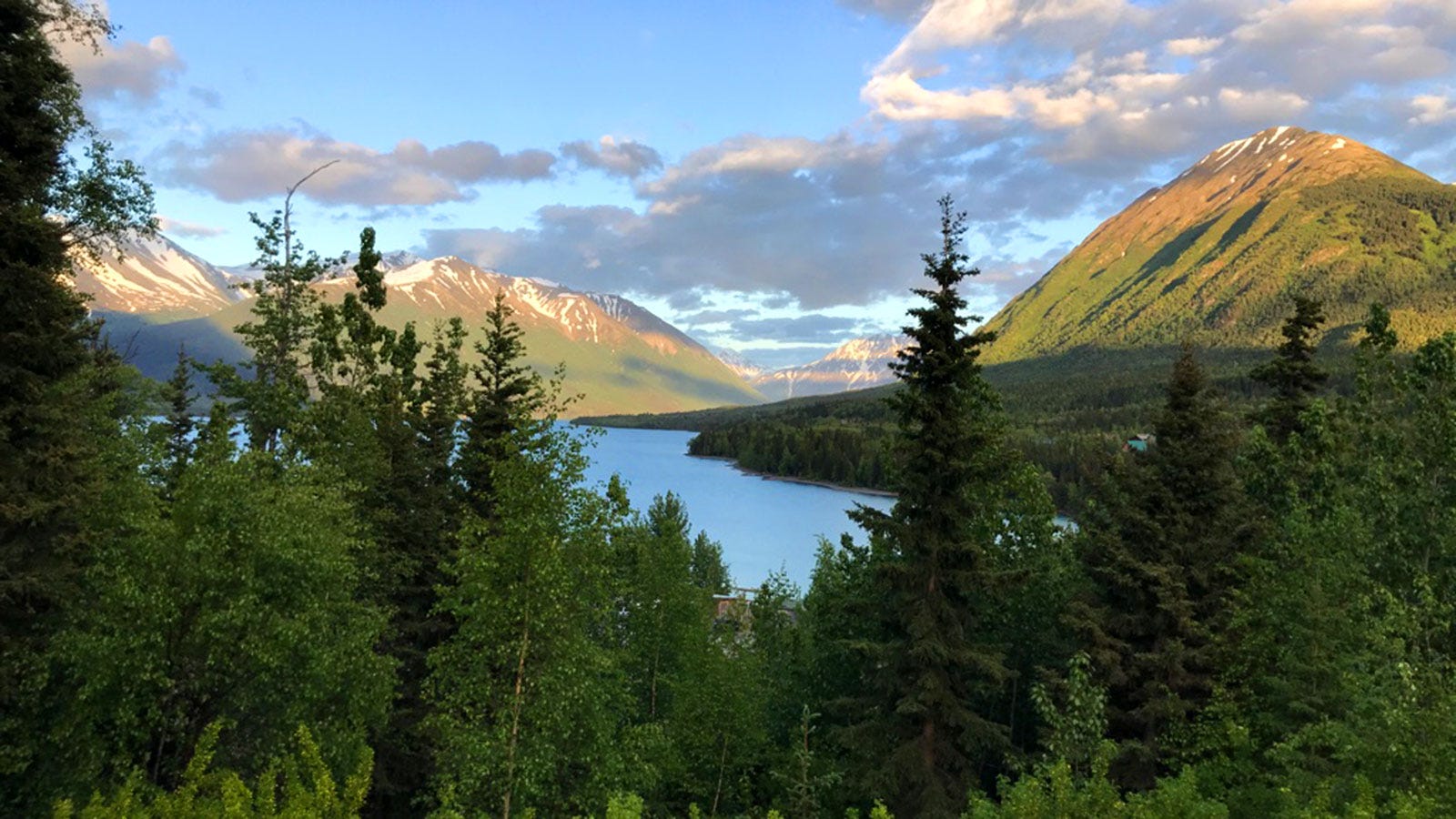
There is a kind of literary chronological fallacy in essays like this. The writer goes into nature for one good thing, discovers another, and within a couple of thousand words leaves better for it. In the case of this piece, a middle-aged male sojourns briefly in nature in pursuit of identity and leaves with a more complex understanding of the lands that provided the chance to do so.
I went fly-fishing in the hopes of building identity. But in doing so, I realized that the opportunity existed only because the lands and waters I walked and fished were publicly accessible — and further came to understand that the laws enabling all of it were deeply rooted in Native Alaskan history.
It has affected the way I fish in Alaska profoundly. I can no longer wet a line without thinking about the Native Alaskan relationship to moving waters, and how in some places — but not all — we are all fortunate that fishing and other customary uses since time immemorial have a chance to continue.
Which is to say that none of this was on my mind as Jeff, Ben, and I pulled an insulated bag of ice from where we’d stashed it in the stream near our camp. Footsore, muscles aching from miles of hiking and slippery wades, yet beaming with the joy of the day. Already spinning yarns of the one that got away (always the biggest fish), still feeling the power of a fish-bent rod, the scent of a handled trout still fresh on our skin. We turned on our thermal mosquito repellents, boiled water to rehydrate our backpacking meals, and divvied out the few ice cubes that remained to cool a pour from the bottle of Japanese whisky we’d hiked in.
We dangled our feet off a rise overlooking the river and told ourselves stories from the day. Whisky and fresh air made the bad food good. The sun arced somewhere not far below the horizon, and a few stars may have winked to life in the eastern sky. We toasted the river and what it sustained. And as we stumbled to our sleeping bags, we agreed that the next day, fishing a little less seemed like the right thing to do.
 | A guest post by
|
Thank you for setting the stage so beautifully! Great storytelling and such a great reminder to be mindful and to share💓. The world should revolve around moments, experiences and joy with nature, community and appreciation for heritage and culture, instead of being consumed by ownership and greed. Of course I’m sorry you lost your grandmother that way, but I am so happy for you that you found your connection ❣️
Matthew, terrific piece. My condolences on the loss of your grandmother ❤️