


Last week, the president signed an unprecedented executive order declaring the administration’s intention to massively overhaul the vaccine schedule for children in the United States.
Entitled “Delivering Gold Standard Childhood Vaccine Recommendations for Americans,” the order wades directly into matters of medical and scientific policy where the president has little legal power and even less expertise. The changes that were ordered were grounded in misinformation. During a press conference for the executive order, the president called an important vaccine for measles, mumps, and rubella “quite lethal.” When a reporter asked him if there was any evidence for his claim, President Trump said, “No. What I’ve heard is that there are some people that say it is that way.”
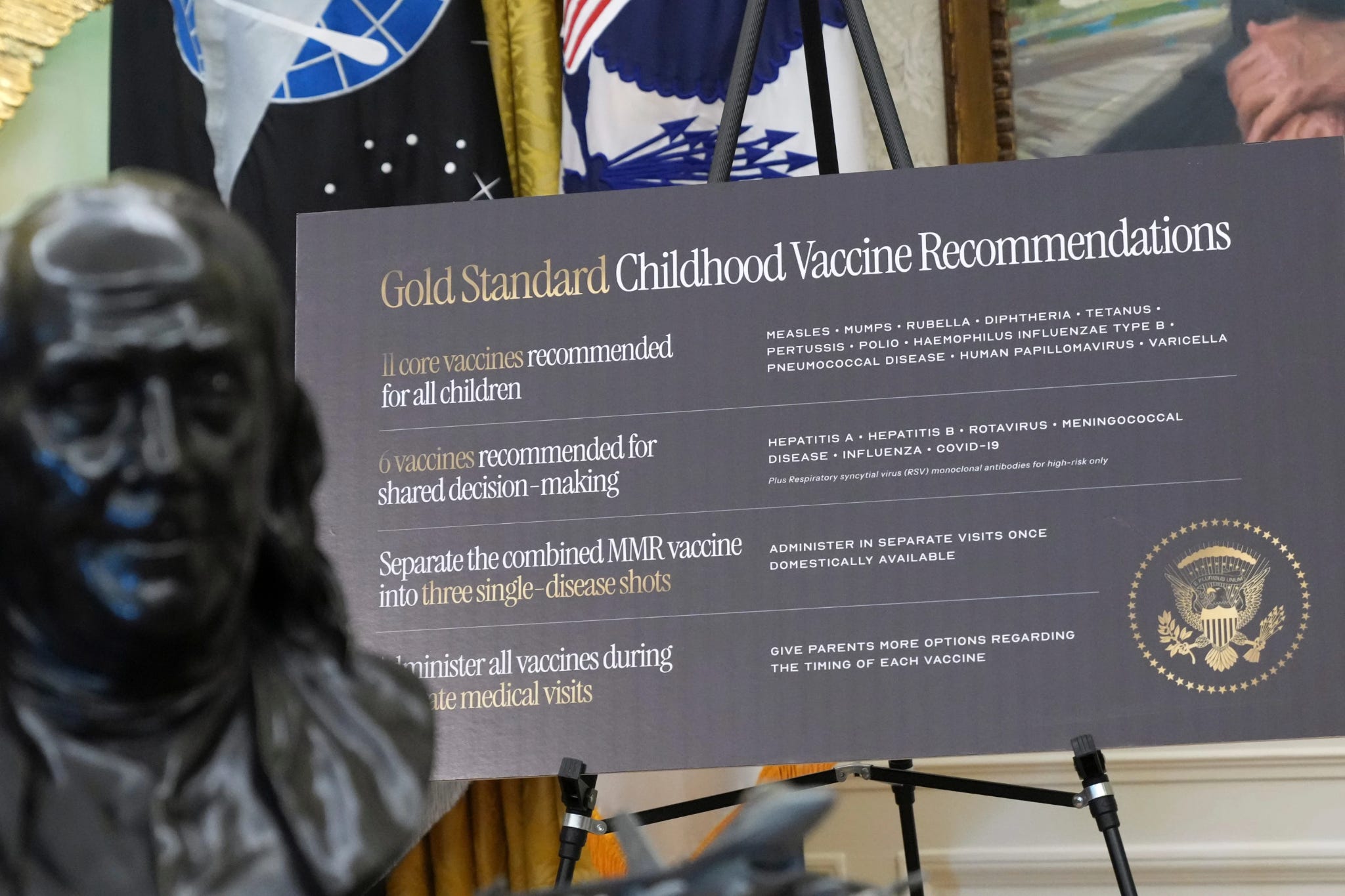
Among other things, the order compels the Health and Human Services (HHS) Secretary Robert F. Kennedy Jr. to direct his recently revived Task Force on Safer Childhood Vaccines to provide recommendations to the president on a range of issues, including potential changes to the timing and sequencing of childhood vaccines, safety monitoring, transparency, research, the development of alternative vaccine components to stimulate the immune responses that make them effective, and more.
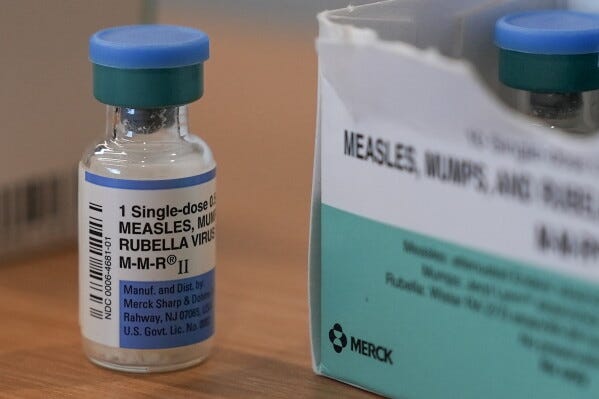
Perhaps the most problematic element of the order is Trump’s direction for providers to administer single dose (or “monovalent”) vaccines for measles, mumps, and rubella, as opposed to combination MMR vaccines.
Monovalent (or separated) vaccines for measles, mumps and rubella don’t exist. They haven’t existed since the 1970s, and the reality is, they are likely never going to be made by the manufacturers or licensed by the FDA as separate doses, ever. The MMR vaccine was specifically tested to determine if a combination dose could and should be administered to protect against three diseases in just two doses, instead of six. The data were abundantly clear: combining the doses did not compromise the vaccine’s safety or efficacy. In fact, the combined approach proved to be quite valuable. Think about it: that’s fewer injections, fewer appointments, fewer opportunities for adverse reactions (even mild ones like fever), fewer co-pays, and fewer missed work or school days — the MMR is a win-win for children and their caregivers.
Apart from the safety and efficacy data, the logistics further make Trump’s directive a nonstarter: while officials were given 90 days to develop a plan to break up the MMR vaccine, in reality the process would take no less than 10 years and tens of millions of dollars for new studies and manufacturing facilities. As such, the manufacturers of the MMR vaccine have already responded saying they are uninterested in relitigating the science and stand behind the safety and effectiveness of their products.
The order also directs the US Attorney General to “take appropriate measures” against states with laws that can be perceived as “conflicting with parental authority” — in other words, punish states that have strict laws against religious and medical vaccine exemptions.
But while this order makes a lot of demands, there’s not a lot of legal power behind it. Federal vaccine recommendations are not made or changed by the president of the United States, they are made by the Centers for Disease Control and Prevention (CDC) after a rigorous scientific review from the Advisory Committee on Immunization Practices (ACIP).
Unfortunately, the US does not currently have an active ACIP because the previous members were improperly replaced during RFK Jr’s attempt to overhaul the vaccine schedule last year, and a federal judge then disbanded the improperly appointed committee. But the absence of the actual authority on these issues does not mean the powers suddenly belong to the president.
Interestingly, this order does not represent the general population’s views on childhood vaccines. In fact, new polling data shows that voters strongly oppose this order.
Even if the executive order has little legal force or public support behind it, it doesn’t mean the president can’t do real harm when it comes to vaccines. During the signing ceremony for the order, Trump and one of his top advisors, Stephen Miller, made a number of dangerous and unscientific claims. It’s worth taking the time to fact check some of them:
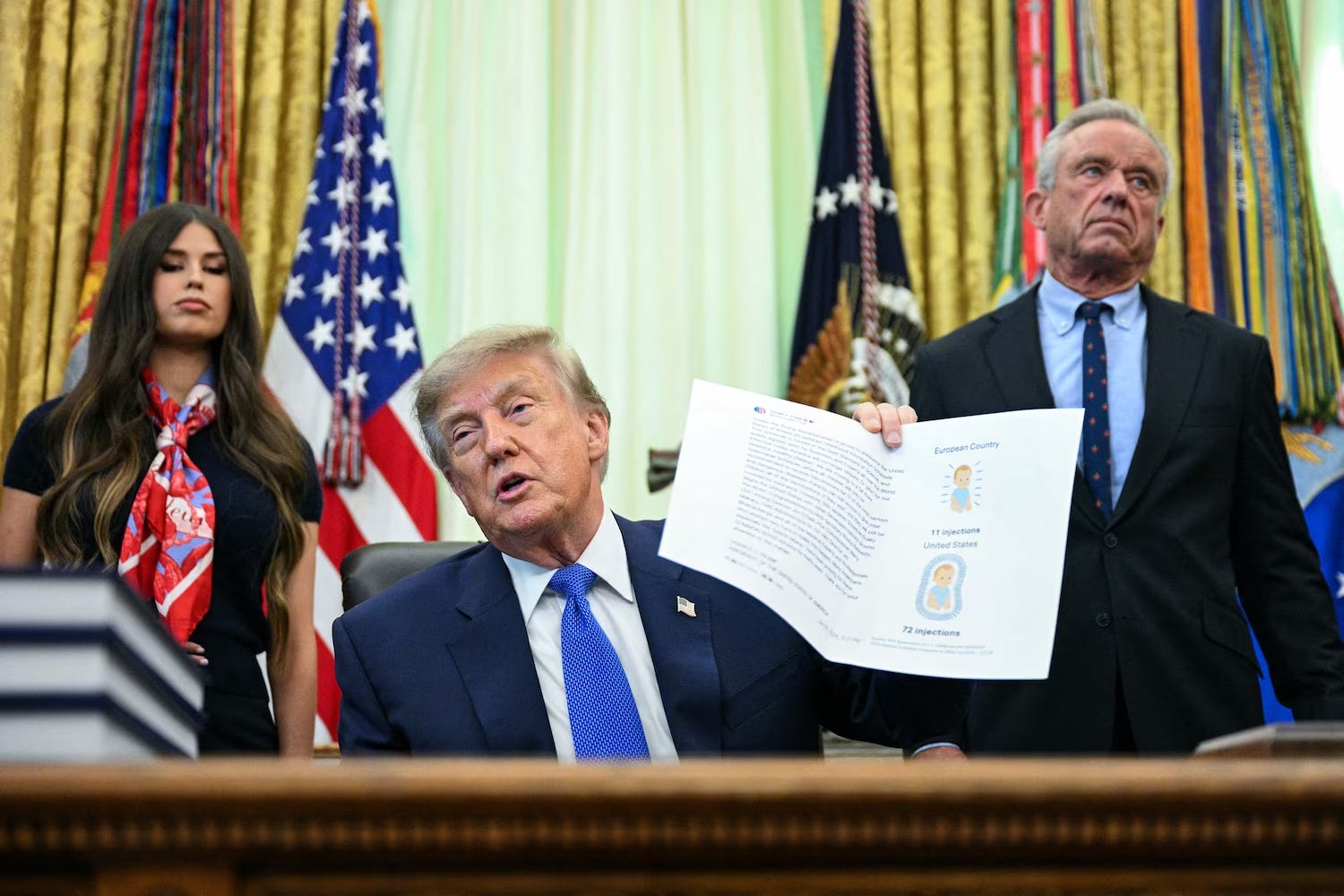
Claim 1: The United States requires “72 jabs” for children.
Trump held up a graphic illustrating this claim during the signing:
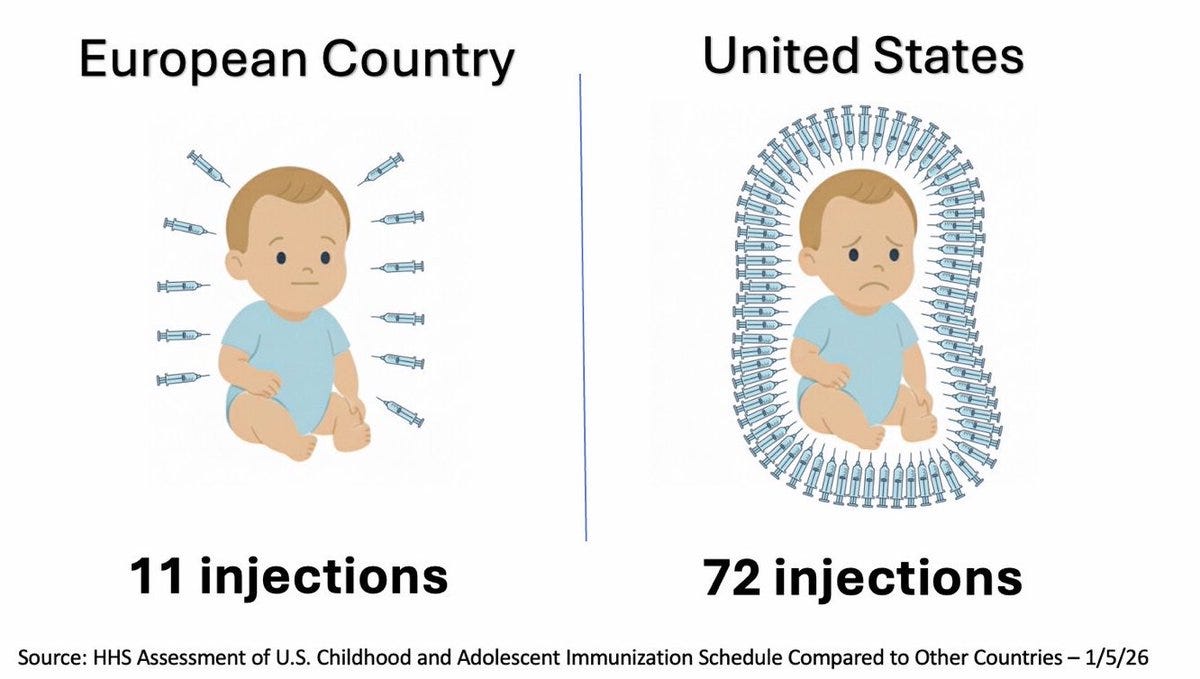
There are many things wrong with this image, but I’ll keep the list short and sweet:
There are 44 countries in Europe. No two European countries have the exact same vaccine schedule because every country — in Europe or otherwise — tailors their vaccine schedule based on their own population’s health needs.
The number 11 refers to the number of diseases that children are protected from — not vaccines, and definitely not injections.
The number 72 is just categorically wrong. The only way you could possibly come up with that number is if you count each combination vaccine as separate injections and include 18 years of annual flu and COVID-19 vaccines.
A baby between the ages of 0-6 months would typically get about 12 injections, or 22 by the age of 2. Using an image of a baby surrounded by syringes is intentionally misleading.
Claim 2: Giving the MMR vaccine as a combination vaccine “could be quite lethal.”
In the words of Carl Sagan, “extraordinary claims require extraordinary evidence,” and there is no evidence that the MMR vaccine dosage is lethal, as President Trump acknowledged to a reporter in the Oval Office. As of today, the CDC website refutes that claim and affirms that the MMR combination vaccine is “very safe.” Data consistently show that getting the vaccine for measles is much safer than getting the measles.
Claim 3: The volume of vaccines children receive today is comparable to a “bottle of soda poured into a little child’s body.”
Let’s start by stating the obvious: a typical vaccine dose is around 0.5 milliliters, or 1/10 of a teaspoon. A soda bottle contains 500 milliliters of liquid.
Children in the United States are not getting too many vaccines. Here’s some helpful context on what the vaccine schedule used to look like, and what it looks like today: In the early 1990s, a child in the US was vaccinated against 8 diseases. In those vaccines were thousands of antigens — the components in vaccines that stimulate an immune response. Today, kids are vaccinated against 16-18 diseases, and in all of the combined doses there are fewer than 200 antigens total. That amounts to an over 90% reduction in antigens with double the amount of protection. To be clear, this doesn’t mean that antigens are harmful, or that they are only present in vaccines. Because we don’t live in sterile environments, young kids are exposed to up to 6,000 antigens per day from the dirt, air, toys, and everything else that ends up in their mouths and noses.
Claim 4: On the childhood vaccine schedule, “Nobody had studied it. Nobody’s looked at it. Nobody’s thought about it.”
The childhood vaccine schedule might be one of the most scrutinized and studied sets of medical interventions ever. ACIP advisors pore over vaccine safety and efficacy data for months or years before formal recommendations are presented. The process to develop a vaccine under the strict criteria established by the FDA is long, arduous, and very expensive.
Claim 5: On the prevalence of autism, “It’s many, many times what it used to be years ago, and it gets progressively worse, and we add progressively more and more vaccines.”
Perhaps one of the most studied topics on vaccine safety is the claim that vaccines, particularly the MMR vaccine, cause autism. Dozens of studies involving millions of people have shown that there is no causal connection between vaccines and autism. Despite the current bizarre language on this page of the CDC’s website (see the screenshot below), until this administration the CDC had affirmed the data that show no links between any vaccines and autism.
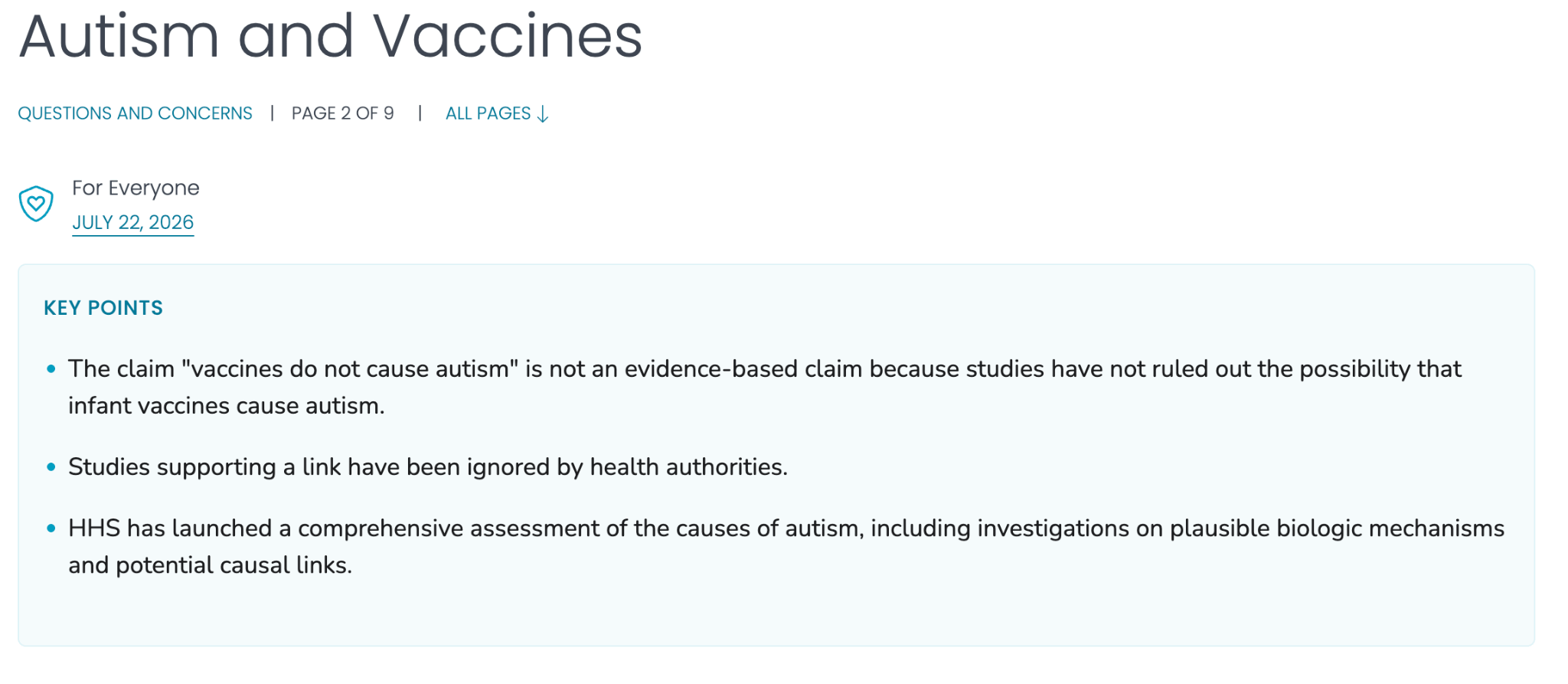
This administration has not provided new evidence to justify their contrarian view, but that’s also because they are playing a semantics game with how studies can even be performed. Researchers don’t conduct studies with the intent to prove a negative, and that’s what a study designed to prove vaccines do not cause autism would do. So to justify the incessant questioning of the science on this issue, RFK Jr. hides behind labels like “gold standard science.”
The reality is, gold standard science does actually exist, but it requires a consideration of the scientific method, bioethics, transparency, reproducibility, and sound methodology. The president’s executive order lacks all of these features.
