

How Well Do You Actually Understand Your Political Opponents?
Democrats and Republicans are not as uniform as the other side assumes

I hadn’t been this nervous for a Zoom meeting in a long time. It was May 11, 2022, the Supreme Court’s decision to overturn Roe v. Wade had just been leaked, and I was about to sit down for a conversation with a friend of a friend who was pro-life.
As someone who has been pro-choice for as long as I can remember, I had found myself wondering how anyone could possibly be happy about overturning this constitutional protection for abortion. And whenever I find myself wondering how someone could possibly hold a particular view, I consider it evidence that it’s time to talk to someone with that view (not to agree with it, but simply to understand).

Thus, as the clock struck noon on that sunny Wednesday in May, there he appeared on the other side of my screen: my sworn enemy. We exchanged pleasantries, and then our moderator, a politically independent mutual friend who had helped us connect in the first place (I literally did not know anyone who was pro-life), asked us to do our best to describe what we each understood the other side’s view to be.
I went first. I said something along the lines of, “People who are pro-life think that abortion should not be allowed for any reason, and that the rights of the fetus come first.”
“That’s fairly accurate,” my pro-life conversation partner (and now friend) said, “but the pro-life position is nuanced.”
Nuanced? I thought. There’s no nuance on the political right!
(Narrator: there is.)
A hint of nuance
It turns out that my initial misperception of the diversity of pro-life views was in line with the findings of a political science research paper that came out in 2025. The researchers report their discovery that Americans who identify with a particular political party (“partisans”) tend to consistently underestimate the level of diversity of policy attitudes among Americans who identify with the opposite party (“out-partisans”).
Specifically, the researchers asked participants to distribute 20 tokens, each representing one Democrat, across a simplified policy space on one of three issues: abortion access, border control, and gun control. They were given a line ranging from 0 to 10, with 0 the most liberal position and 10 the most conservative, and asked to arrange the tokens to represent where they thought Democrats might land ideologically. They were then asked to do the same for Republicans. (Figure 1 in their non-paywalled(!) paper demonstrates what this looks like.)
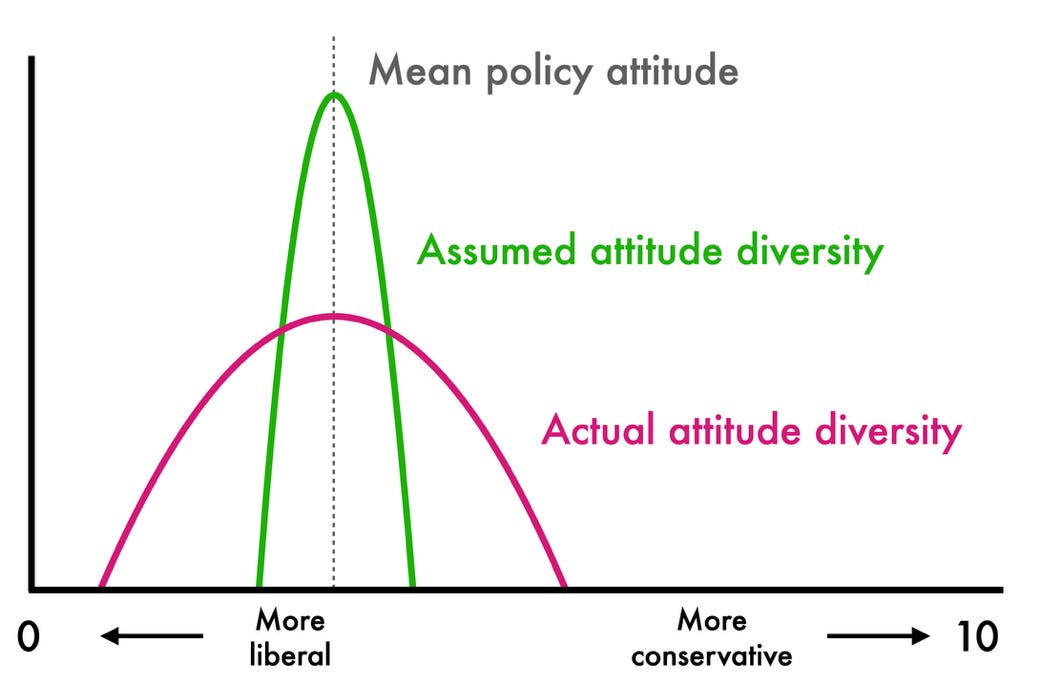
For all three issues, and across five different experimental designs, the results were the same: we think the diversity of policy attitudes among Democrats and among Republicans is narrower than it really is.
Diversity of views is easier to understand if we visualize it. The bad news is I don’t have the copyright to reproduce their charts here. The good news is that because the paper is open-access, you can inspect the results directly in their Figure 4. And the great news is that I am a fantastically skilled artist (step aside, Bob Ross!), so here is my very own rendering of the kinds of errors Americans appear to make when it comes to estimating the diversity of their out-partisans.
Illustrative example of errors in assumed policy-attitude diversity
A hypothetical example of how subjects in Dias et al. (2025) might have depicted the views of a political party (green) against the actual views of members of that party (pink).
What is the actual diversity of views on each side? It turns out, this is a difficult, complicated, and very fraught question to answer.
A quest to understand diversity of thought
The idea that a group might exhibit varying levels of thought diversity is not new. It’s been a talking and research point in the corporate world for years. I’ve done a fair amount of consulting research in this space, and usually when we go into companies that want to better understand the diversity of thought among their employees, we are looking for things like a range of education and training backgrounds, or perhaps prior work experience across different types of industries or companies. The idea is that groups of people with more varied skills and knowledge tend to outperform more homogeneous groups. (I should mention that Scott E. Page, the author or co-author of the sources in this paragraph, was my Ph.D. adviser and I work with him a lot on this.)
Diversity of thought doesn’t have to refer just to formal education or skills acquired at work. One company I worked with was interested in understanding the array of interests and hobbies their employees had outside of work. For example, a team of only soccer fans might have less diversity of thought than a mix of soccer fans, former competitive divers, poets, and someone who runs an Etsy shop. Other companies have been interested in personality diversity — do we have a mix of extraverts and introverts? Of people who are risk-takers and those who are more cautious? Is our workplace one where folks who are neurodivergent can flourish?
Identity diversity very much contributes to diversity of thought. In fact, one of the many(!) reasons having a demographically diverse workforce is advantageous is that our lived experiences shape who we are, how we see the world, and the kinds of innovative problem-solving perspectives we might bring (one of the many reasons we might want to celebrate diversity!). A team of engineers who have identical training backgrounds and are all straight, white, cisgender Gen X men from middle-class backgrounds is likely to have less diversity of thought than a team with the same training that includes people of different races, gender identities, ages, sexual orientations, and class backgrounds.
So how does this connect with politics?
If we want to understand the levels of thought diversity in the two major political parties, we could look at all kinds of different things: demographic diversity, education and work diversity, personality diversity, diversity in hobbies and interests, and much more.
 | A guest post by
|