

How the Word “Alien” Became a Political Weapon
The White House’s new Aliens.gov webpage draws on a dark American tradition

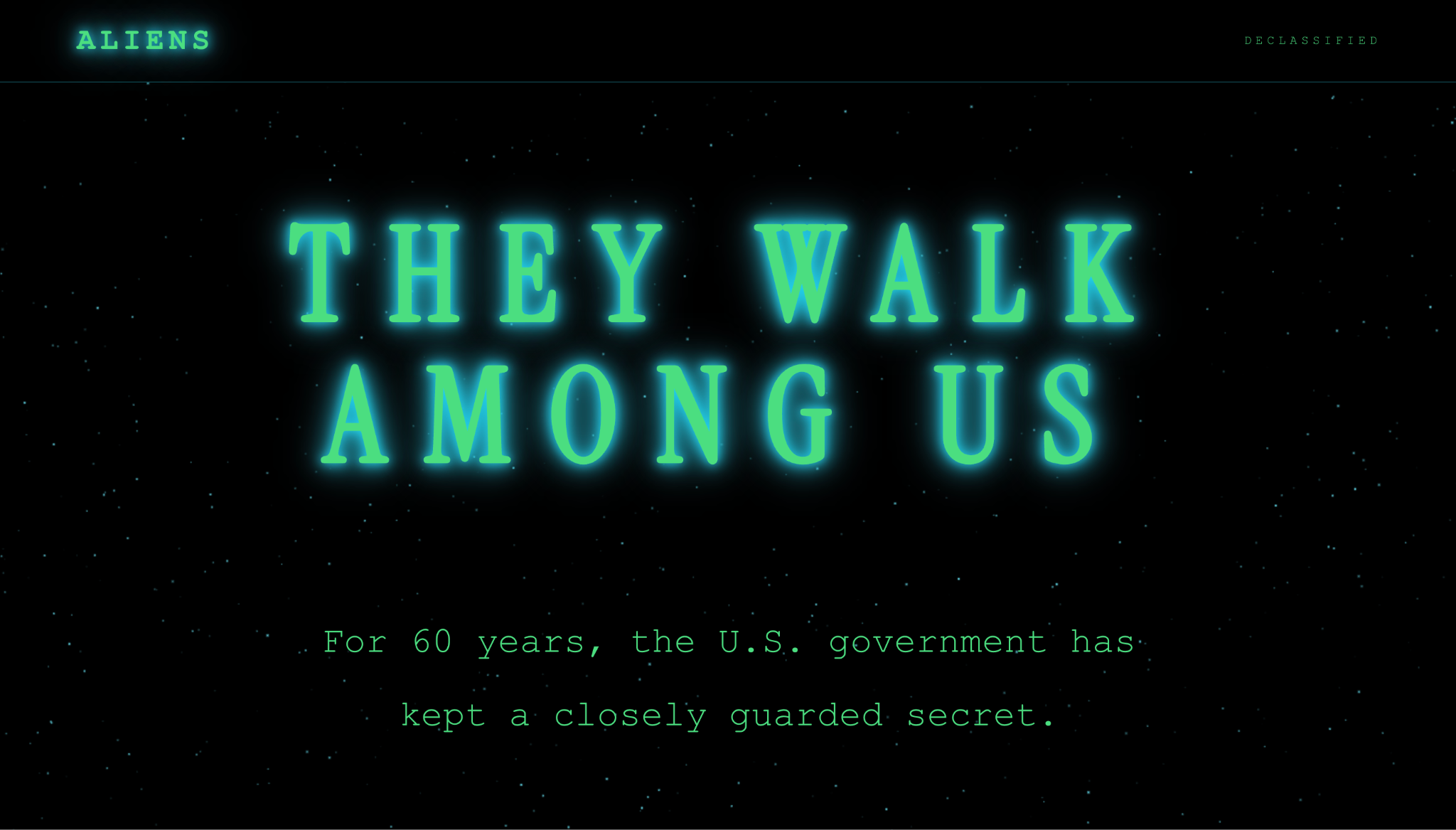
“THEY WALK AMONG US,” announces a new White House webpage in oversized, glowing green letters centered on a dark background twinkling with stars. “ALIENS” and a “DECLASSIFIED” stamp appear above the title in smaller fonts, but with similar spooky, green type. With letters spooling slowly onto the screen in an iconic Star Wars crawl, the script continues: “For 60 years, the US government has kept a closely guarded secret.”
The webpage discusses the threat of these “aliens,” who have been secretly “interacting with us in our daily lives,” “attend[ing] the same classes as our children,” and “liv[ing] seemingly normal human existences.” Yet, according to the page, there is a key difference between these aliens and “real” Americans: “they do not belong here.”
After registering the domain name “Aliens.gov” in March, and then teasing the new page on X in late May, the Trump administration added the webpage to the official whitehouse.gov website. It linked its announcement of the new page to a post on X of an AI-generated image of a UFO beaming up an undocumented immigrant over the southern border wall.
The language of dehumanization
Although it has been referred to as a “parody” and described as “tongue-in-cheek,” “mocking,” and “cheeky,” the webpage is no joke. It’s the latest in a steady stream of online content celebrating the Trump administration’s aggressive immigration crackdown with deliberately inflammatory memes that have no apparent purpose other than to denigrate immigrants. The “dangerous speech” rhetoric, the dehumanizing diction, and the fear-mongering design all contribute to the message that these “aliens” are an imminent threat and should all be driven out of the US. The page urges: “Deport them all!” It even includes a “Tip Line” that refers to the “aliens” with the pronoun “it”: “If you’ve witnessed an Alien abduction, do not be alarmed… We will take care of it… and return it safely to its place of origin.”
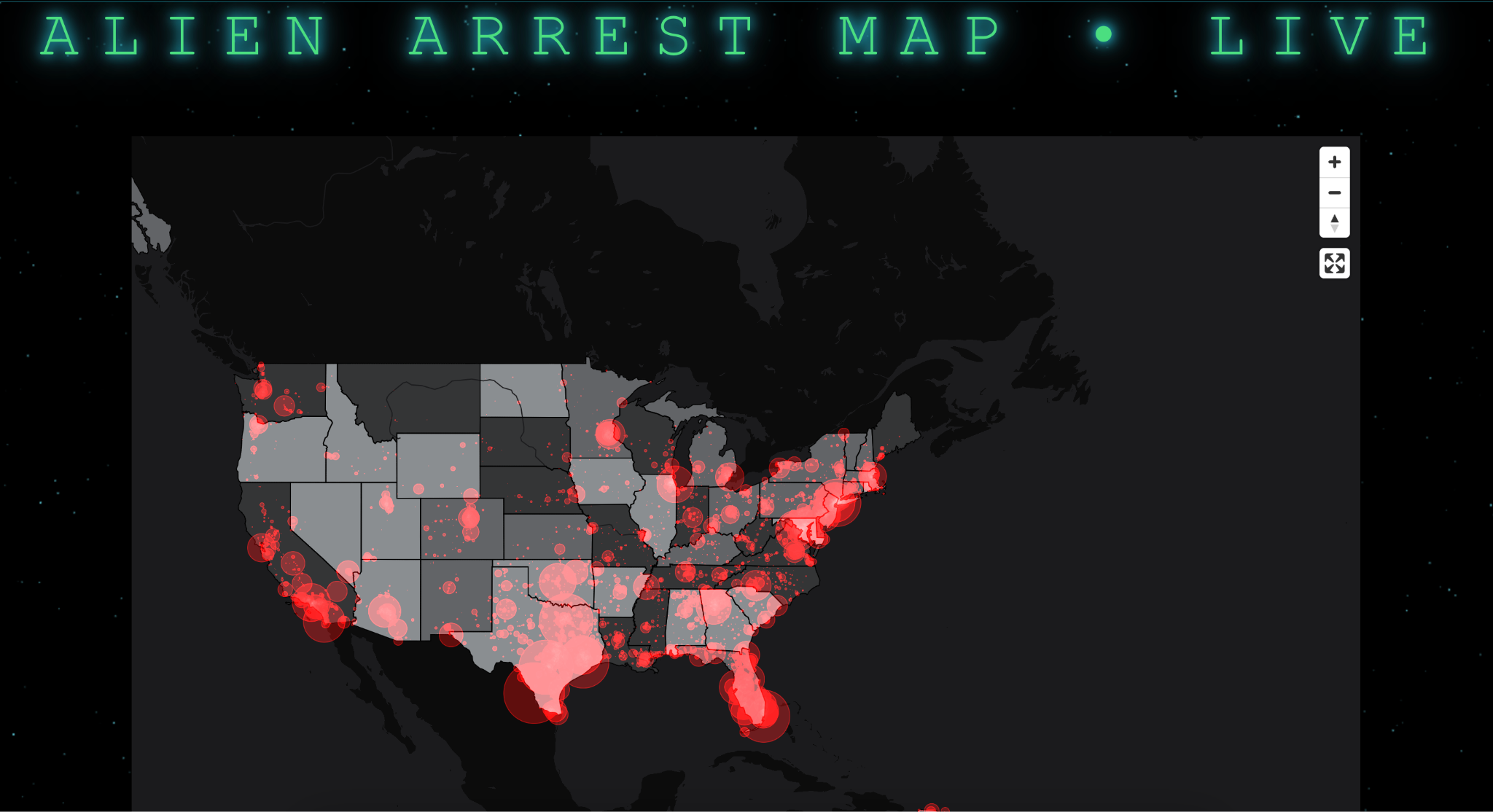
Following the introductory text, the webpage has a supposedly live ticker of alien “ENCOUNTERS,” beginning at around 3.1 million; a purportedly live “Alien Arrest Map” with red dots that you can click to reveal numbers of arrests, charges, and countries of origin; and, finally, a large red button identified as an “ICE Tip Line,” where readers are encouraged to “REPORT SUSPICIOUS ALIENS.” The Arrest Map links to a list of almost 3,000 pages of alleged “alien” encounters and immigration operations nationwide. By encouraging people to report “suspicious aliens,” the government is soliciting the public’s complicity against the targeted group.
All the data have nebulous and unlisted sources, a familiar hallmark of both President Trump and his administration. According to an analysis of the page’s code done by Wired magazine: “The counter is fake… The figure does not correspond to any enforcement total published by immigration authorities and is roughly seven times larger than the actual ICE arrest count since January 2025.” Wired also reported that, according to the site’s heat map of arrests, ICE has grabbed at least one US-born person in 715 of the listed American cities and towns. In 83 of the locations identified, every single person ICE arrested was a US citizen. And in 3,159 locations, the crime people are accused of is “Immigration.”
The website’s name is based on a dehumanizing double entendre — the word “alien” has a long history in the context of immigration. Tracing back to its Latin root, alius, meaning “other” or “else,” the 14th-century English word “alien” derives from both the Old French alien and the Latin alienus, which meant “belonging to another” and “foreign.” The term “aliens” has existed in American law since the 1700s. The nation’s first immigration law, the Naturalization Act of 1790, stated that “any alien, being a free white person, who shall have resided within the limits and under the jurisdiction of the United States, for the term of two years,” may become a citizen. The term also figured widely in the Alien and Sedition Acts of 1798, which gave the president power to arrest, imprison, and detain “aliens,” or noncitizens, during wartime. For much early US history, however, the word functioned only as a bureaucratic term.
Shifting terminology
During the Great Depression and immediately following World War II, when jobs were scarce, there was a gradual shift toward use of “alien” to describe Mexican farm laborers on temporary US visas. Waves of deportations of those workers — who were stripped of their papers and deemed “illegal aliens” — ensued and continued through the 1950s, culminating in Operation Wetback in 1954. This focused pushback against labor by immigrants in the country without authorization involved mass deportation of “illegal aliens.”
Operation Wetback comprised many tactics like those we are seeing today, including false claims by the government that the migrant workers brought sickness, crime, and “other socio-economic problems” with them. Government pamphlets dehumanized them as “wetbacks,” “hordes of aliens,” and a “peasant class” that was “infesting areas with disease.”
Border agents snatched the Mexican laborers from private homes, restaurants, and businesses, and gave them no opportunity to contact family or friends to tell them what had happened. Those detained were subjected to inhumane conditions while in custody and shipped as far as possible into Mexico, without any hearings or regard for their actual immigration status. Ultimately, around 300,000 to 800,000 people were deported in a matter of months, and many did not survive the trip.
 | A guest post by
|