

How the FCC is Trying to Control the News You See and Hear
An agency started to prevent censorship has started suppressing news

On August 18, 1933 — seven months after Adolf Hitler became Chancellor of Germany — Nazi Minister for Public Enlightenment and Propaganda Joseph Goebbels stood before a crowd of journalists and radio officials in Berlin and gave a speech he called “Radio as the Eighth Great Power.”
He was not being modest. Within months of Hitler taking office, the Nazi regime had seized control of every radio station in Germany, fired every Jewish journalist, and expelled every political opponent from the profession. They worked with radio manufacturers to introduce a subsidized receiver called the Volksempfänger — the “people’s receiver” — so that even more German families could bring Hitler’s voice into their home. By 1938, nearly ten million had been sold. While listeners could sometimes pick up international broadcasts, doing so was dangerous: when the war began, listening to foreign broadcasts became a criminal offense, punishable by death.
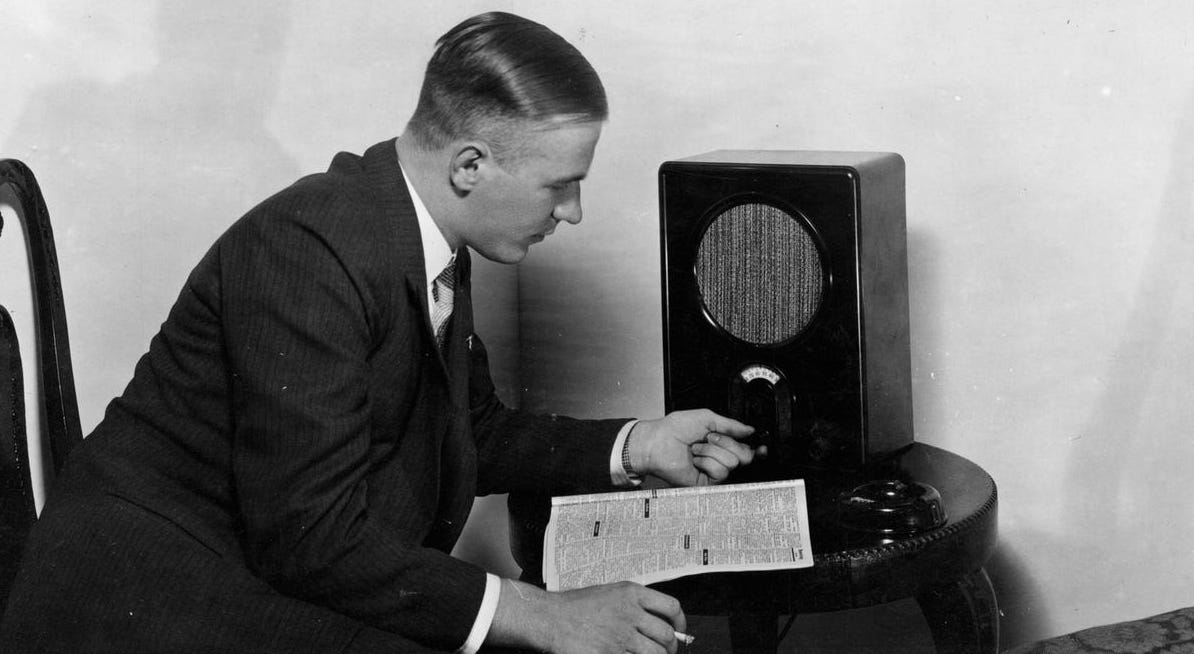
In his speech that day in 1933, Goebbels said: “It would not have been possible for us to take power or to use it in the ways we have without the radio.”
Goebbels later reflected on what the radio takeover had done to the journalists who remained. In his diary, he wrote: “Any man who still has a residue of honor will be very careful not to become a journalist.”
Back in the US, the members of Congress who watched all of this were paying attention.
In 1934, they passed the Communications Act — the law that created the Federal Communications Commission (FCC). They made it an independent agency, specifically so no president could control it. They declared that the American airwaves belonged to the public, not the government. And they wrote an explicit prohibition into the law. As the FCC’s own website still says: “The First Amendment and the Communications Act expressly prohibit the Commission from censoring broadcast matter.”
That was 92 years ago.
On Saturday, March 14, 2026, FCC Chair Brendan Carr posted a threat on social media. The president had just complained on Truth Social that news coverage of the US-Israeli war in Iran was fake. Carr amplified it, adding his own warning: “Broadcasters that are running hoaxes and news distortions — also known as the fake news — have a chance now to correct course before their license renewals come up. The law is clear. Broadcasters must operate in the public interest, and they will lose their licenses if they do not.”
Carr didn’t name a specific station or story, nor did he identify which hoaxes or distortions he was referring to.
In September 2025, Trump said networks covering him negatively should “maybe” have their licenses revoked, adding that such a decision would be “up to” Carr, the man he had appointed to run the FCC. The opportunity to test that arrangement arrived quickly. After Charlie Kirk was assassinated in September 2025, late-night host Jimmy Kimmel used part of his nightly monologue to criticize the way Trump and his allies were using Kirk’s death for political purposes. Two days later, Carr told a conservative podcaster that Kimmel’s comments were “truly sick” and warned ABC directly: “We can do this the easy way or the hard way. These companies can find ways to change conduct to take actions, frankly on Kimmel, or there’s going to be additional work for the FCC ahead.”
Within hours, two major broadcast companies that own ABC affiliates — both of which were actively pursuing mergers that would require the FCC to sign off — announced they would preempt Kimmel’s show. ABC followed, pulling Jimmy Kimmel Live! from the air indefinitely. The show stayed off for nearly a week before the massive public outcry from Republicans and Democrats alike caused ABC to reinstate it, issuing a statement saying Kimmel’s comments had been “ill-timed and thus insensitive.” No formal FCC action was ever filed — Carr used threats to create the illusion of control instead.
Here is the legal reality, from Ken Paulson, director of the Free Speech Center at Middle Tennessee State University, writing this weekend: The FCC “has not [revoked a broadcast license] in the last half-century. It cannot revoke a license because it disapproves of the content of a broadcast.” And the FCC’s authority applies only to local broadcast stations — not to cable networks. CNN, MSNOW, and every other cable news outlet are entirely outside Carr’s jurisdiction.
It’s important to understand exactly how this works: the FCC licenses individual local television stations — WCBS in New York, for example, or KABC in Los Angeles — not the networks that own them. CBS News, the organization that actually decides what gets reported and how, holds no broadcast license. Neither does ABC News, or NBC News.
So when Carr threatens a network over its coverage, he cannot touch the newsroom that made the editorial decision. He can only go after individual local stations, which would require documented violations specific to each one and would take years to resolve in court. This week, Carr’s threat was aimed in part at coverage by The New York Times and the Wall Street Journal. Neither outlet owns a single broadcast station. The FCC has no jurisdiction over them whatsoever.
But Carr has another tool. And he has already shown he will use it.
In January 2025, days after taking office, Carr reopened an FCC complaint against CBS that his predecessor had already dismissed. The complaint was about a 60 Minutes interview — specifically, whether CBS had edited a response in a way that violated FCC “news distortion” rules. CBS’s parent company, Paramount, had a multibillion-dollar merger with Skydance pending before the FCC. The merger required Carr’s approval. CBS handed over the unedited footage. President Trump also sued CBS over the same interview, in his capacity as a private citizen. Paramount ultimately settled the president’s lawsuit against the network for $16 million, just a few weeks before the FCC approved the merger.
A dissenting FCC commissioner, Anna Gomez, called it “an unprecedented, absolute weaponization” of the agency’s licensing power.
The people who built the FCC understood what it looks like when a government decides that the press exists to serve power rather than to check it. They had watched it happen in Germany, in Italy, in country after country where the machinery of communication was slowly turned against the people it was meant to inform. They wrote the prohibition of censorship into law because they knew that without it, “the public interest” would become whatever the man in charge decided it meant that week.
Brendan Carr is the man in charge this week. And what he has decided is that it means broadcasters who cover a war in ways the president dislikes should be warned — publicly, with the weight of federal licensing authority behind the warning — that there are consequences for telling you what is happening.
The law still says he cannot do this, and the law has said that for 92 years.
But what the law cannot do is make him stop trying. He hasn’t had to file a single complaint to change what you see on television. He just had to post on social media.
This is why it’s so important to follow the rule that Tim Snyder always says: Never obey in advance! Don’t give them more power than they really have.
Frightening!!! We have to stay vigilant and strong!!! Eyes, ears and communications open.