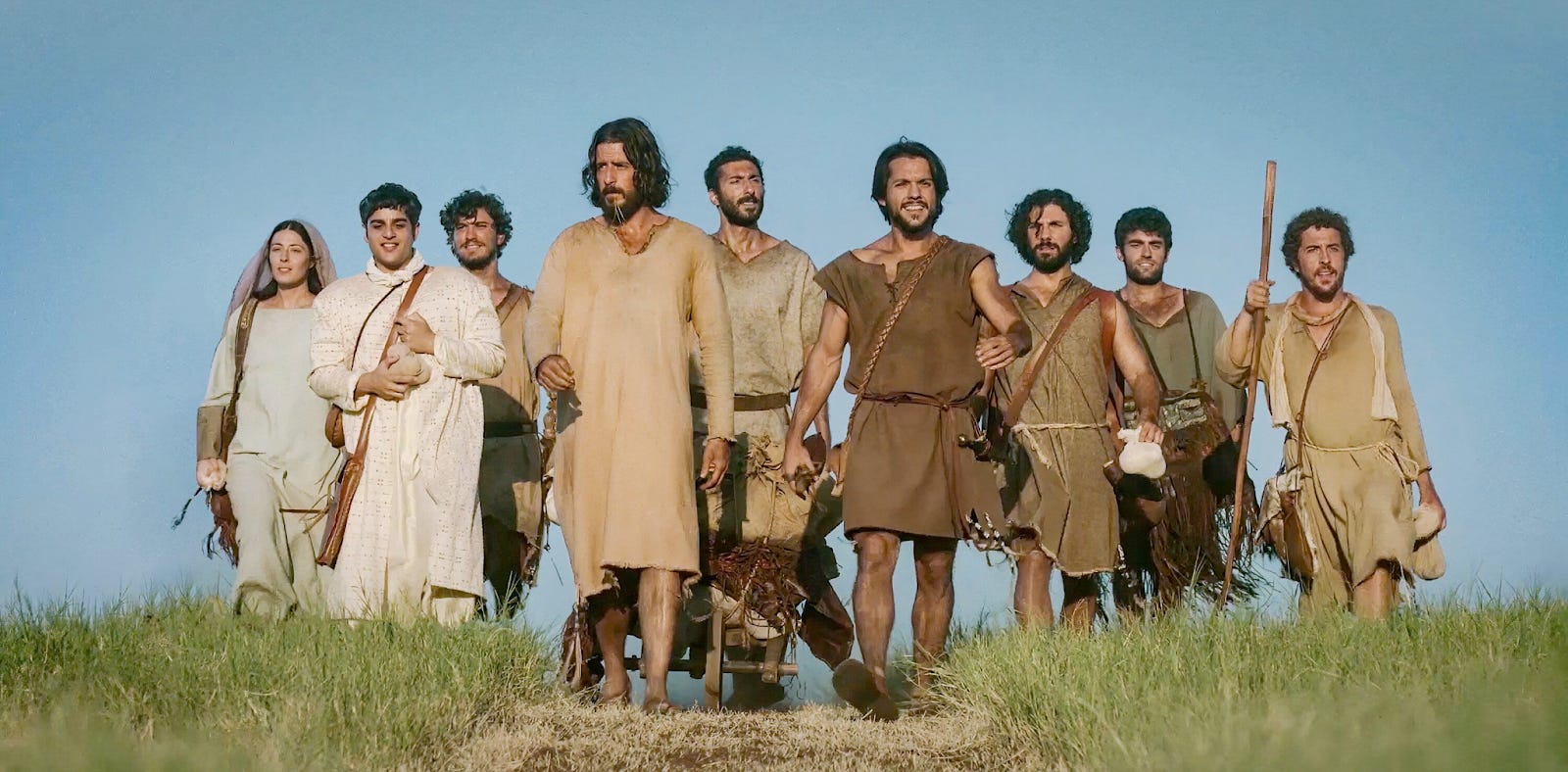
How The Chosen Became a Global Phenomenon
Crowdfunding, controversy, conversion stories — and the moment Dallas Jenkins stopped trying to feed the 5,000 himself.
Editor’s note: What would you like to see us cover in future editions of The Preamble? Be sure to read to the end of this article, where paid subscribers will be able to give their input!
And now, back to your regularly scheduled article:
Filmmaker Dallas Jenkins comes from Christian media royalty. His father, Jerry B. Jenkins, co-authored the Left Behind book series that sold more than 60 million copies. Dallas grew up around faith-based storytelling and spent 20 years trying to make his own mark in the industry.
In 2017, he had little to show for it. His latest film, The Resurrection of Gavin Stone, bombed at the box office. He was 43 years old, questioning everything, wondering if he’d chosen the wrong career.
One night, Jenkins and his wife Amanda were home alone, praying together and crying. “Really, I didn’t know what was next in my life,” Jenkins says.
Then something happened to Amanda. She describes it as God speaking to her — something “very powerfully and clearly” came into her mind. The message was about a specific Bible story: the feeding of the 5,000.
In that gospel account, Jesus faces a massive crowd of hungry people in a remote place. His disciples panic about the logistics — how can they possibly feed everyone? But a boy offers five loaves of bread and two fish. Jesus takes that meager offering, blesses it, and somehow feeds the entire crowd, with twelve baskets of food left over. It’s one of the most famous miracles in the New Testament, demonstrating that God can take something small and make it impossibly abundant.
The phrase that Amanda felt came from God: “I do impossible math.”
But what the Jenkinses didn’t understand was what it meant for Dallas’s career or what God wanted them to do with it.
At 4 a.m. the next morning, Dallas’s phone lit up: a Facebook message from an acquaintance named Alex, someone Dallas had talked to online about once a year. No greeting. No context. Just one line: “Remember, it’s not your job to feed the 5,000. Your job is to bring your bread and fish.”
Alex was in Romania at the time, seven time zones ahead. He later told Jenkins he had no idea why he sent the message at that exact moment, except that he felt prompted by God to send it. He didn’t know about Dallas and Amanda’s prayer the night before. He didn’t know about the phrase “impossible math” or that they’d been specifically contemplating that biblical story.
The message clarified what Amanda had heard: Dallas wasn’t responsible for making something massive happen. He just needed to show up with whatever small offering he had — his bread and fish — and let God do the impossible math.
That project became The Chosen.
A different kind of Jesus story
What Jenkins created was unprecedented: a multi-season television drama about the life of Jesus Christ, told not as a two-hour film but as an episodic series designed to be binge-watched like any Netflix show.
The Chosen tells the gospel story primarily through the eyes of the people who encountered Jesus — the disciples, the religious leaders, the crowds, the skeptics. It imagines their backstories, their personalities, their daily struggles.
While the text of the Bible doesn’t tell us much about the lives of Jesus’s disciples, Jenkins fills those gaps as a storyteller would, with invented scenes he considers “plausible.” Peter isn’t just a name in Scripture; he’s a struggling fisherman with a thick accent and a temper. Mary Magdalene’s deliverance from demons is shown through her tormented life before Jesus found her. The woman at the well gets a name — Photina — and a context for why she’s drawing water alone at noon.
Jenkins made a critical creative choice: while he invents dialogue and backstories for the supporting characters, he tries to keep Jesus’s actual words as close to Scripture as possible.
The show is now about to air its sixth season. Seven seasons are planned, covering Jesus’s ministry from the calling of the first disciples through the crucifixion and resurrection. The show can linger on conversations and imagine the texture of first-century life in ways a feature film never could.
But first, Jenkins needed to make it. And nobody in Hollywood wanted to fund a multi-season drama about Jesus.
The crowdfunding gamble
Jenkins started small. He made a short film called The Shepherd for the annual Christmas Eve service at Harvest Bible Chapel in Elgin, IL. When VidAngel — a faith-based streaming service — suggested uploading it to Facebook to build interest in a possible series, it got over 100 million views.
Jenkins partnered with VidAngel and made a crucial decision: they would bypass traditional studios entirely and pay for production with equity crowdfunding. In 2016, President Obama had signed the Jobs Act, which included a provision allowing companies to sell ownership shares to online investors.
For its first season, the team offered one share for every dollar invested, and promised that the show would not make money until the investors had made a profit of 20%. (It’s unclear whether the investors have in fact profited. In general the show’s proceeds have been used to fund future production. Seasons after the first have been crowdfunded without the sale of equity.)
Robert Bloomquist from Michigan watched the pilot episode with his wife Karrie and immediately recognized something different. “From the scene with Mary at the end of the very first episode, it was clear that this series was ‘doing a new thing,’” Robert says. “It resonated with my spirit in a profound way. We realized the reach and impact this could have globally for the kingdom, and we started supporting it immediately.”
More than 16,000 people invested — many of them probably, like Bloomquist, not because they expected financial returns but because they believed God was doing something through this project.
The 2018 campaign raised $10.2 million, shattering the previous crowdfunding record for media projects by nearly double. Season two raised another $10 million. To date, more than $37 million has been crowdfunded — all of it from people who saw themselves not as investors but as participants in spreading the gospel.
The show distributed itself through its own app. There was no subscription fee, no paywall — anyone could watch for free. Viewers could “pay it forward” by funding future episodes.
The movement
Walk onto the Chosen set in Midlothian, TX, and you’ll find something unusual: extras who paid their own way to be there. Hannah Teoh flew 17 hours from Singapore. Brandon and Lucy came from Jacksonville, 11 days before their wedding. Six hundred extras showed up for one day of filming. Paying and costuming that many would normally cost over $100,000 per day. The Chosen didn’t pay that. The extras brought their own costumes, following a distributed costume guide.
The show has also released a few episodes in theaters. The Chosen: The Last Supper grossed over $11 million on its opening weekend.
Jenkins found that theatrical releases transformed the viewing experience into something approaching a worship service. Audiences don’t just watch silently — they laugh together, weep together, react in real time as if they’re part of something larger than entertainment. “There’s something special about that gathering of people with a shared belief and a shared passion,” Jenkins says.
Then there’s ChosenCon — modeled after Comic-Con — where fans pay to attend panels, meet the cast, and buy merchandise. Every dollar funds the next season.
The Chosen has been viewed in 175 countries. In February 2025, Jenkins signed a distribution deal with Amazon MGM Studios. The show is now being dubbed in 600 languages through a partnership with the Come and See Foundation. If successful, that means 95% of the world’s population could watch The Chosen in their native language. So far, it’s available in 75 languages, including Arabic, Cantonese, Japanese, Russian, and Tagalog. The goal is to reach 1 billion people.
The backlash
The Chosen isn’t without its critics. Some Christians argue the show takes unacceptable creative liberties. As noted above, it adds dialogue not found in Scripture. One critic wrote that its portrayal of Matthew and John as collecting information to write their gospels “destroys the inspiration of Scripture, portraying it as a common book comprised of hearsay.”
U.S. Catholic magazine pointed out various inconsistencies between the show and the gospels, while some conservative Protestants object to any visual depiction of Jesus as a violation of the Second Commandment.
Some worry about the show’s LDS connections. Angel Studios, the original distribution partner, was founded by members of the Church of Jesus Christ of Latter-day Saints, which has various differences from many other Christian denominations. Critics fear subtle theological drift.
Other critics worry simply that the show will replace Scripture in viewers’ minds.
Jenkins addresses the last concern directly. The show includes disclaimers encouraging viewers to read the Bible. Jenkins regularly says his goal is to lead people to Scripture, not replace it.
And it could be working. Jonathan Roumie, who plays Jesus, shared stories from his Instagram DMs. Two people — both lifelong atheists — messaged him about what happened after they watched the show: they became interested in the Bible. Then they started going to church. Then they converted to Christianity.
“Both of these people who wrote to me happened to have been lifelong atheists and never had any interest in God,” Roumie said.
The lesson
The success of The Chosen has pushed Jenkins to expand beyond the original series. His production company is developing new projects — including a Chosen-style miniseries on Joseph of Egypt and an animated show, The Chosen Adventures.
“We’re taking everything we’ve learned and applying it to future projects,” he says. “Every Bible story we tell will have the same approach — finding the humanity in it so that people can see themselves in the story.”
When he was crying at home in 2017, wondering if his career was over, Jenkins had no idea that a Facebook message would redirect his entire life. He didn’t know that volunteers would fly across the world to be extras or that atheists would convert after watching his show.
All he had was the instruction to bring his bread and fish. Not to feed the 5,000 himself, but to show up with what he had and let God do the impossible math.
Seven seasons, 420 million views, and 600 planned language translations later, the math is starting to make sense. A 4 a.m. message from a stranger changed the landscape of faith-based media. Sometimes the biggest movements start with the smallest obedience. Jenkins brought his bread and fish and believes God did the rest.
Subscriber topic poll — what should we cover next?
A: Work is changing in real time—from drone pilots to death doulas, from AI trainers to solar installers—and so are the lives built around it. This issue explores fascinating jobs and emerging industries, and the deeper question underneath it all: what makes work feel meaningful in an economy built on constant reinvention.
B: Public lands shape ordinary days — from a kid’s first campsite to a rancher’s grazing permit, a tribal nation’s sacred site, a hunter’s dawn, a river guide’s season, a wild land firefighter’s summer. This issue follows the people and policies that decide access and stewardship — water, wildlife, minerals, energy, and trails—and asks what we owe each other when the land belongs to all of us.
C: The 1960s reshaped ordinary life — who could vote, where families could live, what kids learned in school, who got drafted, and whose voices made it onto the evening news. This issue follows the people and turning-point decisions of the decade, and traces how its unfinished arguments still shape the country we live in now.
D: A single school board vote can reshape a curriculum, a library shelf, and a teacher’s job overnight. This issue traces who holds the levers — states, districts, courts, and parents — how money and mandates flow, and why classroom decisions so often become national fights.
Which option would you like to see us cover next?


The Preamble really lost the plot with this one.
Thanks for covering The Chosen. Back when it was first being released I began watching it. I loved it. As Christian Nationalism and Trump’s clear influence on American Christians began to take hold, I started to step away from active participation in my church and had a real crisis of faith. So, I haven’t engaged with The Chosen since 2022. I do think it’s a good project, one that shows Jesus in the way that Christians should see Him and should emulate. This made me want to re-engage with that content.