

How NATO Built the World We Take for Granted
The alliance that reshaped the globe

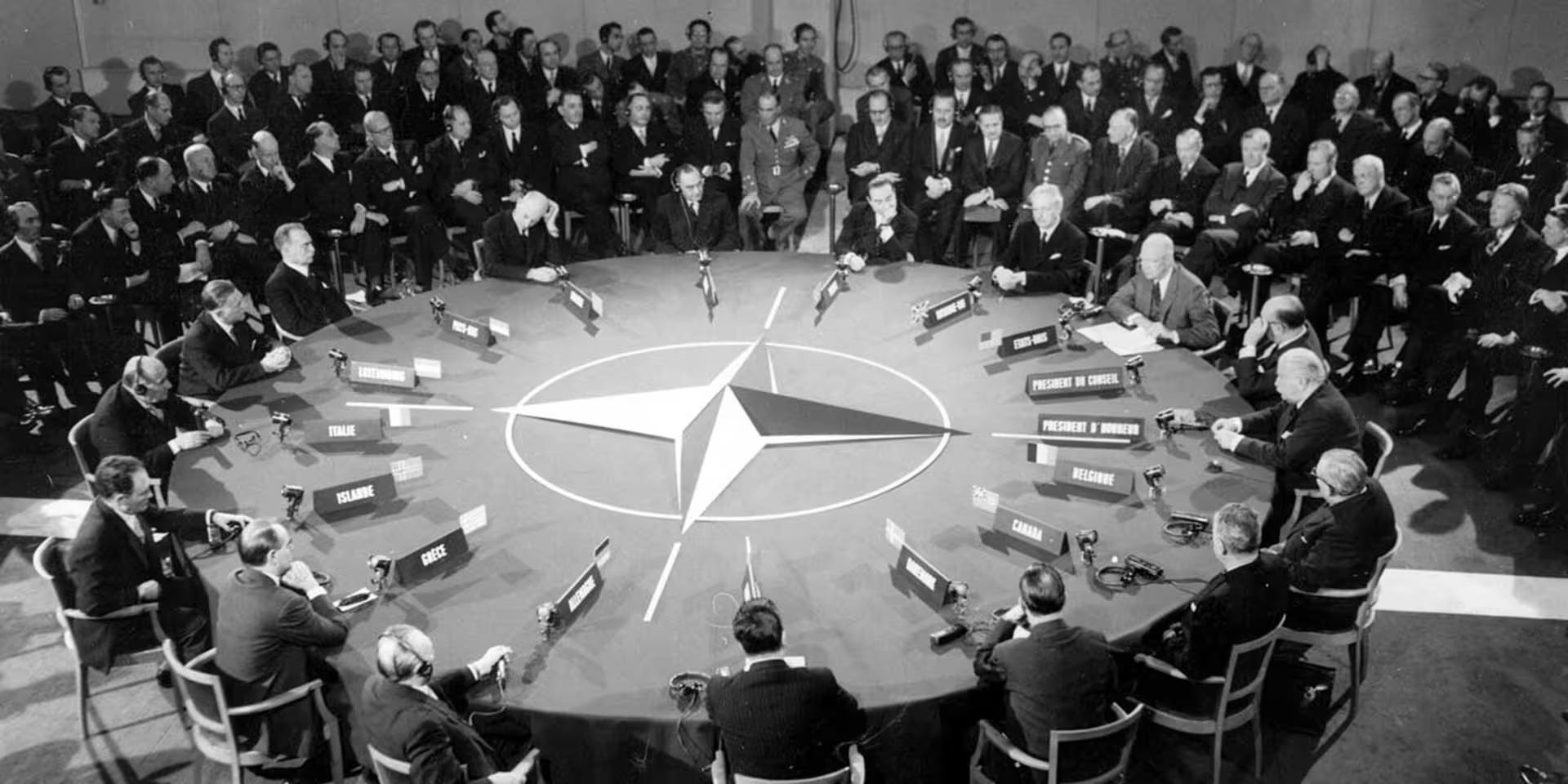
In April 1949, the United States did something it hadn’t done for well over a century: the United States and a group of European democracies signed a military alliance in peacetime. In the words of President Truman, the North Atlantic Treaty sought “to establish freedom from aggression and from the use of force in the North Atlantic community… To protect this area against war will be a long step toward permanent peace in the whole world.”
The pact was the embryo of what would become the North Atlantic Treaty Organization (NATO), which has grown to 32 members from the original 12.
Today, NATO is familiar enough that many Americans notice it only when it feels fragile. But what it created — or preserved — was something extraordinary: a durable peace among the world’s great powers.
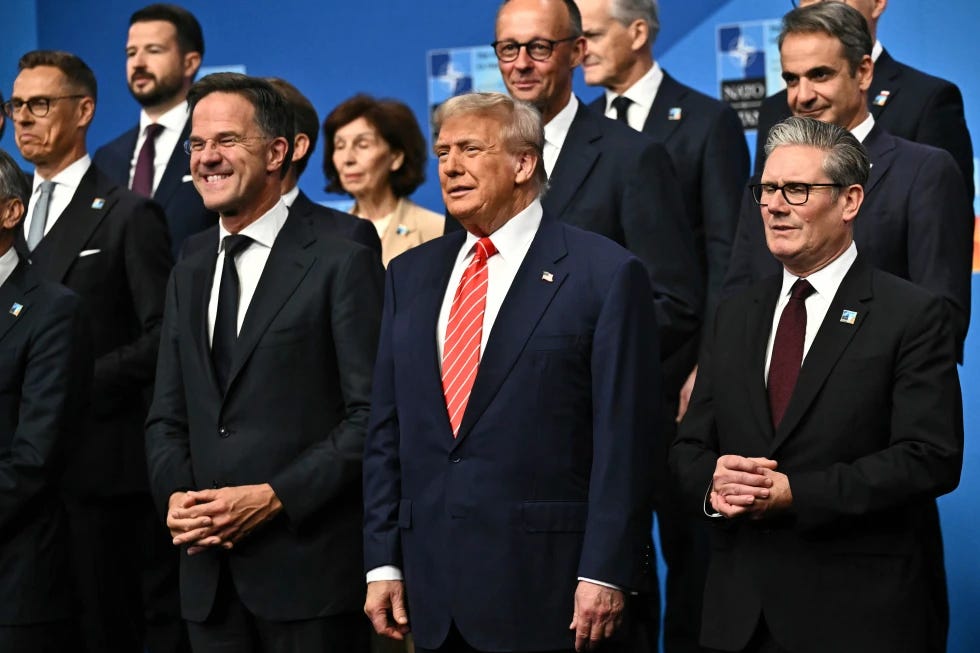
That post-war order, however, faces fresh strains not just from geopolitical rivals, but from within the alliance itself — including the doubts of a US president who has repeatedly questioned NATO’s value, called it “obsolete,” and said he would “certainly look at” pulling the United States out of the alliance if it isn’t restructured or allies don’t pay more of the costs.
Understanding why NATO mattered historically and still matters today requires a short detour into history, a lesson in how treaties work under US law, and a clear-eyed answer to the question now hovering over the alliance: Can Trump (or any other president) actually pull the United States out of NATO on his own?
The long arc: why NATO was created and why it worked
The first half of the 20th century didn’t just scar Europe. It nearly destroyed it. Two world wars left tens of millions dead, cities in ruins, populations displaced, and political orders in ashes. World War I introduced industrialized slaughter; World War II added genocide and mass civilian bombing.
This wasn’t a tragic anomaly. It exposed a deeper failure in how international politics worked. For decades, great-power war had been built into the system. Diplomacy assumed rivalry, military buildup was treated as prudence, and alliances shifted easily when circumstances changed. Stability required more than economic recovery; it required a new structure. The old scramble for military advantage had to be replaced with institutions that made peace normal and war exceptional.
That logic produced a radical departure from past practice: a permanent, peacetime security alliance binding the United States and Western Europe together in defense. Representatives from the United States, Canada, and ten European nations signed the North Atlantic Treaty in Washington. At its core was Article 5, a collective defense pledge declaring that an attack on one member would be treated as an attack on all.
NATO’s formation did not happen in a vacuum. It was the culmination of a series of strategic responses to postwar conditions. After World War II, the United States launched the Marshall Plan, deploying massive economic assistance to reconstruct European economies and diminish the appeal of communist movements. But European leaders saw that economic recovery alone could not guarantee security, and they looked to bind their futures to one another and to the United States.
In the same period, tensions such as the Berlin Blockade — when Soviet pressure on West Berlin required an extraordinary Allied airlift to sustain the city’s population — demonstrated both the severity of the Soviet challenge and the limits of unilateral or ad hoc responses. NATO offered a way to integrate military planning, share burdens, and present a united front.
That design proved unusually durable. By embedding American power in Europe’s defense while requiring European allies to invest in their own security, NATO reduced incentives for unilateral action and strengthened deterrence without provoking war. Over time, the alliance adapted to new threats, expanded eastward after the Cold War, and took on missions beyond Europe. Yet its core purpose — collective defense, credible deterrence, and predictable cooperation — remained intact.
Why NATO still matters today
After the Cold War, some — including President Trump — began to ask whether NATO had outlived its purpose. The Soviet Union had collapsed. Europe was largely democratic. The original enemy was gone. More recently, President Trump gave that skepticism a sharper edge, repeatedly questioning why the United States should remain bound to an alliance formed for a very different era, and even floating the idea that US protection should depend on whether allies were “paying their bills.”
The short answer is that NATO’s value was never limited to countering the threat from one enemy. It was built to solve a recurring problem: how to deter aggression, reassure allies, and prevent security vacuums from spiraling into war. Such threats have clearly not disappeared. But they have changed shape.
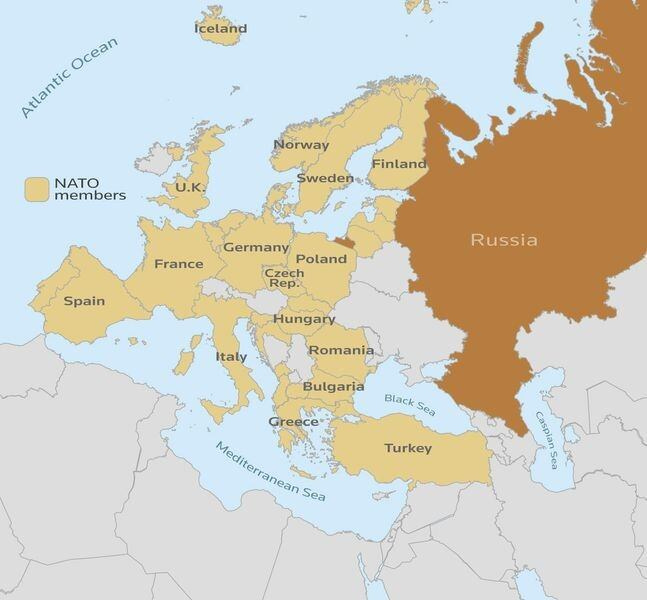
Russia’s invasion of Ukraine is the clearest illustration. Ukraine is not a NATO member, and that fact matters. Countries on NATO’s eastern flank — Poland, the Baltic states, Romania — have not faced the same kind of direct military assault, in large part because NATO membership makes US and allied commitments explicit. Deterrence works best when lines are clear. Where they are ambiguous, aggression becomes more tempting.
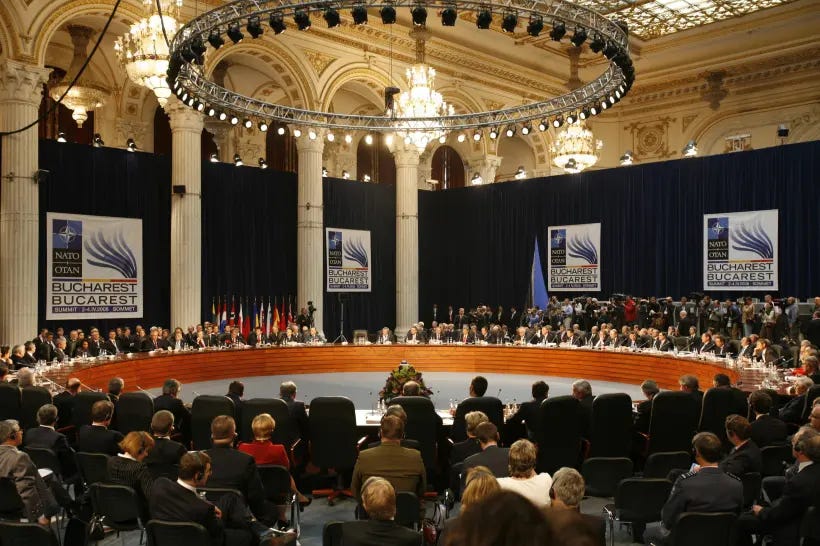
The most common objection to NATO today is cost. Why, critics ask, should the United States continue underwriting European security? NATO’s own benchmark is often misunderstood. Members are not required to pay into a central NATO fund. Instead, in 2006 they committed to spending at least 2% of their GDP on defense, with 20% of that spending devoted to major equipment and modernization. By 2035, member countries must contribute at least 5% of their GDP. This is not a tax paid to NATO headquarters; it is each country’s pledge to invest in its own military so the alliance is credible as a whole.
On this point, Trump’s criticism has not been entirely wrong. For years, many NATO members failed to meet the 2% target. As recently as the mid-2010s, only a small handful of allies met the benchmark. Even today, several countries remain below it, though the number meeting or exceeding the target has grown significantly since Russia’s invasion of Ukraine.
That reality complicates the caricature of NATO as pure American charity. The alliance is better understood as leverage. It allows the United States to shape security outcomes alongside partners rather than act alone. It spreads costs, integrates military planning, and ensures that American power is multiplied rather than isolated.
Beyond its military role, NATO functions as a political institution. It provides more than 30 democracies with a standing forum to consult, coordinate, and signal resolve before crises escalate. For smaller member states, that consultation acts as a shield against coercion. For adversaries, it serves as a warning.
As Russia tests boundaries and China watches closely, NATO is not a Cold War relic. It is the infrastructure that allows collective security to operate in an era when uncertainty is the norm.
What happens if NATO fractures?
Talk of NATO fracturing can sound alarmist, especially given the alliance’s long history of surviving internal disputes. But alliances rarely collapse all at once. They weaken gradually, through doubt, mixed signals, and unmet expectations. The danger is not a single announcement or formal withdrawal. It is erosion.
If the United States signals that its commitments are conditional or uncertain, the deterrent value of the alliance diminishes almost immediately. Deterrence depends on credibility. When allies begin to wonder whether Washington would actually honor its commitments, they adjust their behavior accordingly. Some hedge by increasing unilateral defense spending outside NATO structures. Others seek alternative security arrangements. Still others pursue accommodation with regional powers they once relied on NATO to deter.
Adversaries respond just as rationally. Ambiguity invites testing. When commitments appear shaky, probing actions become cheaper. Gray-zone tactics, cyber intrusions, airspace violations, and political coercion become more attractive precisely because they fall short of open conflict while still exploiting uncertainty. Over time, the line between peace and crisis blurs, making miscalculation more likely.
A fracturing alliance also struggles to function internally. NATO’s strength has never been automatic. It relies on constant coordination, shared planning, and political consensus. When trust erodes, decision-making slows. Joint exercises lose meaning. Intelligence sharing becomes more guarded. The alliance may still exist on paper, but its capacity to act collectively weakens in practice.
The long-term consequences of a weakened or fractured NATO would extend beyond Europe. NATO has been a signal to the world that US commitments endure beyond individual leaders or election cycles. If that signal weakens, other security arrangements come under pressure as well. Allies in Asia and elsewhere would have reason to question whether their own defense guarantees were similarly contingent. The result would not be immediate chaos, but a gradual shift toward a more fragmented, less predictable global order as the conditions that kept the peace slowly disappeared.
Can a president unilaterally break a treaty?
This legal question isn’t just academic anymore.
Under the US Constitution, the president negotiates treaties and the Senate must give its “advice and consent” by a two-thirds vote before they can take effect. Treaties that have been ratified become part of US law and are considered “the supreme Law of the Land” under the Constitution’s Supremacy Clause — on par with federal statutes and superior to state law.
That means once the United States ratified the North Atlantic Treaty in 1949 with a Senate vote of 73–2, it was not a casual diplomatic agreement but binding American law — domestically and internationally.
If only it had remained that black and white.
The Constitution is precise about treaty entry but silent about treaty exit. Historically, many presidents have withdrawn the US from treaties without congressional approval, relying on executive authority in foreign affairs. Some of these treaties have been significant: Trump, for instance, withdrew the US from the Intermediate Range Nuclear Forces Treaty in 2019.
Because of that history, many legal scholars argue that the president has the power to withdraw from treaties unilaterally unless Congress acts to restrict that power.
And in the case of NATO, Congress did exactly that.
More specifically, then–Senator Marco Rubio (R-FL) — now Trump’s secretary of state — helped lead the charge to do exactly that.
In 2023, lawmakers passed bipartisan legislation barring any US president from withdrawing from the North Atlantic Treaty without either Senate approval or an act of Congress. The bill passed with overwhelming bipartisan support. It was the first instance in which Congress proactively prohibited a president from withdrawing from a treaty unilaterally.
Since treaties are understood as domestic law once ratified — and since a statute now prohibits NATO withdrawal without Senate approval — a president who tried to exit NATO unilaterally could be on shaky legal ground, potentially facing judicial challenges or a showdown with Congress.
The stakes
NATO is not a relic of the 20th century. It is the mechanism through which democracy, deterrence, and cooperation kept great-power war from returning to Europe. It is how the United States anchored itself in an international order that amplified its power without turning Europe into a dependent satellite. And it is how allied nations learned to act together predictably and credibly rather than stumble from crisis to crisis.
Treaties like NATO are also not ceremonial artifacts. They are binding law, domestic obligation, and international promise at the same time. In US law, they carry the force of statute once ratified. In global politics, they signal permanence in a world defined by uncertainty. That dual role is precisely why they matter — and why unraveling them is never as simple as it sounds.
When people talk about NATO fracturing today — whether through legal ambiguity over treaty obligations or rhetorical hostility from political leaders — they are not debating an abstract institution. They are debating a confidence system. To weaken that confidence would not simply reduce the number of meetings in Brussels. It would encourage allies to hedge, invite adversaries to push limits, and degrade the assumptions that have helped keep peace among major powers for generations.
NATO is not flawless. It has endured disputes over cost, strategy, and burden-sharing since its earliest days. But its durability is the point. It has survived because the alternative — a world where commitments are conditional and security is improvised — is far worse. In an era of renewed rivalry and fragile trust, the real question is not whether NATO is perfect. It is whether the international order it helped build can survive if its core commitments are treated as negotiable.
 | A guest post by
|
Thanks Casey! While reading this, I'm reminded of vaccines: NATO is a victim of its own success. Lack of disease and war are rationales to pull our resources back from proven antidotes and instead go toward... hiring bonuses for people who can't pass background checks to terrorize our own communities. How does any of this make sense from the perspective of a voter who purports to love America?
Democracy is wonderful, but without proper education, it empowers short-sighted, simplistic decisions at the ballot box that can endanger the world. And by "proper education" I don't mean going to college, I mean media literacy and access to quality information. And by "access to quality information" I don't mean that this essay and others like it are behind a paywall, I mean that culturally they're inaccessible. We treat our news and opinion sources as markers of identity, and reading/listening to perspectives that don't confirm our political ideologies is treated as treasonous to our own tribes. Because then we might find some bipartisan consensus. Wouldn't that be terrible?