
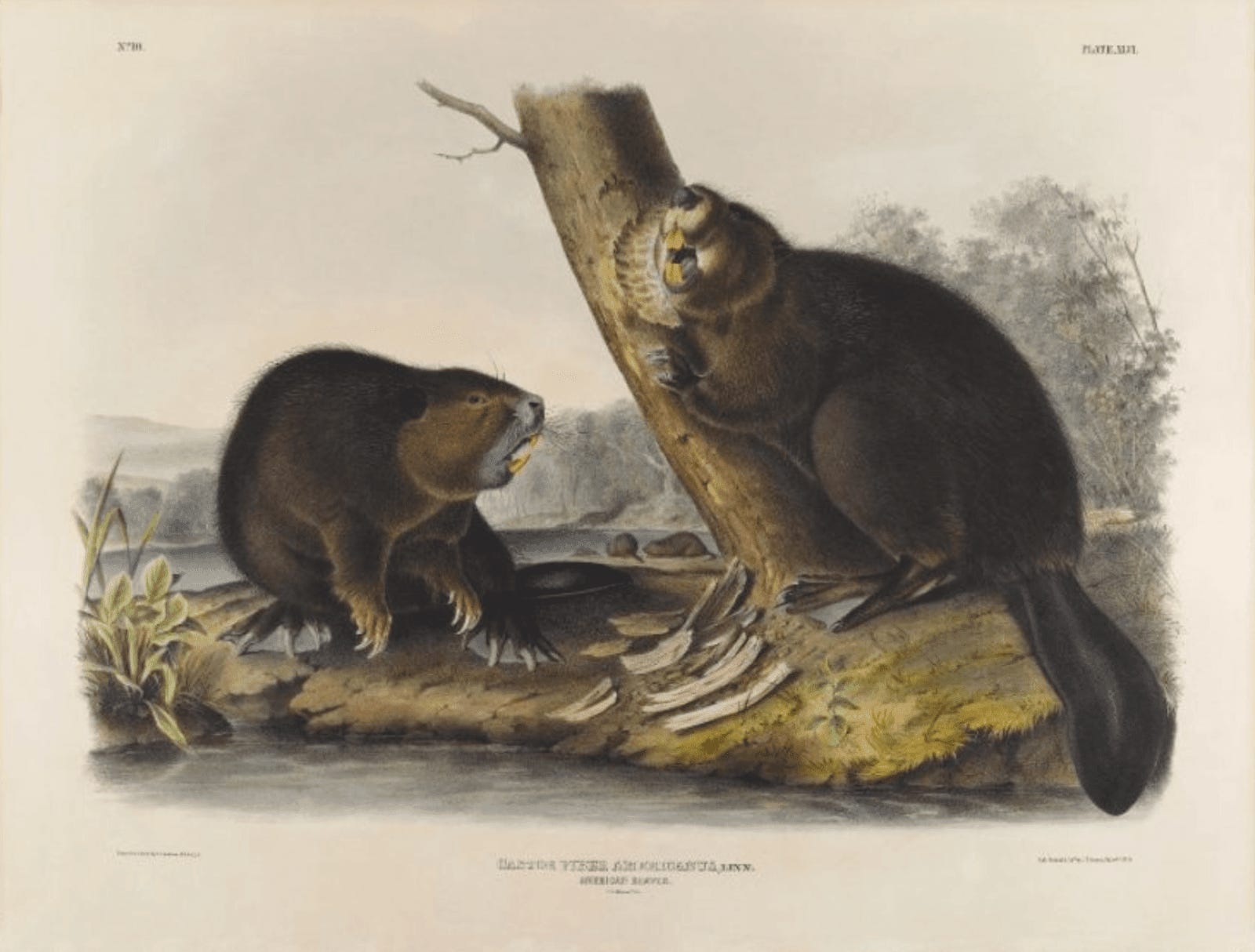
If you had wandered across North America several thousand years ago, you might have crossed paths with a creature that looked like it belonged in The Princess Bride — a beaver the size of a black bear. Yes, you read that correctly. Giant beavers once roamed North America, Asia, and Europe, sharing the landscape with creatures like saber-toothed tigers. Today’s beavers are smaller and far more familiar, but they remain just as astonishing. They have five fingers. A tail that seems custom-designed by a committee. And when they hear the sound of running water, something in their brain simply says: No. Absolutely not. They head off to stop it.

Why they do any of this is a scientific mystery. Researchers don’t fully understand why beavers build dams or how that behavior began. They don’t know whether instinct drives them or whether their intelligence pushes them toward these massive engineering projects. Their eyesight is poor. Their brains are small. They navigate primarily by smell, using the unique scent of each tree to decide which one to bring down next. And yet their impact on the landscape rivals anything done by humans.
Beavers don’t fit neatly inside our categories for intelligence. But maybe the problem is the categories themselves. Our human instinct is to evaluate intelligence by the tools we use — logic, memory, language. But other creatures operate with forms of knowledge that don’t map onto our charts. Watch a beehive long enough and you will realize the insects simply understand something we do not. Beavers, in their own way, do too.

They are one of the few keystone species on the continent. If you remove them, the entire ecosystem collapses. And they are, other than humans, the only species that intentionally and dramatically reshapes the natural world. They are ecosystem engineers. And for thousands of years, they were among the most successful mammals in North America. When Europeans first began exploring the continent, an estimated 400 million beavers lived here.
Indigenous communities understood their importance long before Europeans ever laid eyes on the Americas. For many woodland tribes, beavers held a status comparable to that of the bison of the Plains — vital, respected, and interwoven into daily life through food, trade, and spiritual meaning.
But when Europeans arrived, they weren’t looking for spiritual meaning. They were looking for trade.

By the 1500s, Spanish, English, Portuguese, and French ships were already crossing the Atlantic, searching for resources. Fish, yes. But also furs — especially those that Native Americans readily traded because, to them, pelts were abundant. Europeans could scarcely believe their luck. One pelt after another, handed over as if there were endless supplies. And in those days, that was true.
France dove in quickly. By the early 1600s, Samuel de Champlain had crossed the ocean nearly two dozen times, helping establish Quebec and New France. The Dutch followed, sending Henry Hudson and founding beaver trading posts on the island that would become Manhattan.
It would not take long before men were fighting over beavers.
Why? Because not all fur was created equal. Europeans distinguished between fancy furs — the showy, fluffy pelts of animals like mink or fox — and staple furs, which have long guard hairs over a dense undercoat. Beavers fall into this second category. And that undercoat, called wool, was the gold. Russian fur processors had perfected the means for separating the beaver’s guard hairs from its wool, and for generations Europe had relied heavily on Russian beaver for felting.

Beaver wool produces the finest felt in the world. Under the right conditions — temperature changes, agitation, and certain chemicals — the microscopic barbs on animal fibers permanently lock together. (Ask anyone who has ever ruined a cashmere sweater in the dryer.) The result is a fabric that is naturally water-resistant, antimicrobial, durable, and able to hold its shape. The perfect material for hats.
Between the 1500s and early 1800s, a beaver felt hat was the Patagonia fleece of its day: expensive, high-quality, and widely recognized as a sign that you had the means to buy the best. By 1700, England alone was consuming about five million hats per year — roughly one per adult. As hat fashion spread across Europe, more than 20 million beaver hats were exported from England between 1700 and 1760.
It took about ten beaver pelts to make a single top-quality hat.
Europe’s appetite required roughly 200–300 million beavers in the 18th century. Which raises an obvious question: where does one get that many beavers?
Largely, from North America.
And what would nations be willing to do to protect those sources?
The short answer: nearly anything. Including war.

As demand soared, England and France established major trading companies to funnel pelts from North America back to Europe. The British Hudson Bay Company built trading posts and waited for trappers to come to them. The French sent voyageurs deep into the interior of the Great Lakes region, forming direct relationships with Indigenous trappers.
The profit margins were astonishing: a pelt that cost three or four shillings’ worth of goods in North America could sell for 40 shillings in London.
Which brings us to a young German immigrant in the 1780s — a 20-year-old apprentice who worked in a relative’s musical instrument shop. He scraped together enough for a steerage ticket to America and boarded a ship, his belongings packed tightly beside him, including several flutes. On the voyage, he overheard wealthy passengers discussing the enormous profits to be made in furs. It was a conversation that would change his life.
His name was Johann Jakob Astor, and he was later known as John Jacob Astor. Within a few years of arriving in New York, he began trading directly with Native Americans, learning to process the furs himself and selling them at remarkable profit. By 1800, he was the modern equivalent of a multimillionaire.
Astor partnered with the Montreal-based North West Company until the United States passed the Embargo Act of 1807, halting trade with foreign nations in response to British impressment — Britain’s practice of boarding American ships and forcing sailors into service. As many as 10,000 Americans were conscripted this way. It was a national humiliation, and an impossible burden on the maritime economy.

The embargo hit Astor’s business hard. So he did what ambitious men often do: he built his own empire. The American Fur Company, the Pacific Fur Company, and the Southwest Fur Company all sprang out of this moment.
He financed the expedition that established Fort Astoria, the first American settlement on the West Coast. And along the way, members of the expedition learned of a key route through the Rocky Mountains — South Pass. Indigenous nations had long known the pass existed, but it was unknown to European traders. Its location would ultimately make possible the Oregon Trail, the California Trail, and the Mormon Trail. In other words, the settlement of the American West.
And yes — this, too, happened because of beavers.
When the War of 1812 broke out, the underlying tension was European: Britain and France could not stand each other. Both demanded that the United States (and other nations) refuse trade with their enemy. The thing everyone wanted to trade? Primarily furs. Primarily beaver furs.
When Britain refused to end impressment, President James Madison declared war. The British responded by blockading the East Coast and burning Washington, DC, including the White House — where Dolley Madison instructed enslaved people to save the now-famous portrait of George Washington. “The Star-Spangled Banner” was written after the bombardment of Fort McHenry. And although generations of schoolchildren were taught that the United States won, the truth is far muddier. No one really did.

Meanwhile, Astor expanded into new ventures — including opium smuggling — before ultimately turning his fortune toward Manhattan real estate. His wealth compared to the size of the national economy would rival that of someone like Jeff Bezos today.
By the 1830s, changing fashions and competition meant the American Fur Company was fading. But Astor’s influence was already baked into the map of the United States.
And behind all of it — every conflict, every trade network, every expedition and settlement — was the beaver.

The beaver trade shaped North America from the 1600s through the 1800s. It drove colonization. It fueled the growth of the United States. It helped spark the American Revolution, pushed the continent toward the War of 1812, and opened pathways into the West. It transformed ecosystems and radically altered Indigenous life.
And even today, beavers remain quietly, steadily at work — reshaping landscapes, creating wetlands, making room for fish, birds, insects, forests, and meadows. Almost every thriving ecosystem they touch traces its success back to their engineering.
The most influential animal in North American history might just be the one chewing on a poplar branch, minding its business, hearing the sound of running water, and muttering to itself: Absolutely not.