
Has Your Election Already Been Won?
Most congressional districts are a lock for one party — and that's a problem
Before reading another word, take a look at the map below and try to guess what it shows.
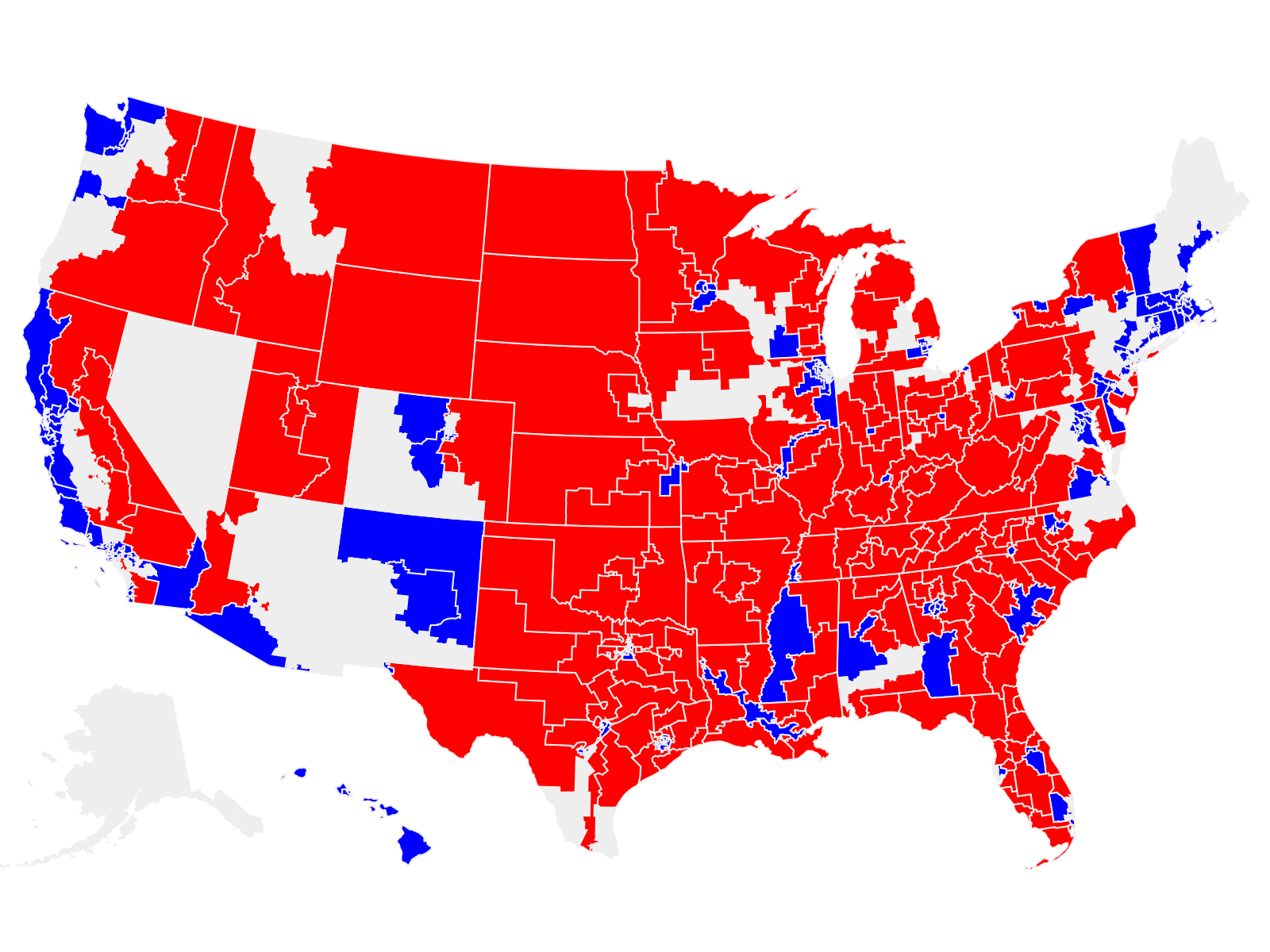
A few things may jump out immediately. The outlines are the 435 House congressional districts used in the 2024 elections. The colors are familiar: red for Republicans, blue for Democrats.
And almost the entire map is filled in. You have no problem identifying every single state in the Union.
But what determines whether a district is colored?
This is the key: the filled-in districts represent House races in 2024 that were decided by more than ten points — elections that were not especially competitive. Landslides. Comfortable victories. Races that, well before Election Day, were widely understood to be safe for one party.
There were 366 such districts in 2024. Three hundred and sixty-six out of 435.
In a record-breaking year for presidential turnout, with Donald Trump at the top of the ballot and control of Congress hanging in the balance, nearly 85 percent of House races were effectively foregone conclusions. Regardless of the candidates, the state of the economy, or Congress’s approval rating, in the vast majority of districts the general election was less a contest than a confirmation.
Now let’s flip the picture.
The next map shows the inverse — the districts decided by ten points or fewer. These are the places where persuasion still mattered, where campaigns had to compete for undecided voters, where the outcome was genuinely uncertain.
There were just 69 of them. Sixty-nine competitive House elections in the entire country, 16% of all House elections, and a huge number of entire states with nothing close to a competitive election.
What these maps reveal isn’t simply where elections were close or lopsided. They reveal how dramatically the competitive landscape of the House has narrowed — and how that narrowing has quietly reshaped the incentive structure of Congress itself, and not for the better.
From competitive chamber to pre-selected outcomes
There was a time — not ancient history, but within living memory — when dozens more House seats were genuinely up for grabs in any given election cycle. As recently as 1996, over 42% of all House seats were competitive.
In the 1970s, ’80s, and even into the ’90s, polarization was far less intense, and ticket-splitting was common. That is, voters routinely supported a presidential candidate from one party and a House member from another. Can you imagine?! In fact, in 1984 — Ronald Reagan’s reelection year — 44% of House seats were carried by a presidential candidate of one party and a House candidate of the opposite party. Members represented politically mixed districts and had to build cross-party coalitions to survive.
Those days are long gone. In the 2020 election, fewer than 4% of House districts split their tickets.
Analysis from groups like FairVote shows that over the past several decades, the number of landslide House victories has grown while the number of competitive districts has shrunk. In 1996, just 30 years ago, a full third of the House chamber — 147 seats — were toss-ups, meaning that both parties had a solid chance at winning the seat. In 2016, that number had shrunk to a nadir of just 18 districts, or 4% of the entire House.
And if early projections for 2026 are any indication, the erosion of the competitive seat is continuing. FairVote predicts that 38 House elections will again be toss-ups.
The Cook Political Report, one of the most accurate prediction orgs going, currently rates only 18 House seats — just 4 percent of all districts — as toss-ups. Even if we add in all seats categorized as “leaners” to one party or the other, we still reach only about 40 districts that might plausibly flip.
Meanwhile, 86% of 2026 seats — 375 of the 435 — are rated “solid” for one party or the other, meaning it would take a political earthquake to avoid the predicted outcome. For nearly 90% of our House elections, we are all but certain which party will win well before we know which candidates will even be on the ballot.
And yet, in 2024 alone, campaigns and outside groups raised and spent roughly $9.5 billion on congressional elections. Billions of dollars flowed through a system in which only a few dozen districts were genuinely up for grabs. The overwhelming share of that money, attention, and advertising ultimately concentrated on a narrow slice of the map.
That concentration makes sense when you consider what’s at stake. The House operates on razor-thin margins. In 2026, Democrats would need to flip just four seats to reclaim the majority. Four districts would determine who holds the speaker’s gavel, who chairs committees, which bills reach the floor, and which investigations move forward.
But that reality also sharpens the paradox: while a tiny number of districts determine control of Congress, the vast majority of Americans live in places where the November outcome is effectively predetermined.
In most districts, the general election is no longer where the decisive contest takes place.
Which raises the deeper question: If November isn’t the moment of real competition, what is?
The primary incentive structure
Imagine you’re a moderate Democrat living in a deeply Republican district, or a pragmatic Republican in a heavily Democratic one. You consider running for Congress, believing you could make a difference, even help build a coalition across party lines. But you also know you can’t ignore math. The district’s partisan lean virtually guarantees that your party loses by double digits every two years.
Do you invest the time, the fundraising, the personal sacrifice? Most people say, “Hell, no!” And it’s tough to blame them.
The shrinking number of competitive districts doesn’t just affect outcomes — it shapes the candidate pool itself. In districts that are overwhelmingly red or blue, the minority party often struggles to recruit serious challengers at all. Why run a race that you’re structurally positioned to lose?
Instead, the only contest that truly matters is the dominant party’s primary.
And primaries are very different elections. They draw far fewer voters, and those who participate tend to be the most ideologically committed. Turnout in congressional primaries hovers around 20 percent. That means a small slice of highly engaged partisans effectively chooses the next member of Congress.
Under those conditions, moderation isn’t rewarded. It’s risky. Candidates compete to demonstrate ideological loyalty, not bipartisan flexibility. The incentive isn’t to appeal to swing voters who won’t decide the outcome — it’s to convince primary voters that you are the most authentic defender of the party’s cause. Once you win the primary, you’re all but assured to coast through the noncompetitive general election a few months later.
What happens once they get to Washington
The primary-focused incentives don’t disappear after Election Day, either.
If you win a seat that your party carries by 20 or more points — which is true in the majority of House districts — your greatest threat in the next cycle is unlikely to come from the opposing party in November. It will come from within your own party in the primary. That is where your vulnerability lies.
And primary electorates are not known for rewarding compromise.
They are more likely to view bipartisan deal-making with suspicion. A member who votes for a cross-party infrastructure bill, a budget agreement, or an immigration compromise risks being labeled disloyal or weak.
The accusations practically write themselves: selling out, caving to the other side, betraying the base. In Republican districts, the epithet might be “RINO.” In Democratic ones, “DINO.” The labels vary; the warning is the same.
So lawmakers, being rational actors who want to keep their jobs and represent their voters, adapt.
They signal ideological purity. They prioritize messaging that energizes their core supporters. They avoid bipartisan coalitions that could become fodder for a primary challenger. When compromise becomes electorally dangerous, confrontation becomes logical.
Over time, this produces a Congress less inclined to negotiate and more inclined to posture. Not because members are uniquely extreme individuals, but because the structure surrounding them rewards that behavior.
The map at the top of this piece is, in many ways, a map of those incentives.
How we got here
Some of this shift reflects broader changes in American society. Voters have sorted themselves geographically along partisan lines. Urban areas have grown more Democratic, rural areas more Republican. Suburbs have realigned. When like-minded voters cluster together, districts become less competitive.
But geography is only part of the story.
District lines are drawn by state governments, and when one party controls that process, it has every incentive to design maps that protect its incumbents and maximize its advantage. We all know this process as gerrymandering. Texas has done it. California responded, and several other states are also pursuing gerrymandered maps to win a few more vital seats come November.
Both parties justify their actions by pointing to the other side, but the cumulative effect is even fewer competitive districts nationwide. That’s literally the goal of their efforts.
And even where independent commissions reduce overt partisan gerrymandering, the underlying winner-take-all structure of single-member districts tends to exaggerate small partisan advantages into secure seats. A district that leans 65–35 will reliably elect one party’s representative 100 percent of the time.
In such a system, competitive elections become the exception rather than the rule.
If this is the problem, what would change it?
There is no reform that would instantly produce dozens of swing districts. But there are structural changes that could alter incentives in meaningful ways.
One approach would be to ban partisan gerrymandering nationally. Independent redistricting commissions in states like Arizona and Michigan show that maps can be drawn with competitiveness and community boundaries in mind, rather than incumbent protection.
Would that require a constitutional amendment?
Probably not. The Constitution’s Elections Clause gives states authority to draw districts, but it also gives Congress the power to “make or alter” those rules. In 2019, the Supreme Court ruled in Rucho v. Common Cause that federal courts cannot police partisan gerrymandering — but it explicitly left the door open for Congress to act.
That means a national ban would likely require legislation, not an amendment, though it would almost certainly face political and legal challenges. An amendment would settle the constitutionality question once and for all.
Another lever of elections reform involves primary elections themselves. Closed primaries restrict participation to registered party members, concentrating power in the hands of the most ideologically committed voters. Opening primaries — allowing independents or even cross-party participation — broadens the electorate and forces candidates to appeal beyond a narrow base.
Some states have gone further still. Washington and California use a top-two primary system in which all candidates compete on a single ballot and the two highest vote-getters advance to the general election regardless of party. In heavily partisan districts, that can mean two candidates from the same party face off in November, giving voters a choice between governing styles rather than party labels. Even within a dominant party, competition reemerges as candidates work to moderate to pick up voters from the non-dominant party.
More ambitious reforms challenge the winner-take-all structure itself. Under proportional representation, parties would receive seats roughly in line with their vote share (for example, if Republicans won 30 percent of the statewide vote, they would receive about 30 percent of the seats). That would ensure minority-party voters in heavily one-sided states still have representation.
Would that require a constitutional amendment? Likely not. The Constitution requires single-member districts only because Congress mandated them by statute in 1967. In theory, Congress could repeal or revise that law and permit multi-member districts with proportional allocation. The barrier is political, not constitutional.
Ranked-choice voting is another election reform idea. RCV allows voters to rank candidates by preference, rewarding those who can build broader coalitions and appeal as a second choice rather than simply energize a narrow base.
States already use it in federal elections, and nothing in the Constitution prohibits it. Congress could encourage or require it nationally under its Elections Clause authority, though such a move would certainly be contentious.
Neither reform would be easy to enact. But neither is foreclosed by the Constitution.
The stakes
The House of Representatives was designed to be the most electorally responsive institution in the federal government. Members face voters every two years to ensure accountability. But accountability requires genuine competition.
When 375 of 435 seats are effectively locked in before a campaign even begins, voters lose leverage. Candidates adapt to narrower constituencies. Members govern with one eye fixed on a small, ideologically intense primary electorate.
If Congress feels dysfunctional — if compromise feels rare, if legislative stalemate feels routine — it is worth examining the map again.
Those 69 competitive districts are not just statistical curiosities. They are the places where persuasion still matters, where candidates must appeal beyond their base, where voters retain meaningful power to change direction.
The rest of the country lives under a different set of incentives.
And until we grapple with that structural reality, we will continue to debate personalities and rhetoric while the deeper mechanics of congressional behavior remain unchanged.
The map is not just a reflection of polarization.
It is a blueprint for it.


Fantastic piece. I had not realized just how much had changed even in the last 30 years. Gerrymandering has always been with us, but we can do it with much more precision nowadays.
I happen to live in one of those rare tossup districts, district 2 in central and northern Maine. Our representative, Jared Golden, is a genuine moderate who often votes with the other party. I find it refreshing and impressive, even when he votes against what I might have preferred. But he catches hell from partisans on both sides who can’t stand actual bipartisanship. Because his vote is not a foregone conclusion, he faces intense pressure on every issue. Unfortunately, the pressure has been too much and he is planning to retire at the end of this term.
The only reason he was elected in the first place was because we have ranked choice voting, which allowed him to appeal to a broader coalition of supporters.
Wonderfully aticulated article. I’d support this type of reform regardless of who / what party brought it forth. Throw in legislation around term limits, banning stock ownership while serving, not being able to move in lobbying within X years of serving - a package like that would gain support from the middle, virtually all independents - and move us as country toward collaboration and genuine problem solving (for the people.)