
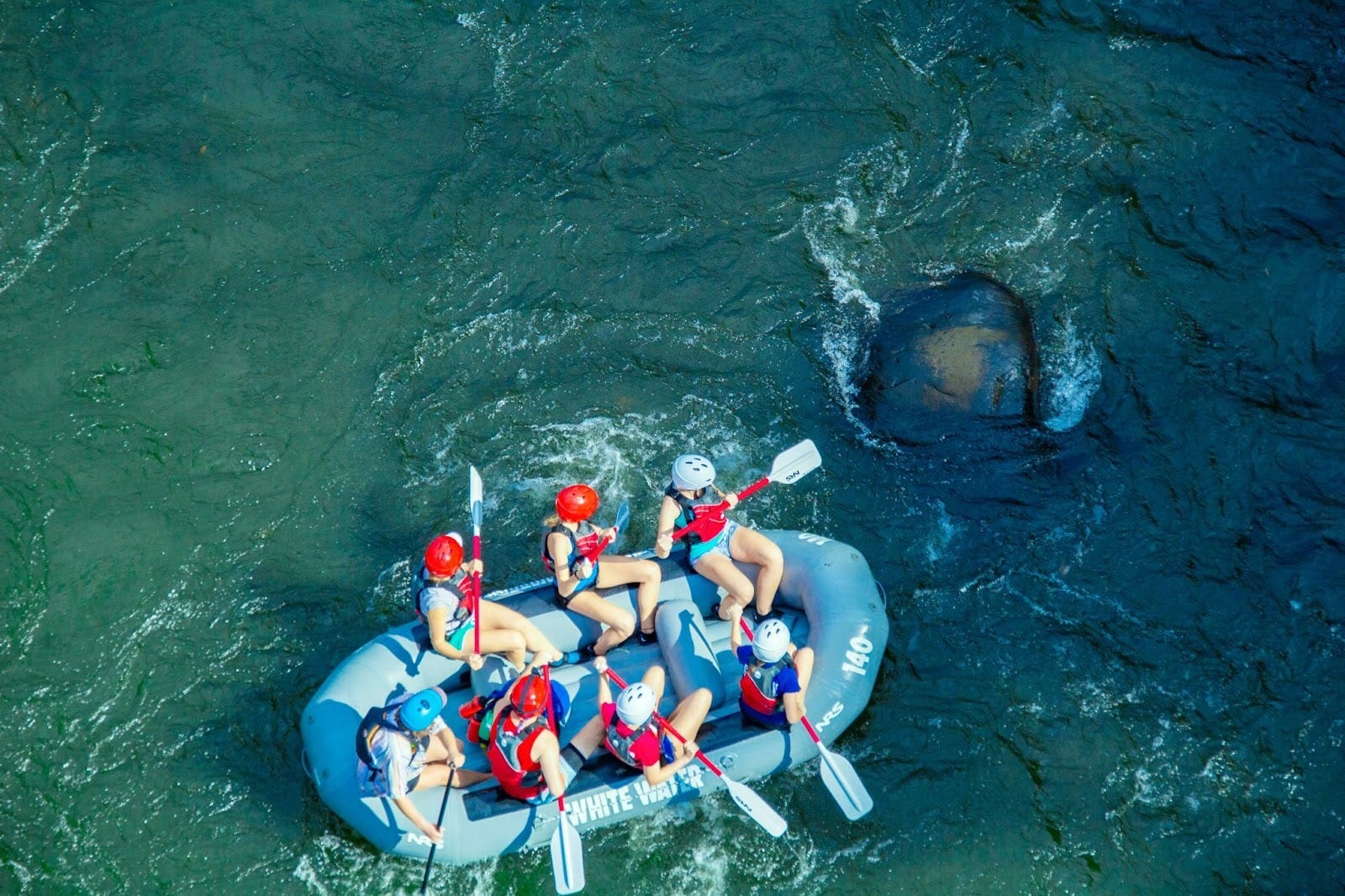
What’s something you’ve always wanted to do but never had the courage to try? Whether it’s standup comedy, a cooking class, singing, or flying trapeze, we all have something we secretly want to do — and perhaps we have never even admitted to others, or maybe even ourselves, that we want to do it.
I’m pleased to share that now is your chance.
Pause your reading of this article (briefly!) and say out loud — or write down somewhere, ideally on something physical — one thing you’ve always wanted to do but, whenever you actually thought about it, you were overcome with fear, dread, or a vague but extremely hard to override visceral reaction of: “Me? I could never do that!”

I am here to tell you not only that you can do that thing, but that you should, and perhaps not for the reasons you think. There’s no shortage of books and resources out there about why we should do new things, and particularly those that scare us. It can be good for our brains, our mental health, our physical health, our social health, and may even underpin what psychologists call a “psychologically rich” life.
But if you’re anything like me, you know all this and you’re still afraid to do that thing. So I’ve drummed up five more reasons that are slightly off the beaten path to do the scary, secret thing you’ve always wanted to do.
1. Increase your appreciation for something you care about
This is probably the one you’re most likely to have heard of before, which is that trying something new, and particularly something well outside your comfort zone, can help you better appreciate that thing.
For example, I always knew figure skating seemed hard. Like many of you, I watched Tara Lipinski become the youngest skater to win Olympic gold in the winter of 1998 (for those of you who were not born yet, it was a big deal) — and it’s not like I was sitting there thinking, “Yeah, yeah, I could do that.” But it wasn’t until about ten years later, when I took adult figure skating lessons because I was an aimless Ph.D. student with a gift for procrastination, that I came to truly appreciate that figure skating isn’t just about strength and balance — it’s also about physics: hurtling yourself through space with a kind of precision, torque, and attention to detail that felt, to me, like trying to conduct open heart surgery while also making turns in the Indianapolis 500 (not that I’ve done either, but I’m certain that’s what it’s like).

I’m not a pro athlete, I don’t compete, and I don’t even take lessons anymore (I was dreadful, it was expensive, and eventually I had to get a job), but every time the Olympics roll around, I feel grateful that I have a little more of a physical appreciation of the majesty that I’m watching because I’ve tried, however humbly, to spin and jump on ice myself.
(I should say here: please don’t do anything where you would hurt yourself. I am not a medical professional, and if the health care industry in this country weren’t so complicated, I’d say talk to your doctor before taking on a new physical activity!)
2. Increase opportunities for divergent thinking
One of my favorite scientific studies is a recent psychology paper in which researchers taught one group of children to perform a magic trick and taught another group a drawing technique to make it look like objects farther away are getting smaller. They then had children in each group complete a number of tests, including the Alternative Uses Test (AUT), a common test in psychology research on creativity in which subjects are given an object (e.g., a brick) and asked to list as many different uses for that object as possible (e.g., a paperweight, a doorstop, a piece of exercise equipment, and so on).

In this study, children who were taught the magic trick were found to generate both more alternative uses as well as more original uses for the objects than the children who learned the drawing technique. Why? The research is still underway, but one explanation is that learning a magic trick is an experience that disrupts existing schemas, or ways of seeing the world. Being exposed to something that seems impossible and then having it revealed how it was possible can invite what researchers call divergent thinking, or an ability to generate many surprising and perhaps seemingly unrelated ideas or solutions.
Does this mean you should ditch any plans you had to take an art class and instead learn a magic trick? Not necessarily (though learning magic is fun!) — but what it does suggest is that exposing yourself, and particularly your brain, to things that seem impossible and then resolving that impossibility can broaden your thinking in other ways about what might be actually possible.
3. Expand the adjacent possible
One of my favorite ideas in the world of innovation comes from the fields of evolutionary biology and complex adaptive systems (an interdisciplinary field interested in how the interactions of diverse actors over networks can give rise to big events, like stock market crashes, traffic jams, and even consciousness). Beginning in 1996, and then over the course of many other works on how evolution can give rise to novelty, a scientist named Stuart Kauffman developed the idea of the adjacent possible, which can be thought of as the space of all possible new discoveries at one time. Combining two previously uncombined ideas, behaviors, organisms, or technologies can expand the adjacent possible and increase innovation.
For example, Gutenberg’s printing press revolutionized human interaction with information, but it was invented by combining existing technologies of the wine press with developments in ink, paper, and typing. The iPhone was possible because of a novel combination of existing technologies, some going back decades, for mobile technology, cellular communication, and touch screens. Even the generative AI revolution happening today can be traced back to work that over decades expanded the adjacent possible of text processing, neural networks, computational power, and transformer architecture.

What does this have to do with you doing your secret weird thing you’re afraid to do? Well, regardless of how the thing itself turns out — whether you’re any good at it, whether you even like it, whether you want to do it again — doing something new means expanding your adjacent possible. Who knows what you might discover or invent if you finally combine, for example, your deep knowledge of teaching with your secret passion for rewilding urban areas?
It’s what my undergraduate environmental economics professor would call a “no regrets” policy: no matter how it turns out, you’re better off because you did it.
To add even further bonus points, John Cleese, Edward de Bono, and I also recommend you lean into the intermediate impossible — the unimpressive, illogical, silly ideas that might arise when you first approach a new problem — because inviting and encouraging it will perhaps get you somewhere incredible that you wouldn’t have found had you stuck with only sensible options from the start.
4. Help heal the country
I know, we’re supposed to be taking a break from politics this week, but I can’t help myself. Involving yourself in something new usually means interacting with new people, whether online or in person. And one of the biggest challenges facing American politics today is that it’s increasingly rare to interact with people who are terribly different from us. Whether it’s our jobs, our neighborhoods, or our curated, personalized algorithms (wanted or not), it increasingly requires some deliberate effort to spend time with people in different walks of life or with different identities or political views from our own. That’s the bad news.
The good news is that a growing body of research on overcoming differences — political or otherwise — suggests that interaction in structured activities in a shared environment can go a long way towards helping us understand and empathize with people different from us. You don’t even have to have a difficult conversation about, say, immigration, while you spot each other in your acro classes. And you might surprise yourself with how much you have in common with people you don’t normally think you like or trust.
To be clear, I’m not telling you to put yourself in danger. If you’re a person of color, I’m not saying to go bowling with the KKK. I’m saying to go into an activity that you think might include people from different walks of life and interact sincerely over your shared learning of that thing.

For example, I recently took a flower-arranging class, not because I have any interest in flower arranging but because a friend suggested it and I try to practice what I preach and do new things. Not only did I end up gaining a profound appreciation for bouquets and flower arrangements (per reason 1 above), but I also got to learn about how mothers of middle schoolers in New York City arrange for their kids to go trick-or-treating in a place without single-family homes. It’s not going to solve our deep divides on its own, but it’s a step towards understanding how people with lives different from ours make it all work. And who knows where else that could lead?
5. Enjoy the absolute liberty of being completely terrible at something
When I first adopted my two puppies (they are rescues, and yes, I am a hero, thank you so much), I quickly learned I was out of my depth and signed up for training sessions for them. I thought the training would involve me sitting back and watching while the trainer taught them things. Imagine my surprise to learn that the primary object of the training was me, because I had to learn how to interact with, communicate with, and (the hardest part) strategically ignore my puppies in order to help them grow up to be independent and not howl every time I leave the house (still working on it, with apologies to my neighbors).
It was so hard, and I was really terrible at it, especially at first. I could not seem to remember the basic things the trainer had taught me from session to session, my timing of rewards and commands was dreadful, and I really lacked intuition around fundamentals, like even how to properly hold a leash. It wasn’t until I was apologizing to my trainer and she said, “You’re not supposed to be good at this, that’s why you’re here,” that it finally dawned on me that it was okay not to be great at something.

I don’t know about you, but every single message in my life (besides the one from my therapist, who tells me to think, “I’m enough” — and, anyway, she’s wrong) is about seeking excellence. We should want to be top students who then become high performers who hopefully in turn inspire others. We have awards for the top athletes, the best actors, and the most skilled surgeons. Even the advice around failure is usually given in the context of succeeding — you should embrace failure so that you can become excellent.
Look, I don’t have any problem with excellence (some of my best friends are excellent), but I would like hereby to declare that it’s overrated. Sure, it’s nice to be good at a few things, but there’s something to be said about the absolute liberty and lack of pressure that comes from not having to be great. I’m not trying to let my dogs down by being the worst training student ever, but once I let myself off the hook of being the best training student ever, guess what: I got better, and I had more fun. Plus, my dogs are perfect.
In conclusion, sure, you could do the secret weird thing you’ve always wanted to do but were too afraid to try because you want to improve your health and/or happiness. But if that’s not enough for you, I hope these slightly more esoteric ideas have offered you a few other reasons to go out there and try something new. There’s a chance you’ll be terrible at it. But there’s an even bigger chance you’ll have a richer life, generate new ideas, make discoveries, help heal the country, and have fun.
P.S. In the spirit of practicing what I’m preaching, my current fear is posting videos of myself being authentic online. I usually only post things that have been rehearsed or edited. So after this article goes out, I’m going to post something unedited and unpolished. See you there.