

Federal Prosecutors Are Resigning in Droves
The DOJ is facing an unprecedented wave of exits across the country

At least 14 federal prosecutors in Minneapolis, and several more in Washington, DC, have resigned or announced their intention to resign in the weeks following the killings of Renee Nicole Good and Alex Pretti by US Immigrations and Customs Enforcement (ICE) officers.
Not only are these departures unprecedented — the office doesn’t normally experience this many resignations in an entire year — but they also come on the heels of unusually high turnover in the Department of Justice (DOJ) as a whole in 2025.
While many of the 2026 resignations are considered to be reactions to the DOJ’s demands in the wake of the Minneapolis killings (including a demand that prosecutors investigate Good’s widow), the 2025 departures may have been for a variety of reasons — from being fired without explanation, to being offered incentives to leave in the name of shrinking the federal workforce, to exiting over objections to Trump policies targeting the DOJ, both nationally and locally.
Regardless of the reasons for it, this massive turnover, particularly among DOJ leadership and experienced attorneys, is creating all kinds of problems — a chasm of institutional memory, mistakes in DOJ work, and a backlog of cases, with some even being dropped because of a lack of personnel to handle them.
So just how many people have left the DOJ since Trump took office? How many of them are attorneys? How unusual are departures in these numbers compared with other recent years?
I took a look at some data to help us get our heads around the magnitude of what’s been afoot at the Justice Department and among federal attorneys working across the 94 judicial districts of the US.
A bit of background on the Department of Justice
With more than 107,000 employees as of December 2025, the DOJ is the fourth-largest department in the federal government (after the Departments of Defense/“War,” Veterans Affairs, and Homeland Security). In general, the job of the DOJ is to enforce and legally defend the federal law of the US, through law enforcement, prosecution, defense of the US in civil cases, and some activity related to debts, fraud, and other legal concerns.
It’s a sprawling organization that gets somewhat rearranged in every presidential administration, with some offices added or removed altogether. Below is the organizational chart approved by Attorney General Pamela Bondi in early February of this year. We’re going to have our eye on the two boxes with gray borders, but it’s helpful to see the whole picture.
Organizational structure of the US Department of Justice
As approved by Attorney General Pamela Bondi on February 17, 2026.
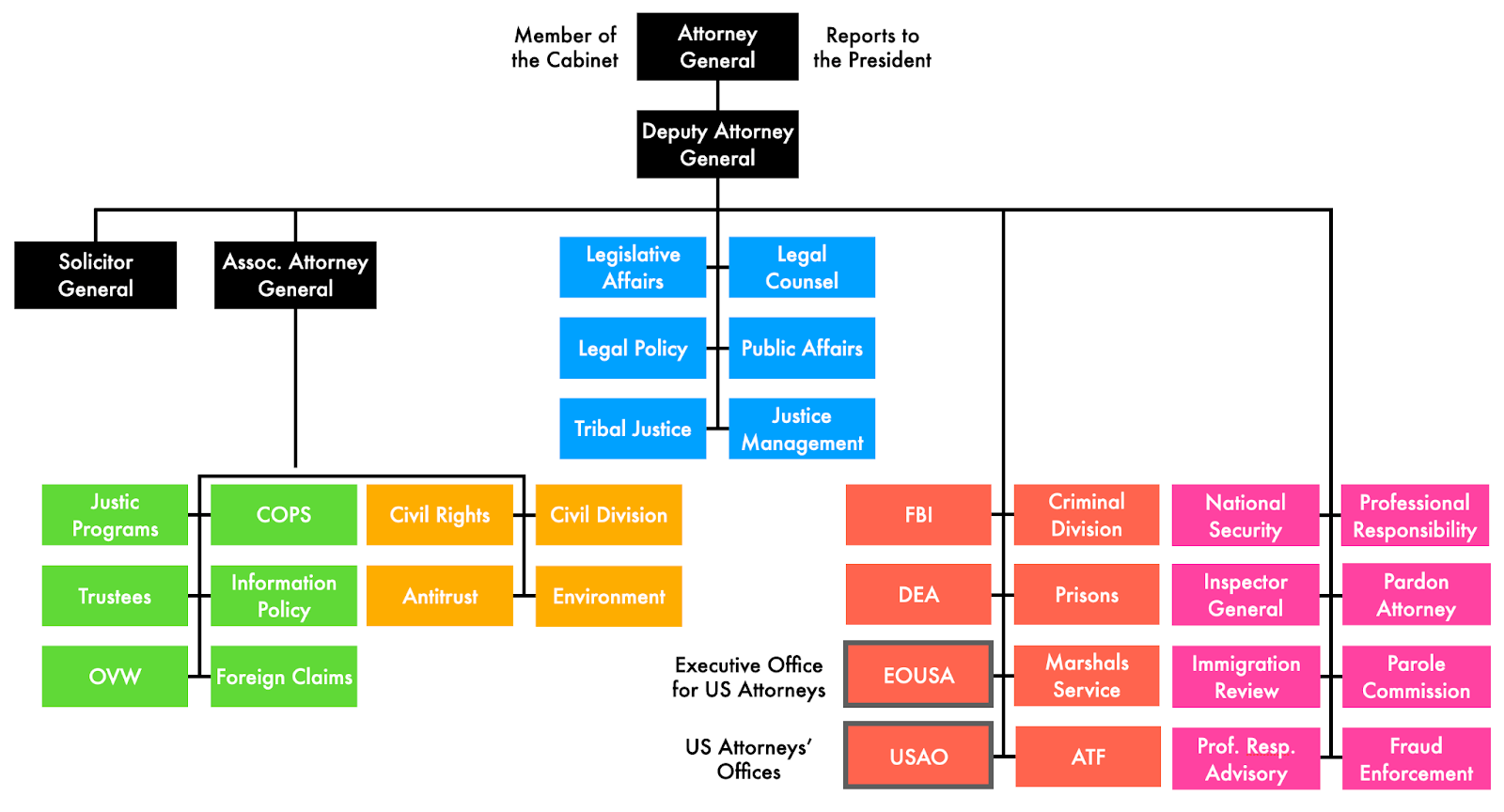
When we refer to federal prosecutors such as the many who resigned in Minneapolis, we are often, though not always, referring to assistant US Attorneys (AUSAs) in the US Attorneys’ Offices (or USAO). (The other thing to know about the DOJ is that it, like much of the government, has a Lot of Abbreviations (LOA).)
There are 93 USAOs across 94 federal districts in the US (Guam and the Northern Mariana Islands are separate districts with one shared attorney). Each office is led by a US Attorney, who is appointed by the president. About 5,000 AUSAs work across these districts and are generally in charge of representing the US government in federal court. That said, some federal prosecutors are not AUSAs but attorneys who serve the DOJ in another capacity, such as in DC rather than a district office.
A final category to note is the Executive Office for US Attorneys (EOUSA). This office houses administrative and executive staff who support the US Attorneys and AUSAs in their work.
We’re going to include both the USAO and the EOUSA in our analysis for two reasons: (1) fully understanding turnover in this section of the DOJ means considering the departure of everyone in the office, not just the attorneys; and, much more important, (2) most of the available data lumps them together, so we don’t always have a choice.
That said, we do know that just over half (54%) of the approximately 10,100 EOUSA and USAO employees are classified as attorneys (approximately 5,500), so we’ll keep this in mind as we inspect the numbers that we can’t drill down on specifically.
Overall workforce changes
Our first stop is to get a sense of how much the overall federal workforce has changed during Trump’s second term compared with recent previous years. All of the data presented below is current through December 2025, which unfortunately means we won’t have information about the many changes in 2026 so far. (We should have January numbers in early March, so stay tuned (cliffhanger!).) But as we’ll see, despite the high recent turnover, there were already some notable swings underway even before the start of 2026.
The chart below shows the percentage change in the size of the workforce for the federal government as a whole, the DOJ in particular, and the EOUSA & USAO (by the way, this never stops being awkward to say or write, so don’t worry if you’re struggling to keep all the vowels straight). Note that the years refer to the government’s fiscal year, which begins on October 1, so the “2026” numbers are, confusingly and disappointingly, current only as of December 2025.
The workforce of the Executive Office for US Attorneys (EOUSA) & US Attorneys’ Offices (USAO) has shrunk considerably since 2025
Percentage change in workforce size of the federal government as a whole (“federal”), the Department of Justice (“DOJ”) specifically, and the EOUSA & USAO combined since 2016.
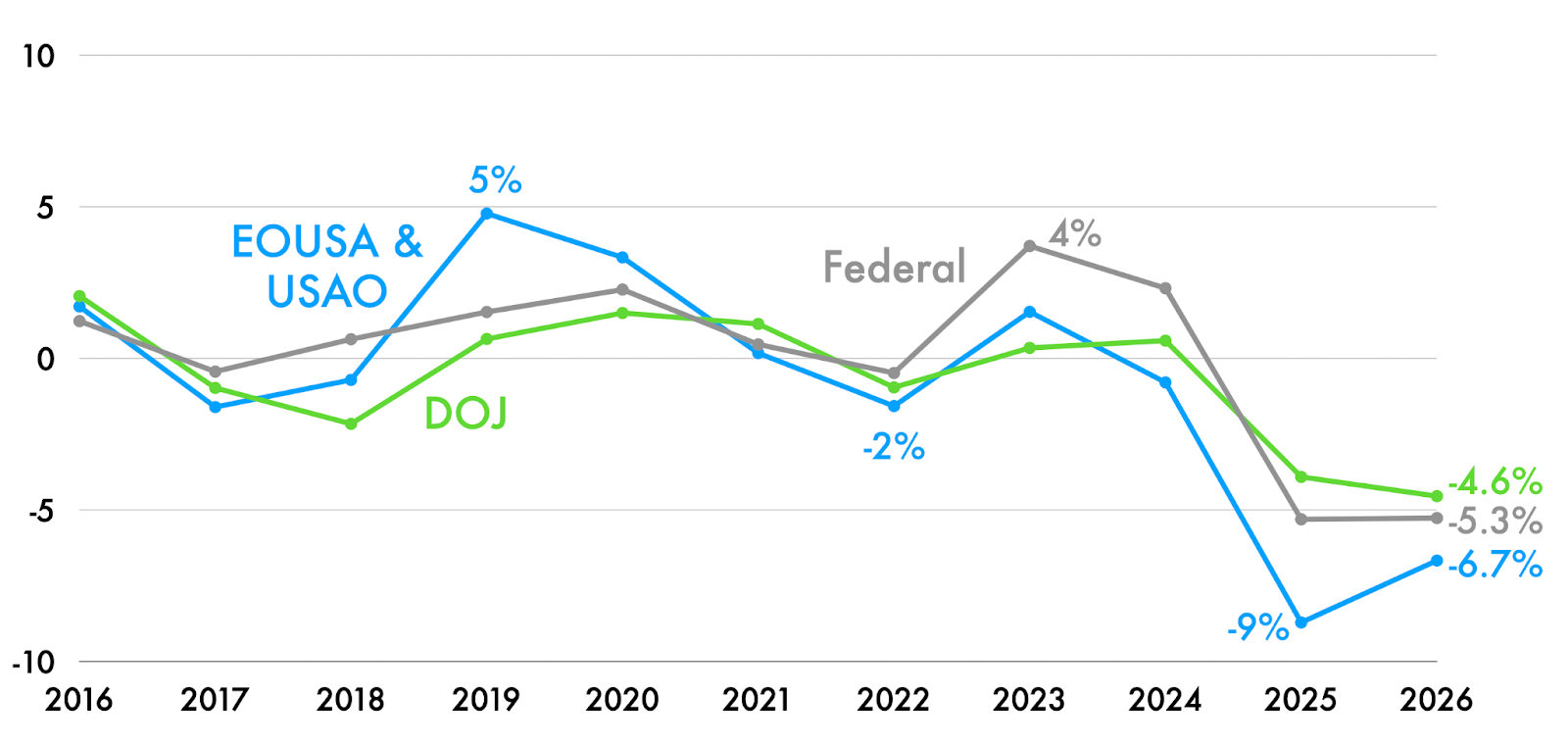
The federal workforce as a whole has shrunk by just over 5% since Trump returned to office, marking the biggest decrease over the last ten years, by quite a large margin. To provide some scale: at the end of 2024, the federal government employed a little more than 2.3 million civilians, but as of the end of 2025, that number was about 2.1 million.
There’s a similar story across the DOJ specifically. The DOJ employs just over 100,000 civilians (about 5% of the federal total), and we’ve also seen just under a 5% shrinking in their workforce. And in the EOUSA & USAO, which employ about 10,000 civilians (about 9% of the DOJ), that decline has been even more dramatic: 9% during fiscal year 2025 and nearly 7% as of December 2025.
Not only are these large and ongoing decreases, but, as with the federal workforce as a whole, these swings are far larger than any shifts, positive or negative, over the past decade.
Why are the numbers going down?
If the overall headcount of employees at an organization goes down considerably, two things might be at play: people are leaving and/or people are not being hired. When it comes to the DOJ and the Attorneys’ Offices, both are afoot: a lot of people are leaving, and hiring has shrunk considerably as well.
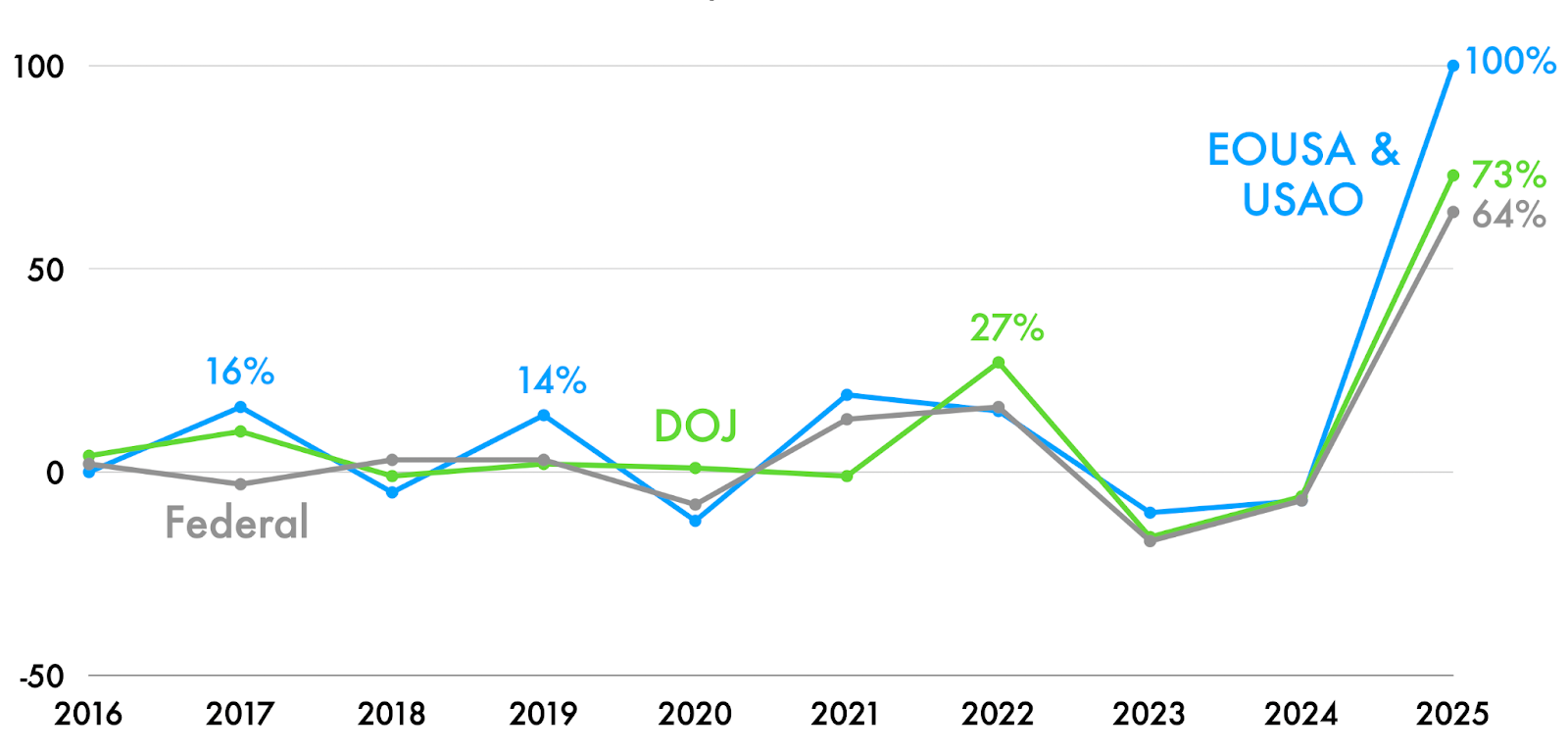
The below chart shows the percentage change in “separations” — leaving the federal service for any reason at all — across our three hero groups. We can see that separations skyrocketed in all three during 2025. Again for some scale: in 2024 the federal government experienced approximately 222,000 separations, and in 2025 this number increased to about 360,000. The DOJ had about 8,500 separations in 2024 and nearly 15,000 in 2025. And the Attorneys’ Offices went from 1,100 separations in 2024 to 2,200 in 2025. (The “2026” data, which actually comes from the last few months of 2025, is only partial at this time, but we’ve already seen 58,000 federal separations, 2,100 DOJ separations, and 281 EOUSA & USAO separations.)
Separations from the US Attorneys’ Offices and the Executive Office for US Attorneys doubled in 2025 compared with 2024
Percentage change in employee separations (leaving federal service for any reason) from the federal government, the DOJ, and the EOUSA & USAO since 2016.
While separations are more dramatic, there are also noteworthy trends in “accessions,” which refers to employees joining the federal service for any reason. Overall, there’s been a bit more fluctuation in these numbers over time, including a bit of a spike in accessions in the DOJ and Attorneys’ Offices in 2019, but in general our trend is similar — far less new hiring across all three of our levels of organizational analysis in 2025.
New hires at the US Attorneys’ Offices and the Executive Office for US Attorneys halved in 2025 compared with 2024
Percentage change in employee accessions (entering federal service for any reason) from the federal government, the DOJ, and the EOUSA & USAO since 2016.
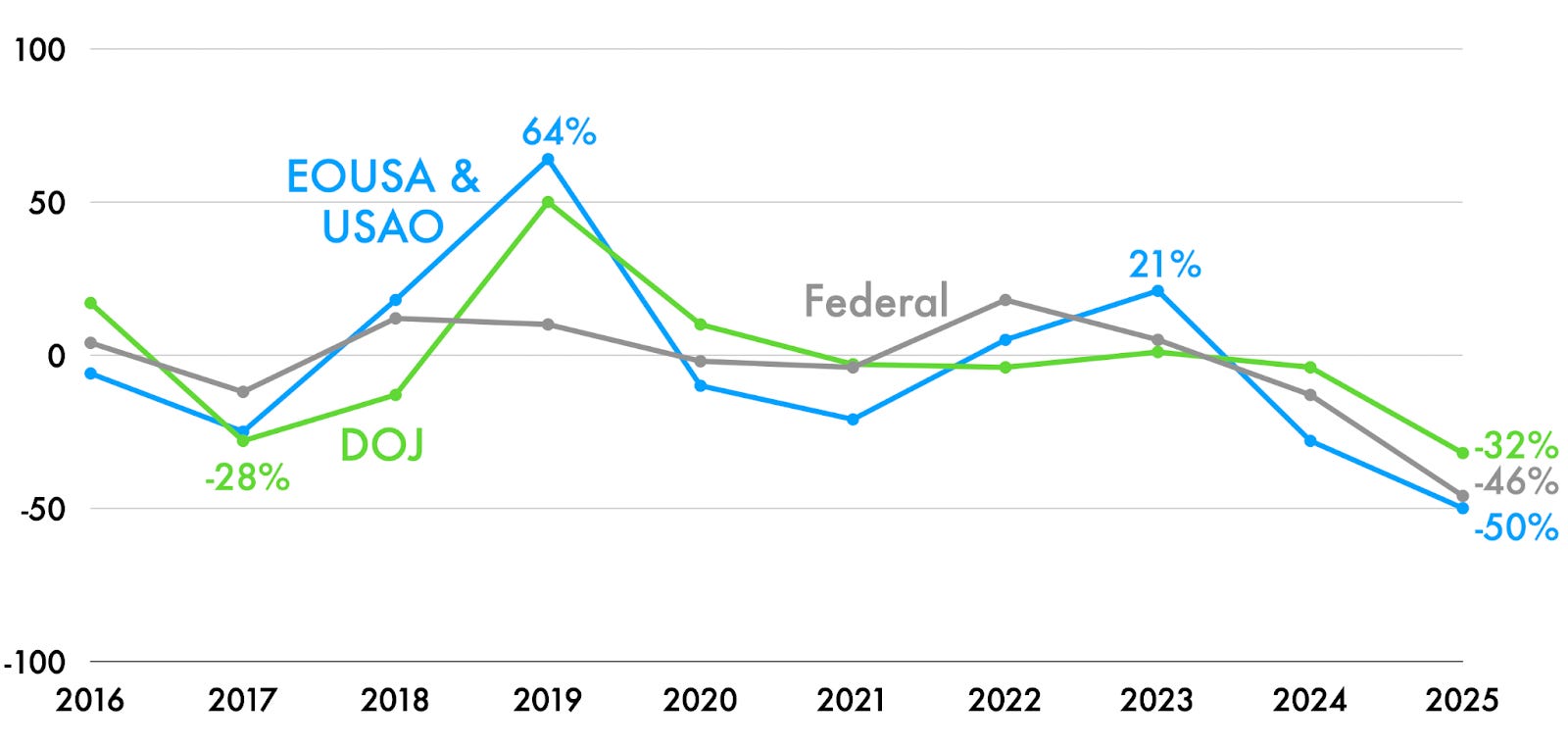
Again for scale: the federal government as a whole hired about 130,000 fewer people in 2025 than in 2024, the DOJ hired about 3,000 fewer people, and the EOUSA & USAO hired about 500 fewer people last year than in the year before Trump returned to office.
Do we have any way of knowing why people are leaving?
Sort of. The government does provide data on people’s reasons for leaving, though not quite to the level of granularity we might hope for (e.g., “Just how mad are you?” or “Is this more of just a money thing and we shouldn’t read too much into it?”).
That said, we can gain a little more clarity with some data about broad-stroke categories of reasons for separation. And, happily, we can also zoom in on our beloved attorneys in particular. The chart below shows some of the reasons most commonly cited for separation (though there are about 14 possible ones in the original data).
The abbreviation (yet another!) “DRP” refers to the Deferred Resignation Program, a Trump administration initiative to reduce the federal workforce by inviting workers to resign while retaining months of benefits and pay without needing to work. Employees who made use of the DRP could have done so through multiple pathways: resignation, retirement, early retirement, or other avenues. As we can see below, it is the most common reason for exit in the federal workforce as a whole since Trump took office, but the second most common once we zoom in on our key department, offices, and role.
More than half of attorneys who exited the EOUSA & USAO since Trump returned to office did so by resigning
Percentage of separations from the federal government, the DOJ, the EOUSA & USAO, and specifically “attorney” careers since January 20, 2025.
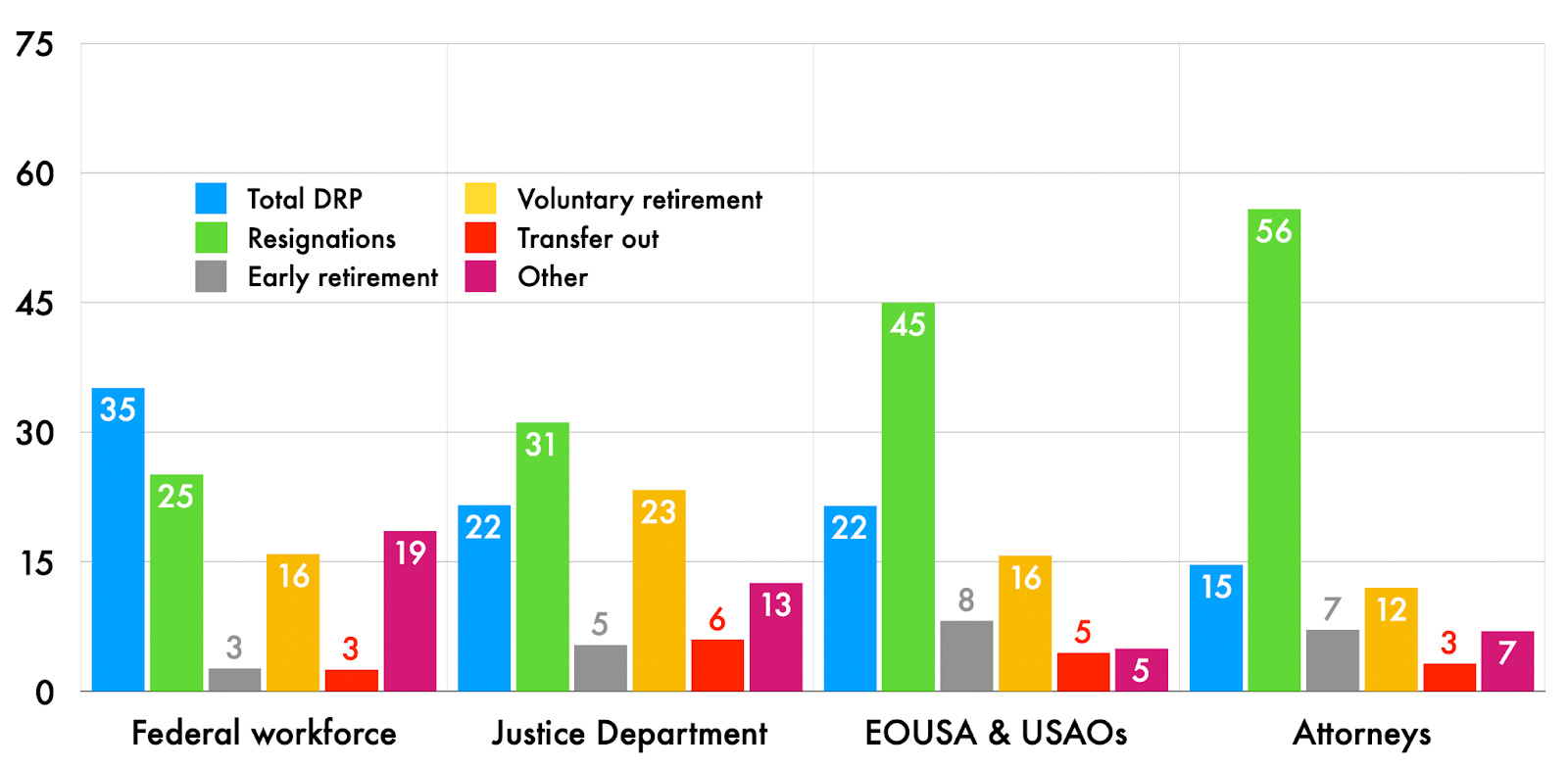
The pattern that immediately stands out from this chart is that unlike separations in the federal workforce overall, where DRP exits are the most common type since Trump returned to office, most separations in the DOJ are due to resignations. That is even truer in our attorneys’ offices and among attorneys specifically. While we cannot say for sure from this data alone why attorneys were far more likely to flat-out resign than to exit via DRP, the pattern is consistent with the hypothesis that there is more discontent in the DOJ, and specifically this segment of it, than in the federal workforce more broadly.
Overall, about 120,000 employees across the federal government exited via DRP in 2025, with about 88,000 separating by offering their resignations. In the DOJ itself, however, about 4,300 employees resigned, while only around 3,000 exited via DRP. In the EOUSA & USAO, there were just over 900 resignations, more than twice as many as the approximately 400 DRP exits. Finally, among our attorneys specifically, the majority of exits were resignations: 631 attorneys resigned between Trump’s coming to office and December 2025, compared with only 166 who left via DRP.
Back to Minneapolis
Of course, these numbers are nationwide, and trends vary across districts. As of January 31, 2025, the District of Minnesota, which is headquartered in Minneapolis, had about 140 total employees, with approximately 70 serving as AUSAs. Even without any turnover in 2025, the 14 departures in early 2026 would represent 20% of all AUSAs in the district. Other reporting suggests not only that this is the highest turnover seen in just one month by the district in its history, but also that the criminal division in Minnesota, which usually has about 50 AUSAs, may now be down to as low as 20.
The twofold concerning conclusion, thus, is that the turnover in Minneapolis among federal prosecutors is both striking in its size and speed compared with broader national patterns of resignations across US Attorneys’ offices, and consistent with (if not an extreme version of) a broader, longer trend of exits around the country since Trump’s second term started. The resignations in Minneapolis, in other words, are a kind of icing on the cake of general USAO, DOJ, and federal workforce turmoil. And I’m sorry for RCFY (Ruining Cake for You).
 | A guest post by
|
Excellent research and statistics. The charts were phenomenal. Thank you for spelling this out so thoroughly. I must admit that because of such an in depth explanation, I’m a little more dismayed and disgusted at this administration. I guess ignorance truly IS bliss. But dangerous. Thank you again.