


DOGE finally got audited by the people whose actual job is to audit the federal government. It didn’t go great.
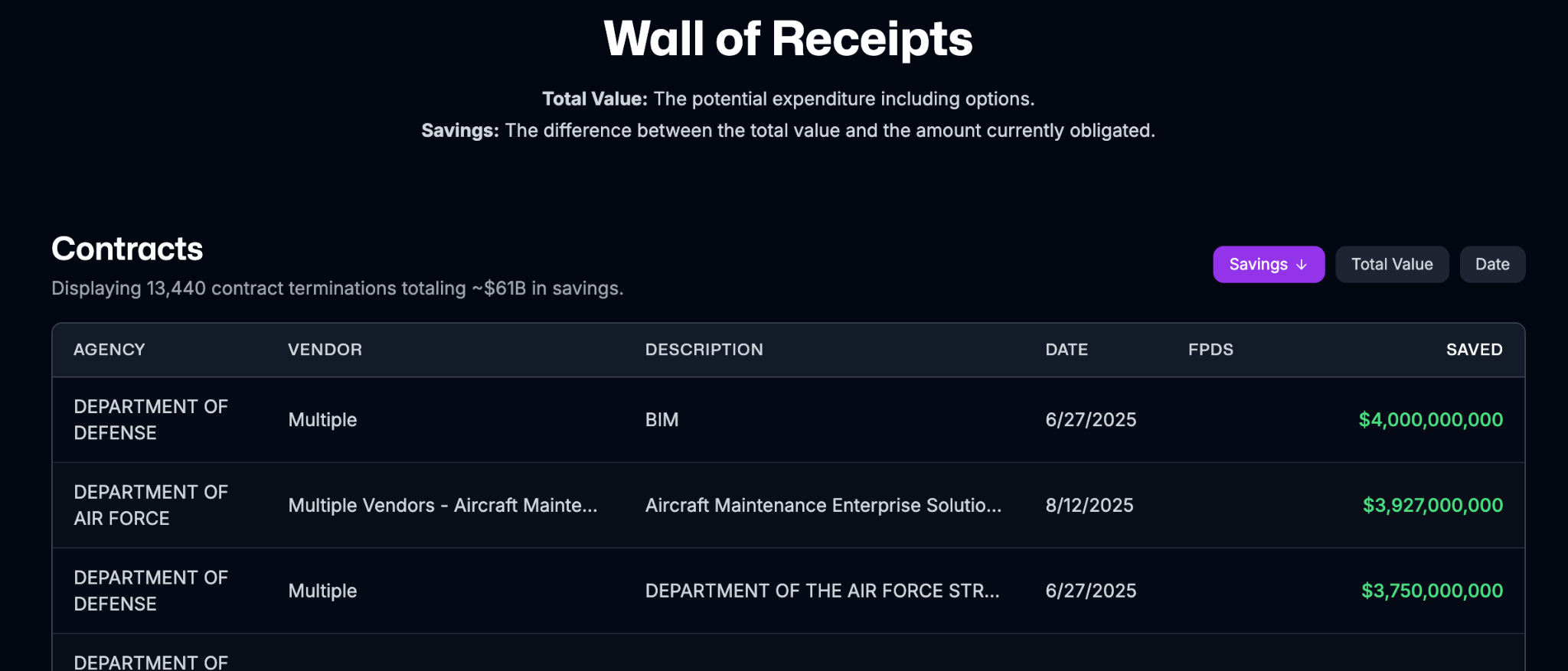
Earlier this month, the Government Accountability Office (GAO) — Congress’s nonpartisan watchdog charged with auditing federal spending and programs — released a 52-page report examining DOGE’s “Wall of Receipts.” Elon Musk, DOGE’s public leader, promoted the site to show Americans how much money it said it was saving by taking a scalpel to government contracts, grants, and leases.

The wall was intended to give the appearance of transparency. DOGE was making enormous claims about government waste and even greater claims about how much money it was saving by rooting that waste out. The wall was a public itemization of the supposed receipts so taxpayers could see for themselves.
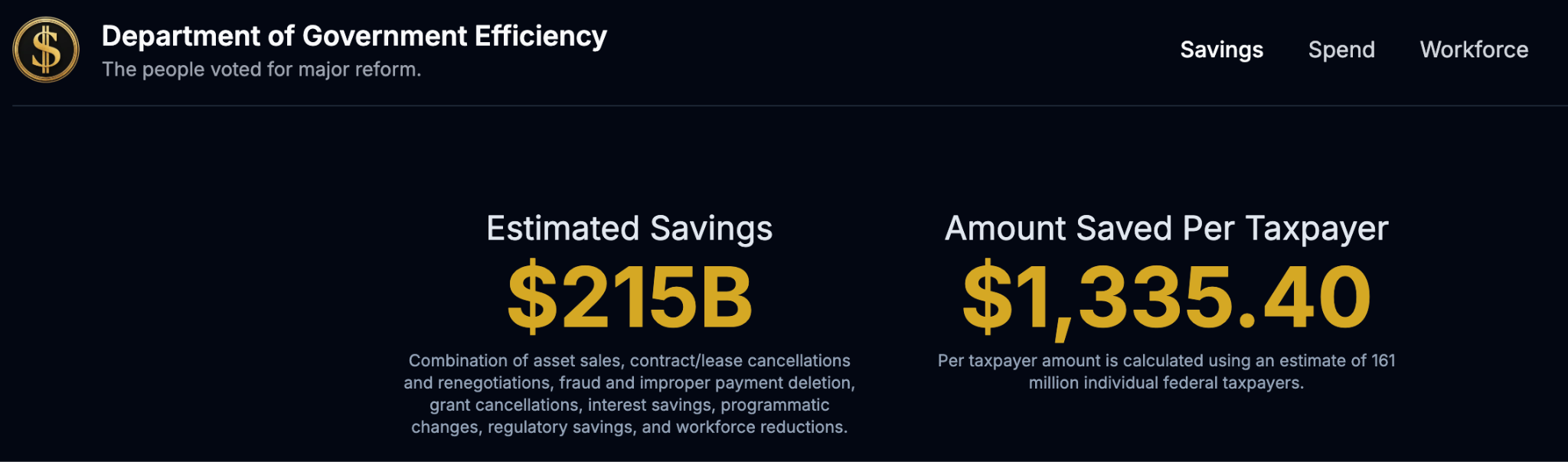
As of January 1, 2026 — the last time the website was updated — the site insisted it had found approximately $110 billion in savings from cutting contracts, grants, and leases. Once workforce reductions (government speak for firings and layoffs), regulatory changes, and interest savings were factored in, the DOGE website puts its overall savings at $215 billion. The page says those savings amount to $1,335.40 for every federal taxpayer.
Given DOGE’s penchant for errors and its failure to live up to its own hype before shutting down earlier this summer, most observers aren’t quick to take DOGE numbers as the gospel. But, luckily for us, the GAO went looking at the receipts behind the receipts.
Some of the claims checked out, while others very much did not. Multiple contracts DOGE said had been terminated had not been. Billions in alleged savings could not be matched to federal contracting records. In around 75% of the cases, the GAO could not verify DOGE’s stated method for calculating its reported savings. Auditors could not recreate the methodology behind 96% of the claimed grant savings, and DOGE took credit for more than 100 lease cancellations that were already underway before DOGE existed.
And if that weren’t enough, sometimes the math was just wrong.
This is quite a problem for an organization whose basic pitch was that everyone else in government needed to show their work.
Start with the contracts
DOGE reported roughly $61 billion in savings from terminating roughly 13,440 contracts.
In attempting to match the terminated DOGE contracts with the Federal Procurement Data System, the government database used to track federal contracts, the GAO was able to verify 11,620 of them.
That left 1,856 contracts representing $7.2 billion in claimed savings that GAO could not reliably identify in the federal database because DOGE had not provided enough information.
Now, this is where some reader care is needed. Just because the GAO could not identify them, it does not mean those contracts were made up. DOGE stripped identifying information from thousands of USAID contracts, for example, and when USAID was dismantled, it also meant some federal contracting records were never properly updated. Record keeping gets tougher the staff who was meant to update the contract data has been fired.
Still, DOGE was the one claiming the savings. If you tell taxpayers you saved $7.2 billion and then the federal auditors cannot even identify the contracts well enough to check your math, “trust us” is a pretty lousy receipt.
Then the GAO looked at the nearly 12,000 contracts it could identify.
DOGE had labeled all of them as “terminated,” but federal records told a different story. GAO found 2,503 contracts worth $27.4 billion in claimed savings that had not actually been terminated, in full or in part. Again, there are caveats here, particularly with USAID records. But even if we remove USAID contracts from the calculations, contracts that were never actually terminated account for 39% of DOGE’s claimed savings.
And of the contracts the GAO could identify and were officially terminated, they found big problems with DOGE’s math. According to DOGE, they calculated savings by taking the total value of a contract and subtracting what the government had already obligated. Whatever hadn’t been paid was cut, and the cut counted toward the tally of savings. Simple enough?
Except GAO found DOGE actually followed their own stated methodology for only 27.5% of its reported contract savings, representing only $16.8 billion. For another $37 billion, DOGE used some other unstated calculation, or GAO could not determine what calculation had been used.
After walking through the books, the GAO requested interviews and clarifications from DOGE employees in an attempt to clear up the discrepancies. DOGE officials did not respond.
One contract buried in the report pretty well sums up the problem. DOGE claimed more than $1.7 billion in savings from a Defense Health Agency contract that provided IT support to more than 700 military medical facilities around the world. DOGE initially targeted the contract for termination, but after defense officials explained why they needed it, DOGE agreed that the contract should continue.
So it did. The contract was not terminated, nor was its scope or value reduced. But DOGE kept the $1.7 billion in savings on its Wall of Receipts anyway, as though it had been. The GAO’s conclusion was about as direct as government auditors get: No savings were achieved.
Saving money is more complicated than canceling stuff
Here is where DOGE earns some credit.
Anyone who has spent much time around government procurement knows that contract ceilings, obligated funds, option years, de-obligations, modifications, task orders, and actual spending are different things. Figuring out precisely how much money the government “saved” when the terms of a contract change can be genuinely difficult.
And the GAO did find real savings in some of the contracts it examined.
More specifically, GAO auditors did a deep dive into 21 Defense Department and Department of Health and Human Services contracts on which DOGE had claimed $7.5 billion in savings. They found $77.8 million in funds that had actually been de-obligated, meaning that money previously committed to those contracts was formally taken back and made available for other government uses.
Those DOGE actions produced true savings of taxpayer funds, but not without real tradeoffs. Thousands of jobs were cut, services were halted, and vital assistance — domestically and internationally — were stopped. DOGE cuts to foreign health care programs have been linked to hundreds of thousands of preventable deaths. And if those tradeoffs are bad enough, the audit found far too few contracts could verifiably document such savings.
Consider an Air Force contract totaling $43.5 million to modernize financial management systems. DOGE shrunk the size of the original contract by $28 million, and claimed the same amount of savings. Soon after, though, the Air Force awarded the same contractor a different $27.4 million contract to do the exact same work that DOGE took out. In fact, as an Air Force official told GAO investigators, the contract shuffle was likely to cost the Air Force more money for fewer services because the prices in the second contract ended up being more expensive.
So, did the government really save $28 million, as DOGE claimed? No. Cutting $28 million from one contract doesn’t save taxpayer money if the government turns around and spends roughly the same amount to get the same work done.
These types of accounting tricks — even outright mistakes — plagued DOGE from the beginning. In February 2025, just days after the Wall of Receipts was put online, DOGE famously bragged they saved $8 billion by cancelling a single contract. The only problem was the contract was actually worth $8 million. So close, just missing a few zeros.
DOGE corrected the mistake, arguing that mistakes would happen due to the scale and speed they were moving. But the GAO audit and report came nearly a year and a half later and the DOGE numbers and stated accounting practices are nowhere close to clean.
The grants are even harder to explain
Let’s move on to the portion of the ledger dealing with government grants. Guess what? There are discrepancies there, too.
In total, DOGE reported $49.21 billion in savings from terminating 15,887 grants. Like with the contracts, GAO investigators tried to nail down where those numbers came from.
For roughly one out of every five grants, auditors could not even identify the grant using the information DOGE provided. Those grants accounted for more than half of all the grant savings DOGE claimed.
But wait, there’s more.
DOGE’s website says savings are calculated by subtracting the amount currently obligated from the “total value” of the award. The problem is that USAspending.gov does not have a comparable total-value field for individual grants. So GAO tried to reverse-engineer DOGE’s numbers using several other reasonable formulas.
After their trial and error, auditors were able to reproduce the number for only $1.89 billion of DOGE’s $49.21 billion in claimed grant savings. This means for 96.2% of the grants — worth $47.32 billion — GAO could not verify the method DOGE used. They couldn’t recreate the methods, which is noteworthy for an agency built around bringing transparency to government spending.
Which brings us to the leases, namely office space and other buildings the federal government was renting and sometimes underutilizing. DOGE’s page said it saved $113 million from 264 terminated leases.
GAO did their own painstaking math on the 264 individual leases and the savings came to only $53.5 million, less than half of the DOGE number.
I truly wish there were a more defensible explanation for the discrepancy, and there isn’t one listed in the report. After diving in further, GAO discovered that 108 of the 264 terminated leases were already being cut before DOGE was even created. Those already-cancelled leases represented $15.3 million of the $113 million claimed by DOGE.
Again, DOGE declined GAO’s entreaties to explain their methods. After adjusting for the errors and preexisting cancellations, GAO calculated $31.8 million in savings attributable to the leases on DOGE’s list rather than the $113 million displayed on the website.
And in at least one case, the government tried to reverse a lease cancellation after an agency decided it still needed the space. The landlord said no. The government ended up signing a new five-year lease at the same place at more than $1.5 million per year above the old rate.
That one is noticeably absent from the Wall of Receipts.
Did DOGE lie?
After everything you just read, you’re likely asking the same question.
GAO does not say DOGE lied, nor was proving such a declaration an objective of the audit. Their job was to look at the numbers, attempt to reconcile them, and point out discrepancies as they found them.
Plus, the GAO writes like the GAO. These are career auditors producing a government report. They aren’t lawyers in a court room or cable news producers trying to settle on a chyron for entertainment purposes.
At the same time, the report’s conclusions are damning. The auditors say unequivocally that many of the savings estimates were incorrect, and even more lacked supporting evidence. The report states repeatedly that DOGE did not consistently use its own stated methodologies to calculate savings, and that the Wall of Receipts failed to disclose important and known problems with its own data. Oh, and DOGE would not answer GAO’s questions throughout the audit.
While DOGE formally closed up shop on July 4, 2026, its Wall of Receipts is still online. The site says DOGE is working to upload its receipts in a “digestible and transparent manner,” even though the site says it was last updated on January 1, a full half of a year before it disbanded.
The irony abounds. For over a year, DOGE employees — cloaked in secrecy while preaching transparency — went through the federal government demanding justification that agencies needed their employees, contracts, programs, grants, and even offices. Some of that scrutiny was warranted. The federal government is huge, often redundant, sometimes wastes money, and could be more efficient and transparent in their procurement processes. Agencies should absolutely have to justify how they spend taxpayer dollars and taxpayers should be able to see where their dollars are going in real time.
But DOGE told a different story about itself than one that played out in the accounting books. It bragged about how much money it had saved, then posted the “receipts” to show it.
The GAO looked at the receipts and found the one thing DOGE promised above all else — transparency — was nowhere to be found. And that is what we call an unfortunate end to the story of DOGE.
