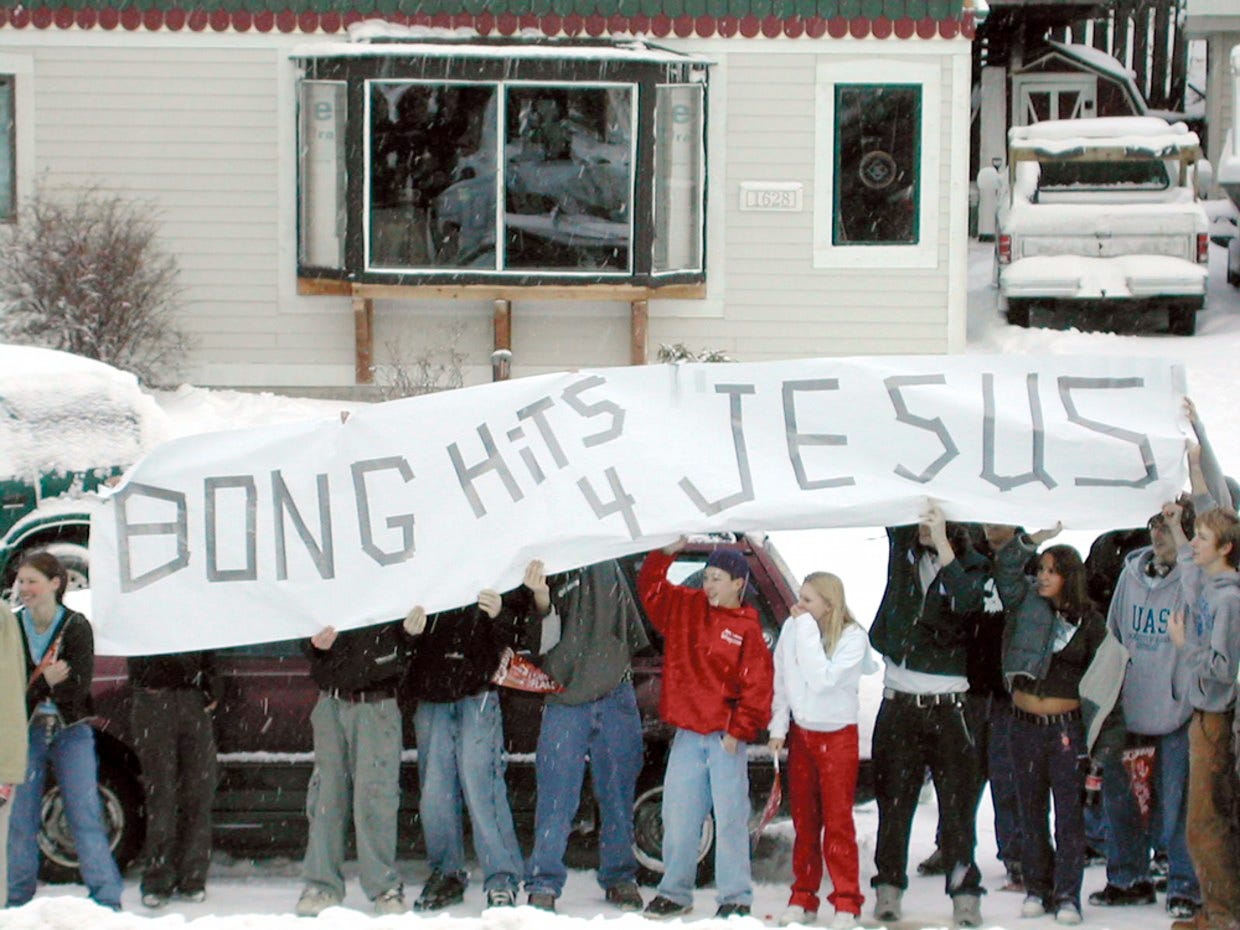
Bong Hits 4 Jesus
The limits of student free speech
On an icy January morning in 2002, students at Juneau-Douglas High School in Juneau, AK, spilled onto the streets to watch as the Olympic torch passed through town. Joseph Frederick — a senior who had not yet been to school that day — joined classmates who were standing across the street from campus. As the television cameras panned toward them, Joseph and his friends unfurled a banner that shocked school administrators. In thick, duct-taped letters that stretched across 14 feet of butcher paper, the banner read, “BONG HiTS 4 JESUS.”
Principal Deborah Morse, who had given approval for students to be outside during the torch relay, immediately ordered the banner taken down. When Frederick refused, Principal Morse grabbed the banner and directed him to her office, where he initially received a five-day suspension for promoting the use of illegal drugs. He received an additional five days after paraphrasing Thomas Jefferson to the principal, reminding her that “speech limited is speech lost.”
Frederick didn’t know it at the time, but this experience would launch a legal battle that went all the way to the Supreme Court. In the process, it would shape what the law says about whether, and when, student speech is constitutionally protected — and demonstrate that while free speech rights in the United States are extensive, they do have limits.
Although Frederick initially described the words on his banner — ones he had first seen on a snowboard — as “meaningless and funny,” he later explained that he intended them as a test of his constitutional right to free speech. After receiving his suspension, he was disappointed by what he thought was too narrow a limit to that right, and he took his case to the Juneau School Board.
When the board supported Principal Morse, Joseph sued both, arguing that his First Amendment right to speech had been violated and requesting that the suspension be expunged from his record. This forced the federal district court to choose between Joseph’s right to speech and the school’s interest in banning the promotion of illicit drugs. The district judge sided with the Juneau School Board, reasoning that because the event was school-sponsored, the principal had the right to enforce school policies against the promotion of banned substances.
It’s worth recalling that 2002 was the high-water mark for the “zero tolerance” movement in American schools. Introduced in the 1980s as part of the “war on drugs,” zero tolerance policies spread nationwide, emphasizing predetermined, harsh penalties for violating school policies against fighting, weapons on campus, and drug use or promotion. For students who came of age in that period, zero tolerance complemented years of D.A.R.E classes in grade school and the brain-on-drugs commercials that aired between Saturday-morning cartoons.
In short, when Joseph Frederick unfurled his banner, the shock value wasn’t limited to getting the controversial slogan on television; it was doubly provocative in the context of a culture that allowed little room for differing viewpoints on drugs — and whose dominant message was clear: “All drugs carry extreme risk.”
Despite the anti-drug school culture of the early 2000s, there was reason for optimism on Joseph’s team when he appealed his case to the Ninth Circuit Court of Appeals. The most important Supreme Court precedent on speech in schools, Tinker v. Des Moines (1969), had offered broad protection for student speech rights, ruling in favor of students who had been disciplined for wearing black armbands in protest of the Vietnam War. But the Supreme Court was clear that student speech could be limited if the speech would “substantially interfere with the work of the school or impinge upon the rights of other students.” Two decades later, in Bethel School District v. Fraser (1986), the Court provided a concrete example of these limits, ruling in favor of a school that disciplined a student for giving a speech laden with sexual innuendo while introducing a candidate for student government.
The Ninth Circuit reversed the decision of the district court and, citing Tinker v. Des Moines, ruled that the principal had violated Joseph Frederick’s First Amendment rights. Not only had the principal punished Frederick for the content of his speech, but she did so without demonstrating how his speech was disruptive.
Unhappy with the result, Morse and the Juneau School District appealed the decision, and in December 2006, the Supreme Court agreed to hear their case.
Morse and the district were represented for free by Kenneth Starr — yes, the one who led the Whitewater investigation that culminated in the impeachment of President Clinton. Starr argued for going beyond the Tinker restrictions. He said that even if advocating drug use at a school-sponsored event failed to cause substantial disruption, it was fundamentally contrary to the school’s mission, necessitating real-time decisions by Principal Morse that were justified and deserving of qualified immunity from civil liability. Further, Starr said that Tinker applied only to political speech and that, by Joseph Frederick’s own admission, “BONG HiTS 4 JESUS” was not a political message.
During oral arguments, a skeptical Justice David Souter pressed Starr. “It’s political speech, it seems to me,” Souter said. “I don’t see what it disrupts, unless disruption simply means any statement of disagreement with a position officially adopted by the school.” Starr responded that categorizing Frederick’s banner as political would be an “unusual characterization” and instead framed the case as “ultimately about drugs and other illegal substances” that are inherently disruptive to a school’s mission. In press meetings as well as legal filings, Starr pleaded for the Court to clear “the doctrinal fog infecting student speech jurisprudence.”
The American Civil Liberties Union (ACLU) provided the defense for Joseph Frederick, presenting the case as a straightforward matter of “whether a school can censor student speech because it disagrees with its message.” Douglas K. Mertz of the ACLU argued that while nondisruptive speech must be tolerated in certain spaces and times — such as cafeterias during lunch — the critical point in the case was that the event was off campus and, prior to its start, Joseph Frederick had been absent from school all morning.
When Justice Ginsburg asked whether the case turned “on the fact that he was late to school that day.” Mertz responded that he believed “it would be a closer question” if Frederick had been at school, “but the fact that he was not there in school today, and intentionally was not there today, turns this into a pure free speech case where you have a citizen in a public space in a public event who was not acting as a student.”
Both sides agreed that the outcome would be critical in defining boundaries for future student speech protections.
In a 5–4 decision issued in February 2007, the Supreme Court sided with Principal Morse and the Juneau School District. The majority opinion, issued by Chief Justice John Roberts, established that schools have the right to protect students from “speech that could reasonably be regarded as encouraging illegal drug use,” which, in their view, created an exception to Tinker: “The special characteristics of the school environment, and the government interest in stopping student drug abuse… allow schools to restrict student expression that they reasonably regard as promoting illegal drug use.” In other words, Principal Morse was justified in removing Joseph Frederick’s banner even if it failed to meet the “substantial disruption” threshold required in Tinker.
As for the specifics of Frederick’s defense, the majority held that the torch event was “school sanctioned and school supervised,” rejecting “the argument that this” was “not a school speech case.” The majority also suggested that Frederick’s “speech was not political” because he was “not advocating the legalization of marijuana or promoting a religious belief”; rather, Roberts wrote, “he was displaying a silly message promoting illegal drug usage in the midst of a school activity.”
The main dissenting opinion was written by Justice Stevens, who — along with Justices Ginsburg, Breyer, Souter, and Stevens — maintained that the banner represented political expression at an off-campus event. They therefore reasoned that the school had restricted the First Amendment rights of Frederick and his friends. Further, Justice Stevens suggested that the Court had overstepped in its ruling, causing “serious violence to the First Amendment” and weakening speech protections intended in Tinker v. Des Moines. He said there was no evidence that the reference to drug paraphernalia on Frederick’s banner “interfered with any of the school’s educational programs,” suggesting the case should have been decided on the “substantial disruption” clause in Tinker rather than by creating a new carve-out for speech that promotes drug use.
Amid the Supreme Court case and the national debate generated by his banner, Joseph Frederick, by then a 23-year-old man, said, “I conducted my free speech experiment in order to assert my rights at a time when I felt that free speech was being eroded in America.” According to NBC, the Court’s decision was the end of a tumultuous era for Frederick, who was forced to drop out of college after his father, “who worked for a company that insured Juneau schools, was fired in connection with his son’s legal fight.”
Ultimately, Morse v. Frederick stands as a reminder that the First Amendment, though foundational, is not absolute — especially in schools. The impact has extended far beyond the “BONG HiTS” banner, forcing us to wrestle anew with one of democracy’s enduring tensions: balancing freedom and order.
Seen in that light, the case is part of a debate that will never go away.