

Betting on the News
Are Washington insiders just profiting from prediction markets, or manipulating them?

Corruption is an enduring feature of the US government, but new prediction markets like Polymarket may have given the old reality a new form. Suspiciously well-timed bets have been raising flags for months now, and it’s worth understanding exactly what Polymarket is and why it suddenly seems to be everywhere. The Preamble contributor Casey Burgat breaks it down in this piece.
— Sharon
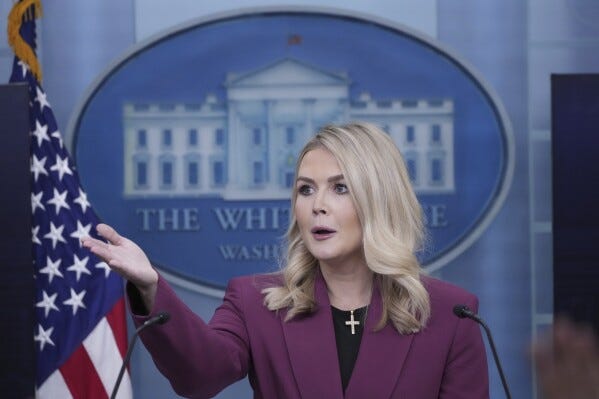
On Jan. 7, 2026, Karoline Leavitt was nearing the end of a routine White House briefing when she stopped mid-thought, thanked reporters, and walked off.
It was a few seconds before the 65-minute mark.
Later, online, people noticed something strange. There had been money riding on whether the briefing would last longer than 65 minutes. The betting markets gave only a 2% chance that the briefing would end under that threshold. So when Leavitt concluded a few seconds shy of the magic number, those holding the “under” contracts won. Big.
That moment might have been a coincidence. It might have been nothing at all.
But, for many, it didn’t feel like nothing because it fit a pattern.
Across a fast-growing platform called Polymarket, people aren’t just following the news. They’re betting on it. Wars. Elections. Fed rate-cut decisions. The weather. And, yes, even the length of a press briefing.
Polymarket presents itself as a prediction tool: a place where crowds, guided by financial incentives, generate better forecasts than pundits or polls. And in some cases, they do. Markets can incorporate dispersed information quickly. They can cut through noise. They can outperform surveys.
But increasingly, some traders seem to be getting bets right in ways that don’t look like luck. Maybe they had an inside source of information that the public didn’t.
And the deeper that concern seeps into politics and policy, the harder it is to ignore a more unsettling possibility: If the people betting on the future actually have a hand in shaping it, will they start to make decisions based on who will win a bet?
A Market for Reality
Polymarket is simple on its face. Users buy and sell contracts tied to real-world outcomes. Will the US enter a war with Iran? Will a specific bill pass Congress? Will a political leader leave office this year?
Each contract trades between 0 and 100 cents, reflecting the market’s estimate of the probability that an event will happen. A contract priced at 65 cents implies a 65% chance. If the event occurs, the contract pays out $1 to those who bet on it. If it doesn’t, they get nothing.
It looks like a scoreboard for the future. But it runs on money, not guesses. Its markets now attract millions of dollars in trading volume on single events, particularly during periods of geopolitical instability like the United States’ recent excursion in Iran.
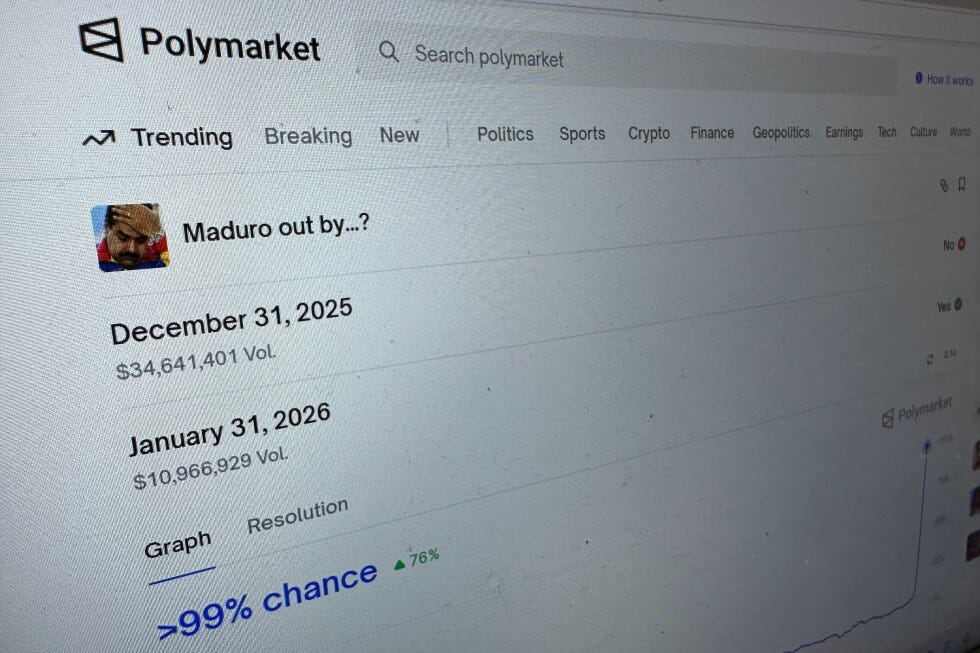
Polymarket isn’t the only platform operating this way. A regulated, US-based exchange called Kalshi offers similar contracts, and CNN, CNBC, and Fox News have even made deals with it to incorporate its prediction data into their programming and streaming platforms. Kalshi has drawn scrutiny from lawmakers, who are investigating whether existing rules are sufficient for this new kind of betting. But Polymarket — which is largely offshore, is based on cryptocurrency, and allows pseudonymous trading — is harder to police. It’s where most of the high-profile, and often suspiciously well-timed, trades have surfaced.
That growth is not happening in a vacuum. Traditional sources of political forecasting have taken hits in recent years. Polling errors in multiple election cycles have eroded trust. Expert analysis often arrives hedged and late. Prediction markets, by contrast, update in real time and force participants to put money behind their beliefs.
That combination of speed, stakes, and clarity has made them feel, to many users, more honest. But they are also more hidden, which creates opportunities to exploit privileged knowledge.
When Being Right Looks Different
In late February, as tensions between the United States, Israel, and Iran escalated, Polymarket lit up.
Traders poured money into contracts tied to possible military escalation, including the likelihood of direct US involvement. At one point, markets implied a sharply rising probability of broader conflict, shifting faster than many official statements or media analyses.
Some traders did suspiciously well. One account reportedly made roughly $1 million by correctly positioning itself ahead of key developments in the Iran conflict, placing bets that aligned closely with events as they unfolded.
It was hardly an isolated instance. An analysis found $143 million in “anomalous” profits on Polymarket since 2024, returns that significantly outpaced what would be expected from chance alone.
At some point, accuracy stops looking like insight and starts looking like access.
 | A guest post by
|