

AI News Isn't Neutral
Corporations and chatbots are deciding which reporting you see

Newsmax, the conservative cable network, has inked a new partnership to get its reporting in front of a big new audience. The irony is that the audience doesn’t own a television.
According to the new deal, Newsmax’s content — including its archives — will be funneled into Meta’s AI tools to help answer questions from users across Facebook, Instagram, WhatsApp, and whatever pair of glasses Mark Zuckerberg would like us all to wear next. This means that when a Facebook user asks a question, an AI chatbot will now lean on Newsmax content to provide the answer.
The press release announcing the deal contained a bingo card full of tech buzzwords and phrases, including “reach,” “AI queries,” and “emerging technology.” And Newsmax said the partnership would ensure the millions of folks using Meta’s AI products and apps would receive its “distinctive perspective.”

“Distinctive” is one word for it.
Newsmax’s coverage is unabashedly conservative. In fact, President Trump told his supporters to watch their coverage instead of FoxNews because he grew frustrated by the latter’s coverage of him during his second term. AllSides, a company reporting on media bias, puts the network in its most conservative column, saying its coverage “strongly align[s] with conservative, traditional, or right-wing thought and/or policy agendas.”
And their bias has cost the network tens of millions of dollars in recent years. In 2025, Newsmax agreed to pay a $40 million settlement to voting-machine maker Smartmatic over false claims regarding the 2020 election. Less than six months later, Newsmax paid another $67 million to Dominion Voting Systems for false and defamatory statements about their voting machines.
Now, some of the same content that led to these settlements may help Meta’s AI answer user questions about the news.
When the machine chooses for you
Americans are increasingly using AI, from ChatGPT to Claude to chatbots, as news guides. As a college professor, I see it every day in class. I recently asked students what the national debt is, and instead of googling, more than half of the class typed it into ChatGPT. We had a long discussion about this immediately after.
But my students aren’t the only ones going the AI route. Reuters reports that at least 10% of people use AI chatbots for their primary news source. Among people younger than 35, the share is 16% and growing.
The appeal is tough to deny. AI can summarize a court ruling in understandable language, give quick bullet points about the latest law being considered in Congress, and allow users to have a back-and-forth for information rather than only getting whatever’s put on the news plate in front of them. Plus, there are no paywalls or automatically playing videos, and far fewer pop-up ad boxes where the ‘x’ to close it is annoyingly hard to find.

But lost in all of these advantages are the very real downsides. A chatbot makes loads of editorial choices well before you even see a word of content. Which sources to pull from? How much context to give to a posed question? Should it only use sources with signed deals (like Meta and Newsmax)? Users are involved in none of these decisions. The system decides and then answers with confidence.
Those answers can be dead wrong. A recent Stanford-led study tested six commercial chatbots with 2,100 questions based on BBC stories published that same day. More than 70% of the mistakes happened because the chatbot pulled from an unreliable source, missed the relevant story, or failed to find the best information available. Once it found reliable material, it usually handled the answer well. The hard part was finding the right facts to begin with.
The same researchers asked the AI questions with known false or biased assumptions — which, if you’ve checked Facebook or X recently, is much closer to real political life. Users asked why a senator voted for a bill she really opposed, or whether ballots were really hidden under tables as in the video her cousin shared. Some of the bots corrected the faulty premise while others never missed a beat and responded in seconds.
That same dynamic is now in play with Newsmax’s coverage and all of Meta’s AI-supported products. Meta also has an agreement with Reuters, an outlet with very different editorial standards and, according to AllSides, unbiased coverage. But the AI system can and will draw from both, strip away any identifying features, and merge the material into one answer. Users won’t know whether their source was the respected one or the one that paid more than $100 million to settle election-defamation cases.
To be fair, disagreement and varied sources belong in healthy political and news systems. Outlets have ideological leanings, and different viewpoints can help cancel out some of those biases and keep any one source from defining the story. But disagreement over taxes or immigration is very different from falsely claiming that voting machines secretly flipped ballots. One is a policy argument; the other is a factual claim.
When AI combines the two perspectives — or, worse, leaves the unbiased one out entirely — readers lose the context needed to judge them. When we ask for answers, the first answer automatically becomes the default. Most people aren’t willing to ask four different outlets, compare sourcing, and comb through court filings. That’s why they asked the AI in the first place.
But don’t forget: biased garbage in, biased garbage out.
What happens when good reporting locks the door?
Recognizing these problems, many of the major news corporations are trying to keep AI out of their business. More specifically, they are demanding that web crawlers — automated programs that scan the web, copy news content, and aggregate searchable answers — be blocked from using their material to feed AI systems. And in April the News/Media Alliance, representing outlets including CNN, NBC, and USA Today, demanded that Common Crawl, one of the biggest web crawlers, stop collecting and distributing their journalism for AI companies.
Their argument is reasonable. Reporting isn’t free. It requires journalists, editors, lawyers, and fact checkers. AI companies shouldn’t be able to scrape that human work off the internet, repackage it as their own, and sell it to their own audience.

But blocking AI companies from the content of reputable sources only exacerbates the bias problem. News outlets with stronger records and less biased content blocked AI systems from using their reporting at far higher rates than less reliable outlets. Which means good reporting is harder for AI to provide to their users, while cheaper, more slanted material is readily available. If the machines can’t reach authoritative information, they will grab something else to answer the user’s query.
This reality creates a catch-22 for news orgs. Outlets can either allow crawlers and subject their content to being thrown in the AI machine that makes unseen editorial choices, or they can close the door and risk disappearing from AI answers entirely. Terrific choices.
All of this is hitting a news industry that is less than healthy in the first place. Nearly 40% of local US newspapers have closed their doors since 2005, and more than 75% of newspaper employees have lost their jobs after Craigslist killed classified ads, tech conglomerates like Google and Facebook took over digital advertising, and local papers started outsourcing their column inches and newsroom jobs to national brands like the Associated Press.
The machine only knows what someone found
This doesn’t mean we should slam the door on AI in journalism entirely. It can be incredibly useful for a variety of tasks, including transcribing interviews, searching and summarizing documents, and even building rough drafts. At Cleveland.com and The Plain Dealer, an AI rewrite desk has been turning reporters’ notes into draft stories, which editors say gives reporters in the field more time to chase down scoops.
But those same tools look very different to a newsroom whose owners are itching to make another round of cuts. Sure, AI can help a reporter and a newsroom, but it can also be the reason for eliminating them.
And newsrooms should never be replaced by AI for a very simple reason: a machine can only summarize what is already known. And in journalism that’s the whole ballgame, because before there can be a summary, someone has to discover something new worth summarizing.
This is often unglamorous, overlooked work that requires a presence and human intuition. It means camping out on the cold tile of Capitol Hill to ask the speaker of the House a follow-up question after they dodged the first one. It means noting how the CEO’s facial expression changed after they were pressed. It means knocking on neighborhood doors to corroborate witness testimony in person.
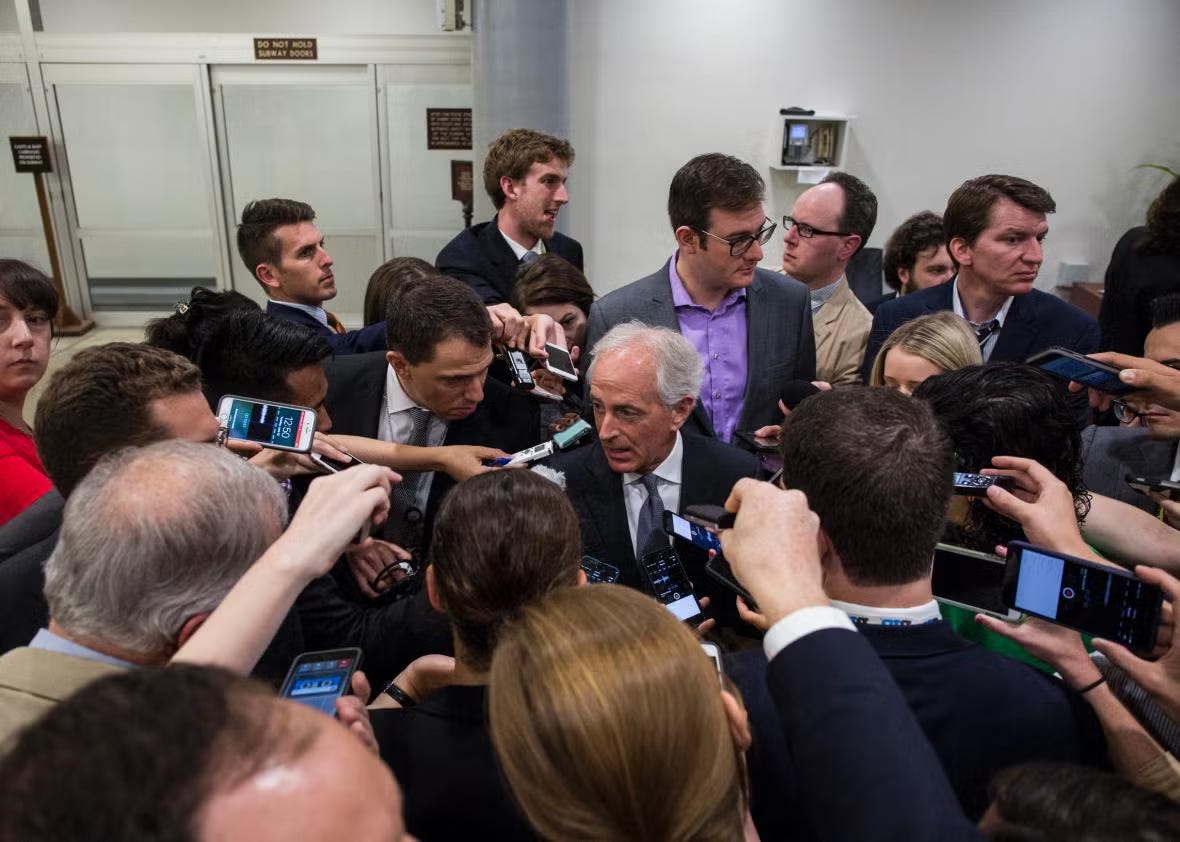
AI can’t replicate these things. It can’t retrieve a document no one requested, quote a whistleblower who hasn’t been found yet, or compare the witness’s evasive answer with something said three years ago but never entered in the record.
The machines can be incredibly helpful, but only downstream from humans. Take the reporters and newsrooms away and the stream dries up or is filled with questionable information scraped from nonauthoritative sources. The machine does not know what is missing, and it can’t warn you that the most important fact never made it online.
That is far more dangerous than the hallucinated chatbot answers that go viral and make us both laugh and feel a bit anxious about the availability of fake news. The answers we can find online in milliseconds will look polished and even be supported by hyperlinks that we too often take as a sign of fact but all go back to the same unreliable outlet or fake press release.
The Newsmax/Meta deal shows that the source list behind widely used AI systems can and will be shaped by contracts, copyright agreements, ideology, and cash. Yes, excellent reporting will remain available, but it isn’t necessarily contracted to be used for your Instagram AI feeds.
The chatbots will choose an answer from their available sources and become the only version millions of people will ever see — and never question.
 | A guest post by
|