

A Slap in the Face for the Far Right
A landslide loss in Hungary sends a message

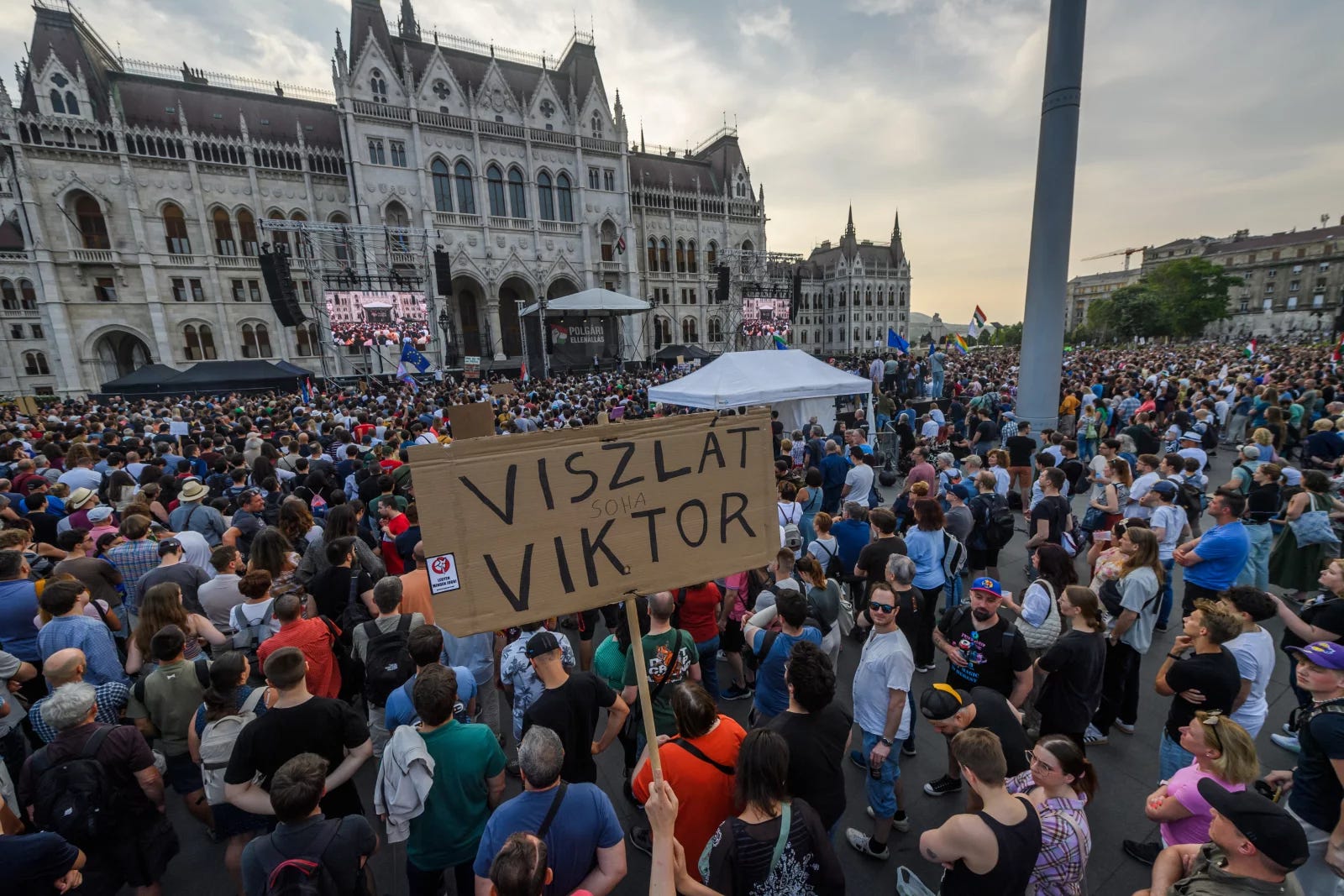
On Sunday night, thousands of Hungarians — many of them young — crowded onto the banks of the Danube in Budapest. They waved flags. They chanted. Some of them wept. By the time Péter Magyar, leader of the victorious opposition party in Hungary’s national elections that day, appeared before them to declare that Hungary had been “liberated,” the result was already beyond dispute: Prime Minister Viktor Orbán, the man who had remade his country in his own image over 16 years, had lost — not narrowly, not ambiguously, but in a landslide that set a record for turnout since the fall of communism.
Five days earlier, the vice president of the United States had flown to Budapest to urge Hungarians to keep him.
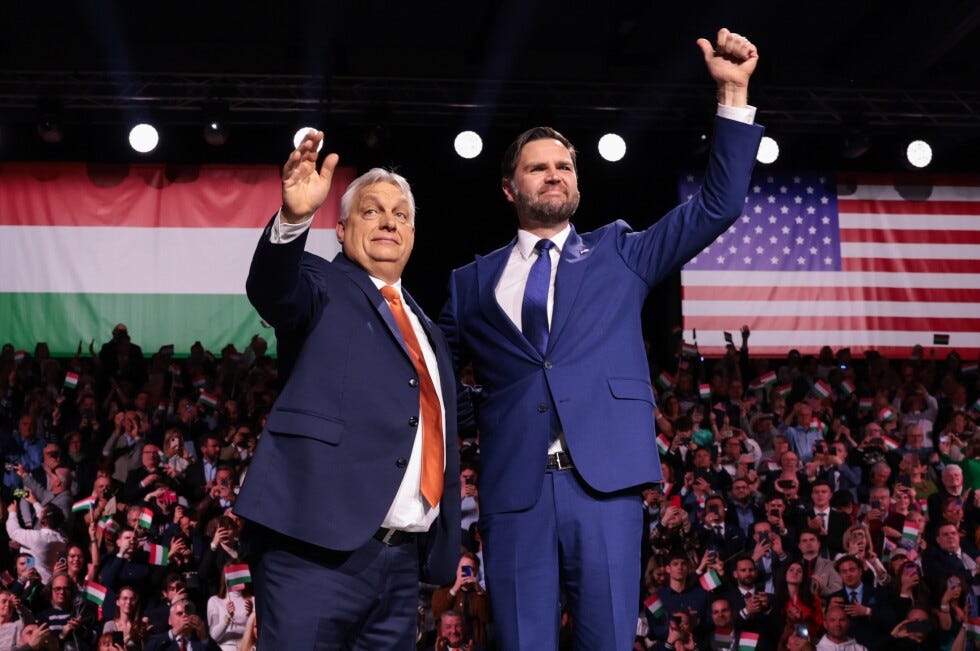
That juxtaposition is worth sitting with. Not only because Orbán lost despite Vance’s campaigning, but because of what it reveals about the current American administration, what it admires, what it has been trying to build, and what Sunday’s result may mean for a political project that has been years in the making.
Vance’s pilgrimage to Budapest
Vance’s visit last Tuesday was billed as “Hungarian–American Friendship Day” — an occasion invented specifically for the trip. In practice it was a campaign rally, and Vance didn’t pretend otherwise. “I’m here to help him in this campaign cycle,” Vance said, standing beside Orbán at a press conference in Buda Castle.
That evening, at a sports arena packed with his Fidesz Party supporters — some in red MAGA hats — Vance told thousands of Hungarians their prime minister represented the future of Western civilization. Then he called Donald Trump on his mobile phone and put him on speakerphone.
“I love Hungary, and I love Viktor,” Trump told the arena. “He’s a fantastic man... I’m with him all the way.”
Then Vance took the microphone. He led the crowd through a call-and-response against EU bureaucrats, woke ideology, and the liberal elites he said were destroying Western civilization. He closed with an explicit instruction: “Go to the polls in the weekend, stand with Viktor Orbán, because he stands for you.”
It was nearly without precedent — a sitting American vice president intervening in the final days of a foreign election to campaign for a specific candidate (while simultaneously accusing the European Union of election interference). The European Union, for its part, declined to take the bait. “In Europe,” an EU spokesman said flatly, “elections are the sole choice of the citizens.”
Péter Magyar was more pointed. “No foreign country may interfere in Hungarian elections,” he said on social media. “This is our country. Hungarian history is not written in Washington, Moscow, or Brussels — it is written in Hungary’s streets and squares.”
Hungary as a laboratory
To understand why Vance was in Budapest at all, it helps to understand what Hungary has represented to the American right for more than a decade.
Orbán himself provided the most candid description. At a Conservative Political Action Conference gathering in Budapest, he called his country “a petri dish for illiberalism” — a place where new political experiments could be run, refined, and exported. Steve Bannon was blunt in his admiration, calling Orbán “Trump before Trump.” Kevin Roberts, president of the Heritage Foundation — the think tank behind Project 2025, an effort to create an Orbánesque governing blueprint for Trump’s second term — declared that “modern Hungary is not just a model for conservative statecraft, but the model.”
This wasn’t casual admiration. It was institutional. CPAC moved its international conference to Budapest. Heritage signed a formal partnership with the Danube Institute, a Fidesz-funded think tank.
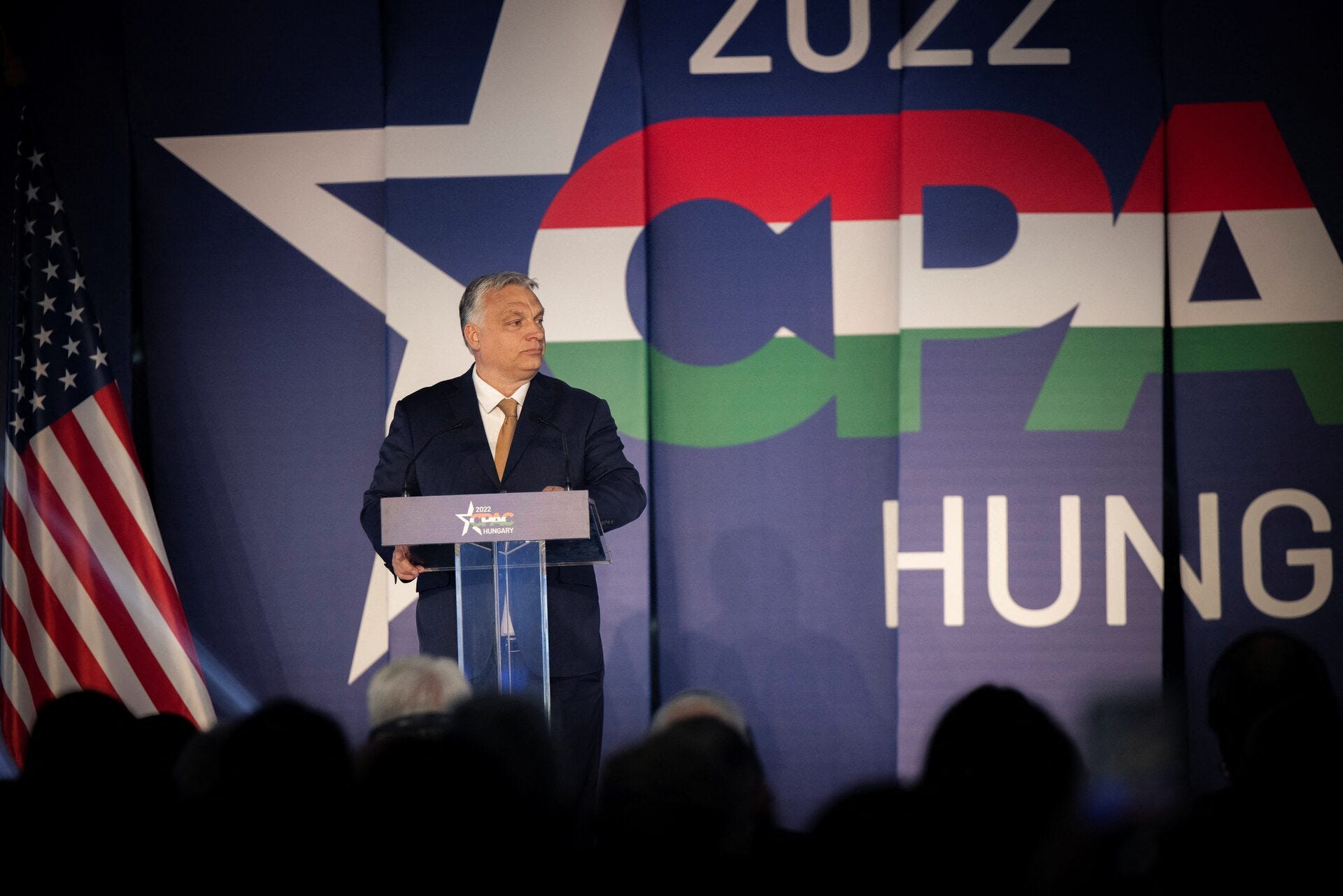
American conservatives made pilgrimages to study Hungarian education policy, media consolidation, and judicial restructuring. Vance praised Orbán’s purge of gender studies from universities as something America should follow. Orbán, for his part, boasted of his “deep involvement” in Trump’s “policy-writing system.”
What Trump’s allies were studying was a specific method. Orbán hadn’t severely weakened Hungarian democracy in a coup or an overnight seizure of power. He had hollowed it out from within — methodically, legally, and patiently. He rewrote the constitution. He replaced independent judges with loyalists and redrew electoral districts to make his party difficult to dislodge. He consolidated roughly 80% of Hungary’s media under allied oligarchs. He used state contracts to enrich his inner circle. He targeted George Soros, then migrants, then Brussels, then Ukraine — a carousel of external threats designed to keep his base agitated and his critics on defense.
And through it all, Orbán maintained the architecture of democracy. Elections were held. Opposition parties existed. Some independent media survived. The European Parliament eventually dubbed the arrangement “electoral autocracy.”
The parallels to Trump’s second term have become difficult to ignore. Where Orbán enacted a media law that allowed his allies to penalize unfavorable coverage, the Trump administration has deployed the FCC to threaten broadcast licenses. Where Orbán’s allies bought and absorbed independent media, Trump has found his own amplifiers in Elon Musk’s X and a network of MAGA outlets now granted preferential White House access. Where Orbán packed Hungary’s courts, Trump has moved aggressively to reshape the federal judiciary and remove government officials deemed insufficiently loyal. Where Orbán used state funding to discipline universities, Trump has made federal dollars a lever against American higher education.
David Pressman served as US ambassador to Hungary from 2022 to 2025. He watched Orbán’s consolidation firsthand. When he returned home, he said he recognized it. “Here, too, powerful people are responding to authoritarian advances just as their Hungarian counterparts have — not with defiance, but with capitulation.” The lesson of Hungary, he wrote, was that those who believe they can quietly accommodate a strongman and emerge unscathed are precisely the ones who don’t.
What made Orbán’s model useful to the American right — more useful than Putin’s Russia — is that it retained the veneer of democracy while systematically disabling the institutions that give democracy its meaning. You can’t import Putin’s approach to an American context. But a system that calls itself a democracy, holds elections, and allows opposition parties to exist while ensuring the game is rigged thoroughly enough that meaningful competition becomes nearly impossible — that is a template you can adopt.
This is why Sunday’s result matters beyond Hungary’s borders.
Why the model failed
With nearly 80% of Hungarians casting ballots, Magyar’s Tisza Party won more than 53% of the vote to Fidesz’s 38%. The projected seat count pointed toward a constitutional supermajority for Tisza, which would give Magyar the numbers not just to govern but to begin dismantling the structural changes Orbán has put in place.
Orbán himself seemed to sense the end coming. His biographer, who has covered him for 16 years, said his body language in the final weeks of the campaign was different — deflated, he said. “I think he knew that nothing lasts forever.”
He conceded early. “The responsibility and opportunity to govern were not given to us,” he told supporters. He promised he would not give up. The crowd was smaller than usual.
The explanation for the defeat was not complicated. It was the economy. It was corruption. It was the lived experience of ordinary Hungarians who had watched Orbán’s family, friends, and business allies grow extraordinarily wealthy while hospitals deteriorated, trains broke down, and wages stagnated.
“What drove Orbán’s defeat was the cost of living, lack of economic opportunities, and lack of jobs,” said Mátyás Bódi, an election geographer at Budapest’s Eötvös Loránd University. Magyar’s message — that the country simply wasn’t working for ordinary people — had cut through 16 years of media control, gerrymandered districts, and state resources deployed in the service of one party’s survival.
“People may go along with a kleptocracy for as long as an economy is doing well,” said Timothy Ash of Britain’s Chatham House. “But ultimately, if the economy starts failing, and they see all these guys lining their pockets, then you can expect a reaction.”
The foreign endorsements made no difference, or may have made things worse. The opposition continued to make gains after Secretary of State Marco Rubio visited Budapest in February. The odds of an Orbán victory fell in betting markets in the days after Vance’s appearance. One opposition lawmaker noted simply that Vance was “absolutely unknown to the Hungarian public.” The cavalry had arrived. The fortress fell anyway.

Magyar, for his part, ran a campaign of disciplined focus. He showed up in Fidesz strongholds that previous challengers had written off. He talked about health care, schools, and public transport. He stayed on message when Orbán tried to make the election about Ukraine and Zelensky and the specter of war. He turned every attempt at distraction into more evidence that his opponent had nothing to say about the things that actually affected people’s lives.
He sounded, as Péter Molnár, a former Fidesz lawmaker turned academic, observed, like Orbán had in 2010 — a young reformer promising to clean up corruption and restore dignity to ordinary Hungarians.
In fact, Magyar had been part of Orbán’s own inner circle before breaking with Fidesz in 2024 — driven out by corruption he had watched from the inside. He campaigned relentlessly on a simple message: the country wasn’t working for ordinary people.
The American experiment
What Orbán’s loss means for the American administration that tried to save him is unclear. As of publication, President Trump had said nothing publicly about the result.
But the pattern of a governing class whose insiders prosper while ordinary people struggle with rising costs and deteriorating services is not a pattern that belongs only to Central Europe. Trump’s approval rating on the economy currently sits at 31%. Four in five Americans now tell pollsters they believe the federal government is corrupt.
Vance flew to Budapest to validate a losing model. A system built on corruption eventually corrupts the economy it depends on. A government that hollows out institutions eventually delivers hollow services. A leader who rules by manufacturing enemies eventually runs out of enemies frightening enough to distract from the electricity bill.
America’s petri dish experiment isn’t over. But the results from Hungary’s laboratory are in.
 | A guest post by
|
Ms. Labott, thank you so much for this comprehensive column. While every action by Orban is praised, copied, and attempted by our own pathetic President and his followers, Americans can clearly see who wrote the first draft of the Trump playbook.
Besides being idiots, Trump, Hegseth, and others of their sick group, are brainless. So instead of staying up all night to craft a democracy for our country, they are cribbing from the despot out of town.
I imagine Trump and Hegseth, lifting their bodies from their schoolroom seats to look over the shoulder of smarty Orban. Copying his words and then turning them into the teacher with the chutzpah of claiming originality.
What always surprises me about our feckless administration is how bold and unashamed they are for hugging their evil heroes.
Hegseth travels there. Stands next to him. Weeps when he loses.
Oh, if only Hegseth had overstayed his welcome. If he were jailed as an example of unwanted sycophants. If his cell were big enough for two. If Trump visited Hegseth in his Hungarian lodgings. If the jail door shut and sealed the two in.
Happiness would return to America.
I’m not going to lie, I evil cackled when Orban lost big on Sunday.